Facts
The complainant, Nathuni Pasi, alleged that on 17.04.1999, the appellants (Bijay Sah and Ram Sah) forcibly dismantled his ancestral house/hut situated on government-allotted land (Basgit Parcha), assaulted him with fists and slaps, and constructed a wall to dispossess him.
Source reference: p.2-3The complainant filed a private complaint after the local police failed to register a case.
Source reference: p.2The Trial Court (Special Judge, SC/ST Act, Madhubani) convicted the appellants under Sections 323 and 427 of the IPC, and Sections 3(1)(v) and 3(1)(x) of the SC/ST (Prevention of Atrocities) Act, 1989, sentencing them to five years of rigorous imprisonment.
Source reference: p.1-2During the pendency of the appeal, appellant Ram Sah died, and the appeal abated as against him.
Source reference: p.1, 5Issues
1. Whether the Trial Court was right in convicting and sentencing the appellant for offences under Sections 323 and 427 IPC and Sections 3(1)(iv) and 3(1)(x) of the SC/ST Act.
Source reference: p.6 / para. 13(i)2. Whether the prosecution proved the guilt of the appellant beyond reasonable doubt, specifically regarding the "public view" requirement and the existence of a civil land dispute.
Source reference: p.6 / para. 13(ii)Law Applied
The court applied Section 3(1)(x) of the SC/ST Act, which requires intentional insult or intimidation in a place within "public view".
Source reference: p.31It relied on Swaran Singh v. State and Hitesh Verma v. State of Uttarakhand, establishing that "public view" means a place where members of the public (not just friends/relatives) can witness the act.
Source reference: p.28-32Under Ramavatar v. State of M.P. and D. Venkateshwar Rao v. P. Bakthavatchalam, the court noted that purely civil or private disputes should not be criminalized under the SC/ST Act unless the victim was targeted specifically due to their caste.
Source reference: p.33-36Regarding evidence, the court applied Rule 58 of the Criminal Rules of Practice and principles from Sukhi Yadav v. State of Bihar, holding that documents must be proved by authors or persons familiar with the handwriting to be admissible as evidence.
Source reference: p.24-27Reasoning
The Court found the prosecution's case riddled with contradictions. While P.W. 2 and 3 claimed to be eye-witnesses, the complainant (P.W. 4) testified that no adults were present at the scene, only children.
Source reference: p.17, 21P.W. 3 claimed his father fell unconscious, yet asserted he witnessed the subsequent construction of the wall, which was logically improbable.
Source reference: p.20Crucially, the court observed that the dispute was essentially civil over "Gair Majarua" land, and there was no evidence that the alleged abuses were made in "public view" to humiliate the complainant based on his caste.
Source reference: p.32, 39Furthermore, the Trial Court committed a procedural error by marking land documents (Exhibits 2, 3, 4) through a typist and an advocate clerk instead of the actual authors or revenue officials, rendering the proof of ownership legally defective.
Source reference: p.13, 27, 41The identification of the appellant was also flawed, as P.W. 1 misidentified the accused in court.
Source reference: p.7, 17Holding
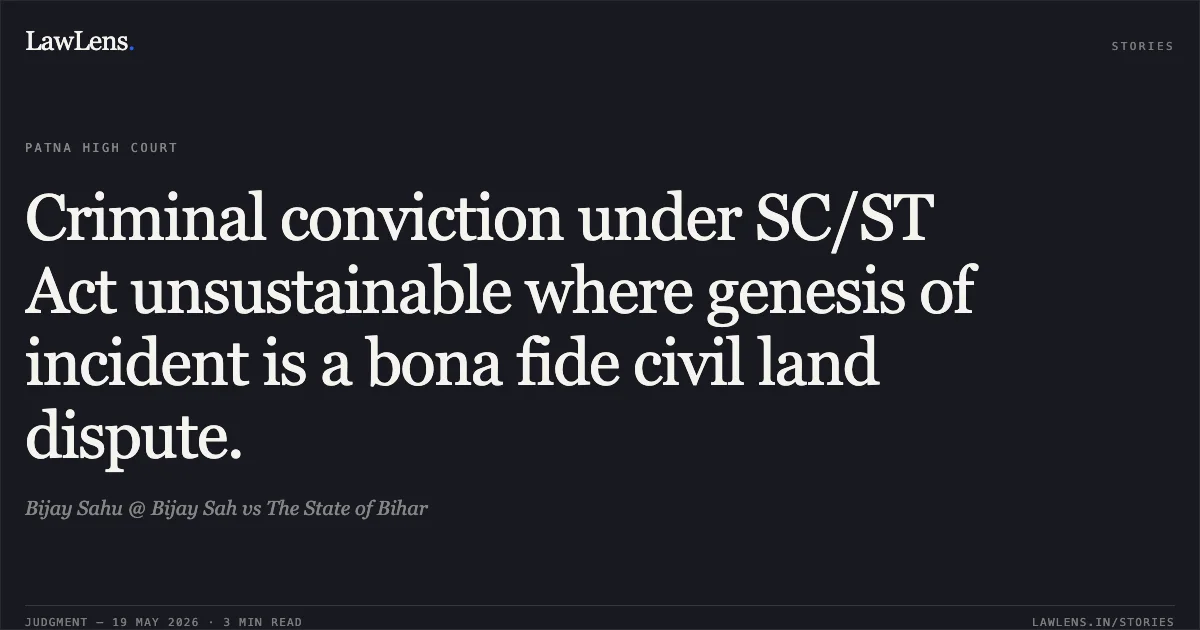
The Court held that the prosecution miserably failed to prove the charges. The conviction under the SC/ST Act was unsustainable as the "public view" ingredient was missing, and the incident arose from a pre-existing civil land dispute.
The High Court set aside the judgment of conviction and order of sentence dated 14.01.2004, acquitted the appellant of all charges, and discharged him from his bail bonds.
Source reference: p.41-42Acts & Sections Cited
10 provisions across 3 statutes referred to in this judgment. Each provision opens on LawLens.
Scheduled Castes and the Scheduled Tribes (Prevention of Atrocities) Act, 19891
Indian Penal Code, 18604
Code of Criminal Procedure, 19735
Original Court PDF
Bijay Sahu @ Bijay SahvsThe State of Bihar
Click to open original judgment
Original judgment, available to read, download and summarize on LawLens.in