01Facts
The Petitioner, a social activist and RTI worker, challenged the legality of F.I.R. No. 756/2025 registered at Choudwar Police Station
pp. 1-2The F.I.R. was lodged suo motu by the police following an internal enquiry based on a Station Diary Entry dated 13.11.2025
pp. 2-3It was alleged that the Petitioner habitually used "abusive and unparliamentary language" on social media against statutory authorities (specifically the Odisha Information Commission) and obstructed public servants during the construction of a service road on NH-55
pp. 2, 7-8The Petitioner moved the High Court under Section 482 CrPC (Section 528 BNSS) seeking to quash the proceedings, citing an unexplained 45-day delay in filing the F.I.R. and a lack of specific evidence regarding the alleged offending posts
pp. 3, 5-602Issues
i.1. Whether the F.I.R. and consequential proceedings were based on vague and omnibus allegations that fail to disclose the commission of any cognizable offence
pp. 10 / para. 10-12ii.2. Whether the invocation of Sections 66(D) and 67 of the IT Act and relevant sections of the BNS was legally sustainable in the absence of the specific "corpus" of the alleged offending material
p. 4 / para. 3(iii)iii.3. Whether the continuation of the criminal proceedings constituted an abuse of the process of the court
pp. 9-10 / para. 803Law Applied
The court applied Section 482 of the CrPC regarding the inherent powers of the High Court to prevent the abuse of the process of any court
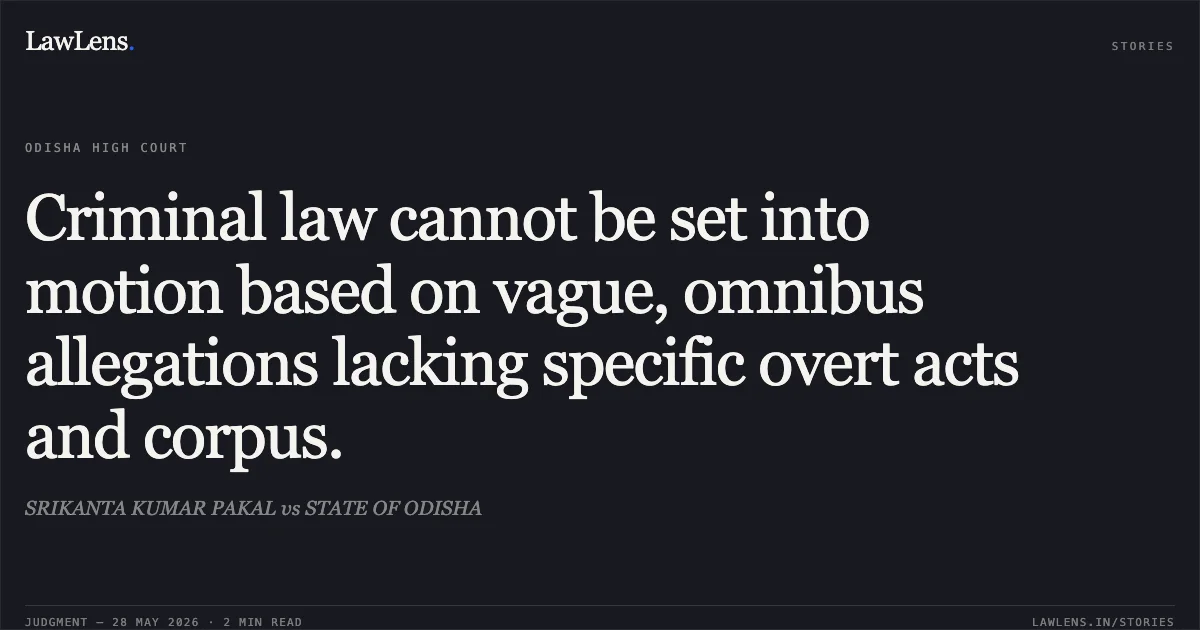
p. 1, 9established principles of criminal jurisprudence which dictate that criminal law cannot be set into motion based on vague or sweeping allegations that criminalize the lawful exercise of Constitutional rights
p. 10Sections 66(D) (impersonation) and 67 (obscenity) of the Information Technology Act, 2000
p. 4Sections 223, 296, 352, and 353(1)(b) of the Bharatiya Nyaya Sanhita, 2023
p. 1, 8Article 19(1)(a) of the Constitution protects the right to criticize statutory authorities in good faith, provided there is no incitement to violence
p. 5Provisions in the judgment · 8 · Linked ones open on LawLens
Bharatiya Nagarik Suraksha Sanhita, 2023 Section 528
Bharatiya Nyaya Sanhita, 2023 Section 223Section 296Section 352Section 353Section 66
Code of Criminal Procedure, 1973 Section 482
Information Technology Act, 2000 Section 67
04Reasoning
The Court observed that the F.I.R. was characterized by "vague, sweeping, and omnibus allegations" without specifying any overt acts, gestures, or the exact text of the alleged social media posts
¶ 10-12Regarding the IT Act charges, the Court noted the prosecution failed to provide the "corpus" or specific electronic content, making Sections 66(D) and 67 inapplicable—particularly since the posts were from the Petitioner's own identifiable account (not impersonation) and criticism does not equate to "obscenity"
¶ 3(iii)-(v)the Court highlighted the "unexplained delay of approximately 45 days" in registering the F.I.R., which cast doubt on its credibility
¶ 3(viii)It reasoned that while rights of social activists are not absolute, the Investigating Agency failed to place any cogent material on record to show the Petitioner's specific role in the alleged obstruction of public work
¶ 13-1405Holding
The Court held that the allegations, even if accepted at face value, did not prima facie disclose the commission of the alleged offences
¶ 16The Court concluded that the criminal proceedings were legally unsustainable and their continuation would amount to an abuse of the process of the law
¶ 8, 12Accordingly, the CRLMC was allowed, and F.I.R. No. 756/2025 along with all consequential proceedings were quashed. All interim orders were vacated
pp. 11-12Original Court PDF
SRIKANTA KUMAR PAKALvsSTATE OF ODISHA
Click to open original judgment
Original judgment, available to read, download and summarize on LawLens.in