Facts
The Petitioner is a DGCA-authorized research and development organization specializing in unmanned aerial systems
Source reference: para 3.1On 29-01-2026, during routine testing within a designated "green zone" on leased land, a lightweight prototype drone suffered a battery malfunction, glided beyond the boundary, and landed in a neighboring property
Source reference: para 3.2A Police Constable, acting on a 112-helpline tip, registered a suo motu FIR (Crime No. 24/2026) against unknown persons for criminal trespass and endangering safety
Source reference: para 3.3Despite the Petitioner’s voluntary disclosure of ownership and its exempt status under Rule 42 of the Drone Rules, 2021, the jurisdictional police refused to provide a copy of the FIR, demanding the physical presence of the Managing Director
Source reference: para 3.4Issues
Whether the landing of a malfunctioning drone on private property satisfies the ingredients of criminal trespass and rash/negligent acts under Sections 329(3) and 125 of the Bharatiya Nyaya Sanhita (BNS), 2023
Source reference: para 7-8Whether the incident attracts the doctrine of triviality under Section 33 of the BNS (corresponding to Section 95 of the IPC)
Source reference: para 9Whether the investigating agency is legally mandated to furnish a copy of the FIR to the accused upon request
Source reference: para 11Law Applied
Section 329 of the BNS regarding criminal trespass, which requires mens rea and intentional human entry to intimidate or annoy
Source reference: para 7Section 125 of the BNS, which predicates liability on a rash or negligent human act endangering safety
Source reference: para 8The court relied on the doctrine of triviality under Section 33 of the BNS (Section 95 of the IPC), as interpreted in Mrs. Veeda Menezes v. Yusuf Khan, which excludes acts causing slight harm from criminal liability
Source reference: para 9Regarding the quashing of the FIR, the court followed the guidelines in State of Haryana v. Bhajan Lal
Source reference: para 10applied the mandatory directions from Youth Bar Association of India v. Union of India regarding the prompt disclosure and uploading of FIRs
Source reference: para 11Reasoning
Section 329 of the BNS requires a culpable human entry with the specific intent to commit an offence or annoy; however, the FIR recorded only the presence of an inanimate drone, failing to attribute any mens rea or intentional human trespass
Source reference: para 7the court found Section 125 inapplicable as the FIR did not identify any rash human act or specific victim endangered by the mechanical failure
Source reference: para 8Applying the doctrine of triviality, the court reasoned that since there was no bodily injury or property damage, the incident constituted "negligible harm" that no person of ordinary sense would complain of
Source reference: para 9The court determined that the allegations, even if accepted, did not prima facie constitute any offence, thus meeting the Bhajan Lal criteria for quashing
Source reference: para 10the court condemned the police for withholding the FIR, noting that such actions render constitutional rights illusory and violate the Supreme Court's mandate for transparency
Source reference: para 11Holding
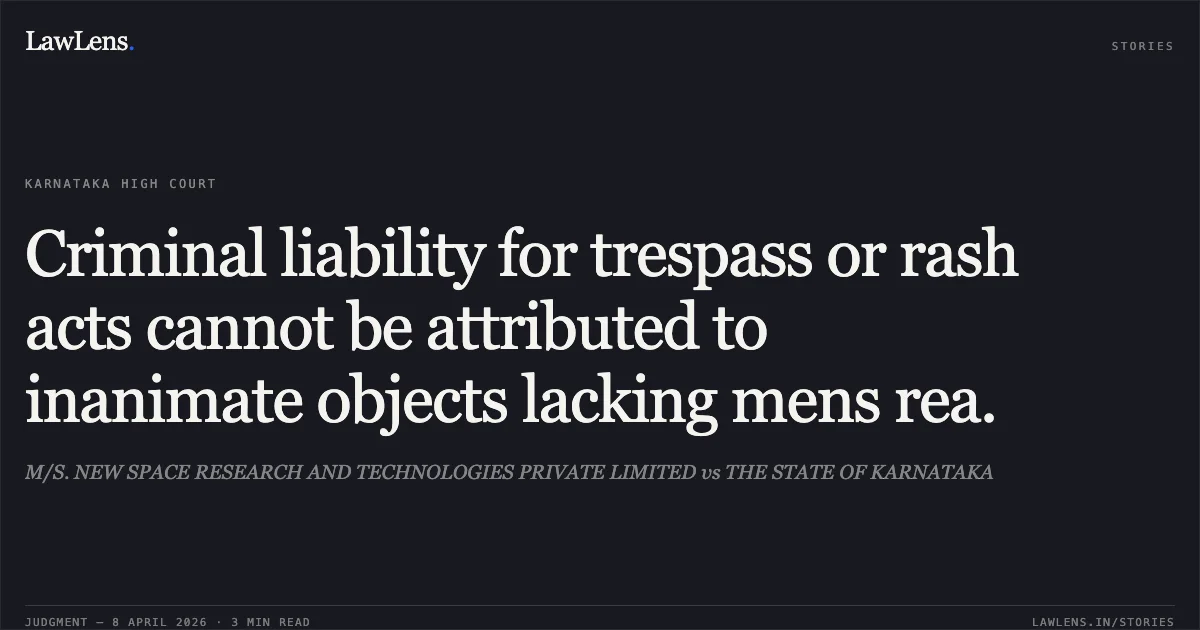
The Court allowed the Writ Petition and quashed the FIR in Crime No. 24/2026
It held that a mechanical failure of a drone cannot be converted into a criminal offence involving mens rea through bald assertions
Source reference: para 8The Court further issued a stern directive that all Police Stations must scrupulously adhere to the mandate of furnishing FIR copies to the accused or providing complete digital details; failure to do so will result in departmental enquiries against the erring Station House Officers
Source reference: para 11Acts & Sections Cited
23 provisions across 4 statutes referred to in this judgment. Each provision opens on LawLens.
Bharatiya Nagarik Suraksha Sanhita, 20231
Bharatiya Nyaya Sanhita, 20233
Indian Penal Code, 1860
Code of Criminal Procedure, 19735
Original Court PDF
M/S. NEW SPACE RESEARCH AND TECHNOLOGIES PRIVATE LIMITEDvsTHE STATE OF KARNATAKA
Click to open original judgment
Original judgment, available to read, download and summarize on LawLens.in