Facts
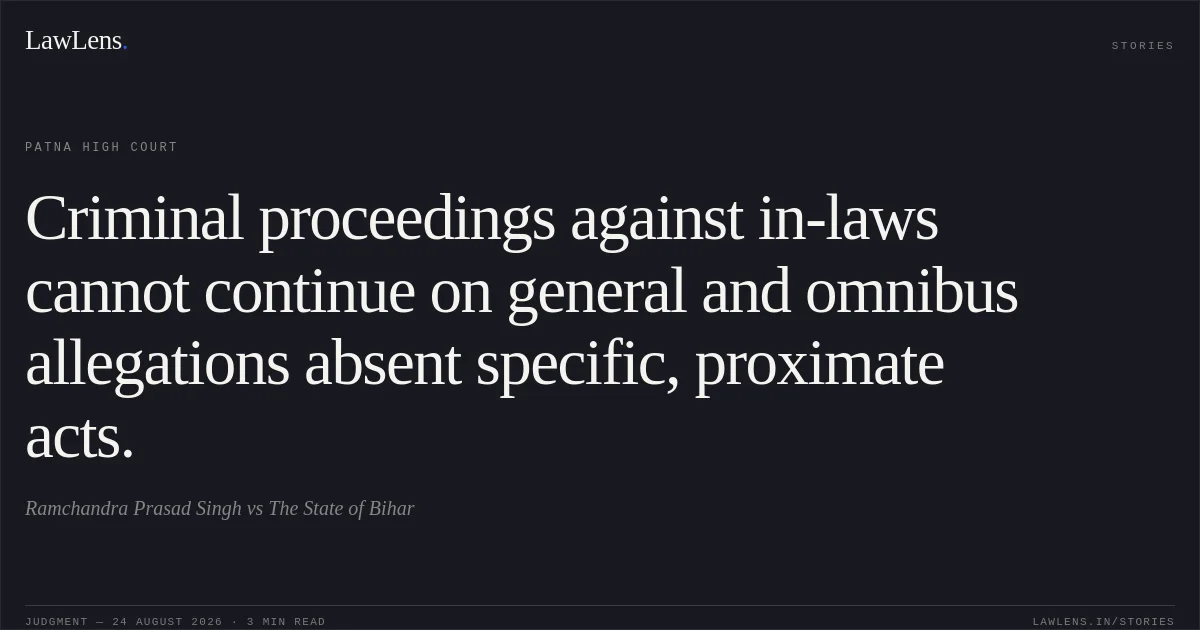
The petitioners, being the father-in-law and mother-in-law of Opposite Party No. 2, sought quashing of the order dated 12 August 2024 by which the Additional Chief Judicial Magistrate, 1st (East), Muzaffarpur, took cognizance in Kazi Mohammadpur P.S. Case No. 107 of 2023 for offences under Sections 341, 323, 504, 506, 498-A/34 of the IPC and Sections 3/4 of the Dowry Prohibition Act.
Source reference: p. 1The FIR alleged dowry demands and cruelty by the petitioners and other family members, including demands for money to enable the husband to start a business and a demand concerning registration of land in the husband’s favour.
Source reference: pp. 2–3The allegations also referred to a transaction concerning the purchase of land from the informant’s father and alleged that, after the husband took the informant to her parental home owing to her father’s illness, she was subsequently not permitted to return to the matrimonial home.
Source reference: pp. 2–4The petitioners contended that they lived separately, had no role in the couple’s day-to-day affairs, and had been implicated through general and omnibus allegations.
Source reference: p. 3The husband had also instituted Matrimonial Suit No. 77 of 2024 for dissolution of marriage.
Source reference: pp. 3–4The State and the informant opposed quashing, arguing that the FIR disclosed offences against the petitioners.
Source reference: p. 4Issues
1. Whether the general and omnibus allegations in the FIR against the petitioners, without specific acts attributed to them, disclosed offences under Sections 341, 323, 504, 506 and 498-A/34 of the IPC or Sections 3/4 of the Dowry Prohibition Act?
Source reference: pp. 4–5, para. 82. Whether continuation of the criminal proceedings and the cognizance order against the petitioners would amount to an abuse of the process of law warranting exercise of the High Court’s quashing jurisdiction?
Source reference: pp. 8–9, paras. 14–15Law Applied
The Court considered the offences under Sections 341, 323, 504, 506 and 498-A/34 of the IPC and Sections 3/4 of the Dowry Prohibition Act.
Source reference: p. 1It applied the principle that relatives of a husband should not be subjected to criminal prosecution in matrimonial disputes merely on the basis of casual, general or omnibus allegations; specific, proximate and substantiated allegations are required.
Source reference: pp. 5–6, paras. 10–11Relying on Preeti Gupta v. State of Jharkhand, (2010) 7 SCC 667, and Kahkashan Kausar v. State of Bihar, (2022) 6 SCC 599, the Court deprecated the tendency to implicate the husband’s entire family in prosecutions arising primarily from matrimonial discord.
Source reference: pp. 6–7, para. 11It further relied on Dara Lakshmi Narayana v. State of Telangana, (2025) 3 SCC 735, and Geddam Jhansi v. State of Telangana, 2025 SCC OnLine SC 263, which require cautious scrutiny of allegations against relatives and hold that exaggerated allegations, without specific acts, should not be given a criminal character.
Source reference: pp. 7–8, paras. 12–13The Court also held that demands relating to business financing or sale and purchase of land, in the circumstances alleged, did not constitute harassment or cruelty under Section 498-A IPC.
Source reference: p. 5, para. 9Reasoning
The Court found that the allegations against the petitioners were sweeping and lacked any specific incident or proximate act of cruelty, assault, intimidation, wrongful restraint or dowry demand attributable to them.
Source reference: pp. 4–5, para. 8The demand for money was primarily connected with the husband’s proposed business, while the allegations concerning land related to a sale and purchase transaction; neither, without more, established the legally necessary element of cruelty under Section 498-A IPC.
Source reference: p. 5, para. 9The Court also noted that the husband had taken the informant to her parental home because of her father’s illness, and that the subsequent allegation that she was not allowed to re-enter the matrimonial home was merely general and omnibus.
Source reference: p. 5, para. 8Applying the Supreme Court’s caution against prosecuting relatives on the basis of matrimonial allegations lacking specific attribution, the Court concluded that the petitioners had been over-implicated and that requiring them to face trial would serve no legitimate criminal-law purpose.
Source reference: pp. 6–8, paras. 10–14Holding
The Court held that the materials on record did not disclose the alleged offences against the petitioners and that continuation of the prosecution would amount to an abuse of the process of law and cause miscarriage of justice.
Accordingly, the order dated 12 August 2024 taking cognizance in Kazi Mohammadpur P.S. Case No. 107 of 2023 was quashed insofar as it related to Ramchandra Prasad Singh and Shail Devi, and the criminal miscellaneous application was allowed.
Source reference: p. 9, paras. 15–16Acts & Sections Cited
8 provisions across 2 statutes referred to in this judgment. Linked provisions open on LawLens.
Indian Penal Code, 18606
Dowry Prohibition Act, 19612
Original Court PDF
Ramchandra Prasad SinghvsThe State of Bihar
Click to open original judgment
Original judgment, available to read, download and summarize on LawLens.in