Facts
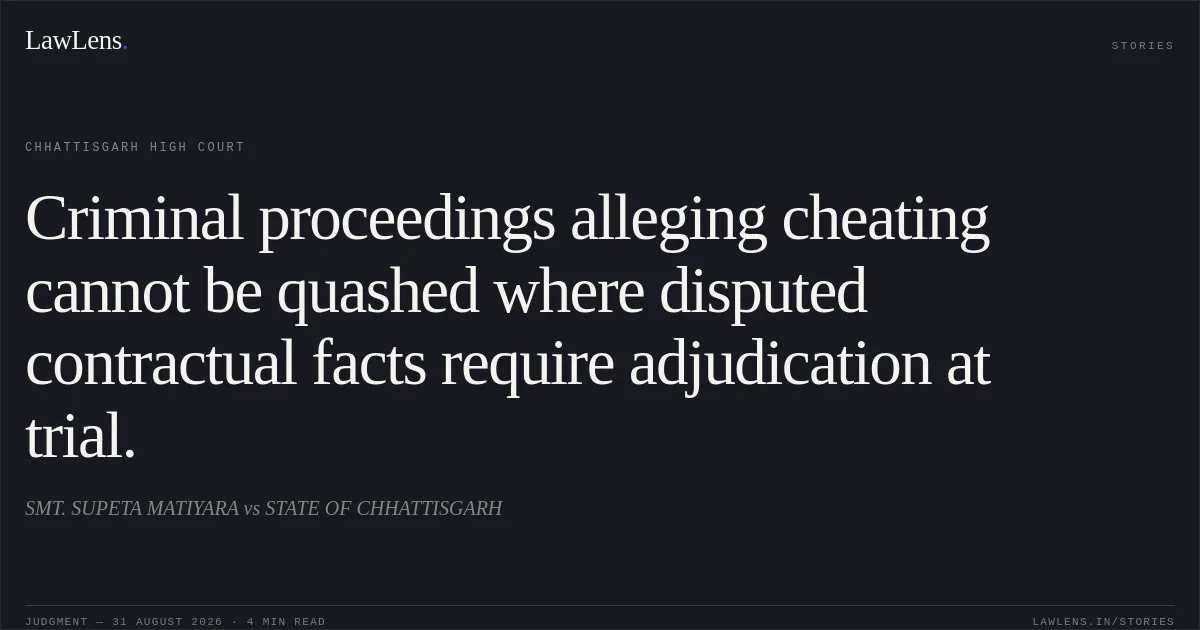
The petitioners, members of one family and co-owners/legal heirs of immovable property bearing Khasra Nos. 1600 and 1717 at Raipur, challenged FIR No. 110/2025 registered at Police Station Purani Basti for offences under Sections 420 and 34 of the IPC, the consequential charge-sheet, cognizance and framing of charges.
Source reference: para. 3–4Their dispute with respondent No. 2 arose from an Agreement to Sell dated 1 November 2019 concerning approximately 0.523 hectare of land for a consideration of about ₹7,47,60,000.
Source reference: para. 3–4The complainant allegedly acted as a broker and was required to procure purchasers and arrange the consideration within one year, while the petitioners were to execute sale deeds in favour of the purchasers.
Source reference: para. 3–4The complainant alleged that approximately ₹4,21,84,623 had been paid through cash, cheques and banking transactions between 2019 and 2023, but that the petitioners failed to account for the amounts and execute the remaining sale deeds.
Source reference: para. 5Certain sale deeds were nevertheless executed during this period.
Source reference: para. 5The complaint was submitted on 25 June 2023, and the FIR was registered on 19 March 2025.
Source reference: para. 5–7Investigation resulted in Charge-sheet No. 393/2025 dated 15 December 2025, followed by Criminal Case No. 56026/2025.
Source reference: para. 5–7The trial court took cognizance and framed charges on 21 May 2026.
Source reference: para. 5–7Issues
1. Whether the FIR, charge-sheet, order taking cognizance, order framing charges and consequential criminal proceedings under Sections 420 and 34 of the IPC should be quashed under Section 528 of the BNSS on the ground that the dispute was essentially civil and contractual in nature?
Source reference: para. 10, 14, 18–192. Whether the alleged absence of dishonest or fraudulent intention at the inception of the Agreement to Sell, and the subsequent execution of certain sale deeds and receipt of payments, could be conclusively determined in proceedings for quashing?
Source reference: para. 15–16Law Applied
The Court applied the principles governing exercise of inherent jurisdiction under Section 528 of the BNSS, corresponding to Section 482 of the CrPC, under which criminal proceedings may be quashed only sparingly and in exceptional cases where the allegations, taken at face value, do not disclose any offence or where continuation would amount to abuse of process.
Source reference: para. 10Relying on Rupan Deol Bajaj v. K.P.S. Gill, Rajesh Bajaj v. State of NCT of Delhi and Medchl Chemicals & Pharma (P) Ltd. v. Biological E Ltd., the Court held that proceedings should not be quashed where the allegations prima facie disclose the ingredients of an offence, although patently absurd or inherently improbable allegations may be quashed.
Source reference: para. 11Under Neeharika Infrastructure Pvt. Ltd. v. State of Maharashtra, the High Court cannot assess the reliability or genuineness of the allegations, appreciate evidence or conduct a mini-trial while exercising quashing jurisdiction.
Source reference: para. 12The Court also relied on Pradeep Kumar Kesharwani v. State of Uttar Pradesh, reiterating that disputed facts cannot be adjudicated at the quashing stage and that accused material must be of sterling and impeccable quality, completely demolishing the prosecution case, before interference is justified.
Source reference: para. 13The existence of a civil remedy does not bar criminal prosecution where the allegations otherwise disclose the ingredients of a criminal offence.
Source reference: para. 17Reasoning
The Court found that the allegations concerning payments, execution and non-execution of sale deeds, and failure to account for the consideration could not, at the threshold, be regarded as inherently improbable or devoid of substance.
Source reference: para. 14The investigation had produced material supporting the prosecution case, and a charge-sheet had been filed after completion of investigation.
Source reference: para. 14The petitioners’ argument that the transaction was contractual and that there was no dishonest intention at inception required determination of whether the payments were made, how they were to be adjusted, whether the petitioners were obliged to execute further sale deeds, and whether their subsequent conduct negated the alleged dishonest intention.
Source reference: para. 15–16These questions required appreciation of documentary and oral evidence and therefore could not be decided under Section 528 of the BNSS without conducting a mini-trial.
Source reference: para. 15–16The fact that the dispute originated in an Agreement to Sell or that certain civil remedies were available did not justify quashing where the prosecution material prima facie disclosed the alleged offences.
Source reference: para. 17The material relied upon by the petitioners did not completely demolish the prosecution case or establish that continuation of the proceedings would constitute abuse of process.
Source reference: para. 18Holding
The High Court held that the case did not fall within the exceptional category warranting exercise of inherent jurisdiction under Section 528 of the BNSS.
It declined to quash FIR No. 110/2025, the consequential charge-sheet, the order taking cognizance, the order framing charges and Criminal Case No. 56026/2025 under Sections 420 and 34 of the IPC.
Source reference: para. 19–20The petition was accordingly dismissed.
Source reference: para. 19–20The petitioners were left at liberty to raise all permissible factual and legal defences before the trial court, which was directed to decide the case independently and uninfluenced by the observations in the quashing proceedings.
Source reference: para. 19–20Acts & Sections Cited
4 provisions across 3 statutes referred to in this judgment. Each provision opens on LawLens.
Indian Penal Code, 18602
Code of Criminal Procedure, 19731
Bharatiya Nagarik Suraksha Sanhita, 20231
Original Court PDF
SMT. SUPETA MATIYARAvsSTATE OF CHHATTISGARH
Click to open original judgment
Original judgment, available to read, download and summarize on LawLens.in