Facts
The petitioner sought quashing under Section 528 of the Bharatiya Nagarik Suraksha Sanhita, 2023, of FIR Crime No. 252/2025 registered at Police Station Sirol, District Gwalior, for offences under Sections 308(2), 308(4), 351(3) and 352 of the Bharatiya Nyaya Sanhita, 2023, along with consequential proceedings, on the basis of a compromise.
Source reference: para. 1The complainant alleged that the petitioner had repeatedly sent persons to threaten him with death and demand ₹50 lakh, had caused false complaints to be lodged to exert pressure upon him, and had threatened and abused him during a meeting at the complainant’s office on 3 October 2025.
Source reference: para. 2During the proceedings, the petitioner and complainant filed compromise applications supported by affidavits. The Principal Registrar verified the parties, signatures, contents and voluntary nature of the compromise and reported that it had been entered into without threat, inducement or coercion.
Source reference: paras. 3–4The petitioner and complainant supported quashing, whereas the State opposed the petition.
Source reference: paras. 5–8Issues
1. Whether the High Court should exercise its inherent jurisdiction under Section 528 of the BNSS to quash the FIR and consequential criminal proceedings solely on the basis of a compromise between the accused and the complainant?
Source reference: paras. 9–122. Whether the allegations of repeated threats, extortionate demand, intimidation and abuse constituted a purely private or civil dispute capable of being quashed on settlement?
Source reference: paras. 13–14Law Applied
The Court applied Section 528 of the BNSS, corresponding to Section 482 of the Code of Criminal Procedure, which confers wide inherent powers to prevent abuse of process and secure the ends of justice, but requires such powers to be exercised sparingly and cautiously.
Source reference: para. 9It relied on Gian Singh v. State of Punjab, (2012) 10 SCC 303, for the principle that serious or heinous offences having an impact on society should not ordinarily be quashed merely because the parties have settled.
Source reference: para. 10It further applied State of Madhya Pradesh v. Laxmi Narayan, (2019) 5 SCC 688, holding that offences involving mental depravity or serious societal impact are generally inappropriate for quashing on compromise, with due regard to the accused’s antecedents and conduct.
Source reference: para. 11The Court also relied on Pramod Kumar v. State of Uttar Pradesh, decided on 26 September 2025, which recognises the nature and effect of the offence on society, seriousness of the injury, voluntariness of the compromise, and the accused’s conduct as relevant considerations; a compromise is only one factor and cannot be the sole basis for quashing.
Source reference: para. 12Reasoning
Although the compromise was found to be voluntary and genuine, the Court held that this fact did not automatically entitle the petitioner to quashing.
Source reference: paras. 3–4, 9, 12The FIR alleged a continuing course of conduct involving threats to the complainant’s life, repeated false complaints intended to exert pressure, a demand for ₹50 lakh, and threats of further harassment and death in the event of non-payment.
Source reference: para. 13These allegations disclosed intimidation and an alleged attempt to obtain money by placing the complainant in fear of injury to his person, reputation and property.
Source reference: para. 14Accordingly, the matter could not, at the threshold, be characterised as purely personal, private or civil in nature. If proved at trial, the alleged conduct could have consequences extending beyond the immediate dispute between the parties.
Source reference: para. 14Applying the principles in Gian Singh, Laxmi Narayan and Pramod Kumar, the Court concluded that the compromise did not outweigh the nature and potential societal impact of the alleged offences.
Source reference: paras. 9–14Holding
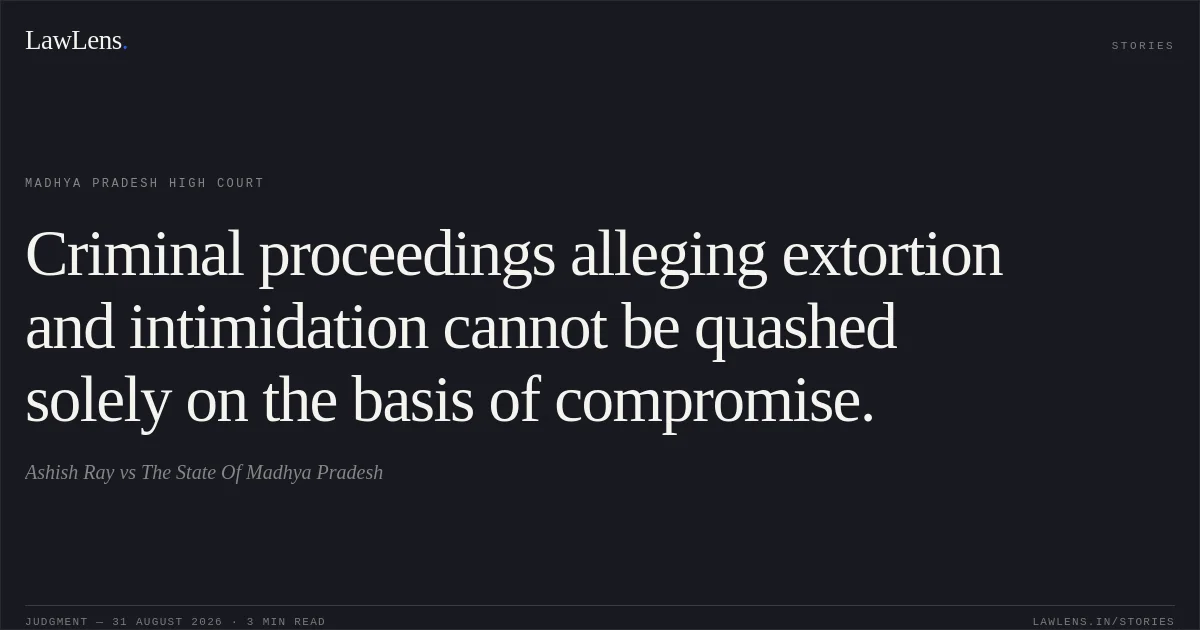
The Court answered the issues against the petitioner. It held that the FIR and consequential proceedings could not be quashed merely because the complainant had entered into a compromise, since the allegations concerned threats, intimidation and an alleged extortionate demand with implications beyond a private dispute.
The petition under Section 528 of the BNSS was therefore dismissed, and all pending interlocutory applications were disposed of.
Source reference: paras. 15–16Acts & Sections Cited
5 provisions across 3 statutes referred to in this judgment. Each provision opens on LawLens.
Bharatiya Nagarik Suraksha Sanhita, 20231
Bharatiya Nyaya Sanhita, 20233
Code of Criminal Procedure, 19731
Original Court PDF
Ashish RayvsThe State Of Madhya Pradesh
Click to open original judgment
Original judgment, available to read, download and summarize on LawLens.in