Facts
Respondent No. 2 lodged I.C.R. No. 10 of 2015 at B Division Police Station, Rajkot City, alleging offences under Sections 406, 420 and 120(B) of the Indian Penal Code in relation to a land/plot dispute.
Source reference: p. 4The applicant sought quashing of the FIR, contending that it concerned an alleged incident of April 2014 but was filed only in January 2015 without an explanation for the delay, and that an earlier police inquiry had found that the complainant had no documentary proof of ownership and had made repeated baseless applications concerning the same subject matter.
Source reference: pp. 2–3Initially, the High Court granted interim protection from further proceedings.
Source reference: p. 2On 7 March 2017, considering that nine similar prosecutions had allegedly been instituted against the applicant, the Court directed expeditious investigation while protecting the applicant from coercive steps, subject to his cooperation.
Source reference: pp. 3–6At the final hearing, the State produced a police communication dated 9 April 2026 stating that the complainant had compromised with Karmanbhai Velabhai Todia, who was in possession of the disputed land, and that the other accused, Indubhai Bachubhai Sarasiya, had died approximately four years earlier.
Source reference: p. 6Issues
Whether, in light of the compromise between the complainant and the person in possession of the disputed land, the criminal complaint/FIR should be quashed.
Source reference: p. 6Whether the death of the other accused and the changed circumstances rendered continuation of the complaint untenable.
Source reference: p. 6Law Applied
The Court exercised its constitutional jurisdiction under Article 226 of the Constitution of India to consider the applicant’s request for quashing of the FIR and criminal proceedings.
Source reference: pp. 3–5The FIR alleged offences under Sections 406, 420 and 120(B) of the Indian Penal Code.
Source reference: p. 4The Court applied the principle that criminal proceedings may be brought to an end where subsequent circumstances—particularly a compromise resolving the underlying dispute and the death of a co-accused—show that continuation of the complaint would serve no surviving purpose.
Source reference: no citationNo judicial precedent was cited in the judgment.
Source reference: no citationReasoning
The Court relied on the State’s communication confirming that the complainant had compromised with the principal person in possession of the disputed land, thereby resolving the subject matter underlying the complaint.
Source reference: p. 6It further noted that the other accused had died approximately four years earlier.
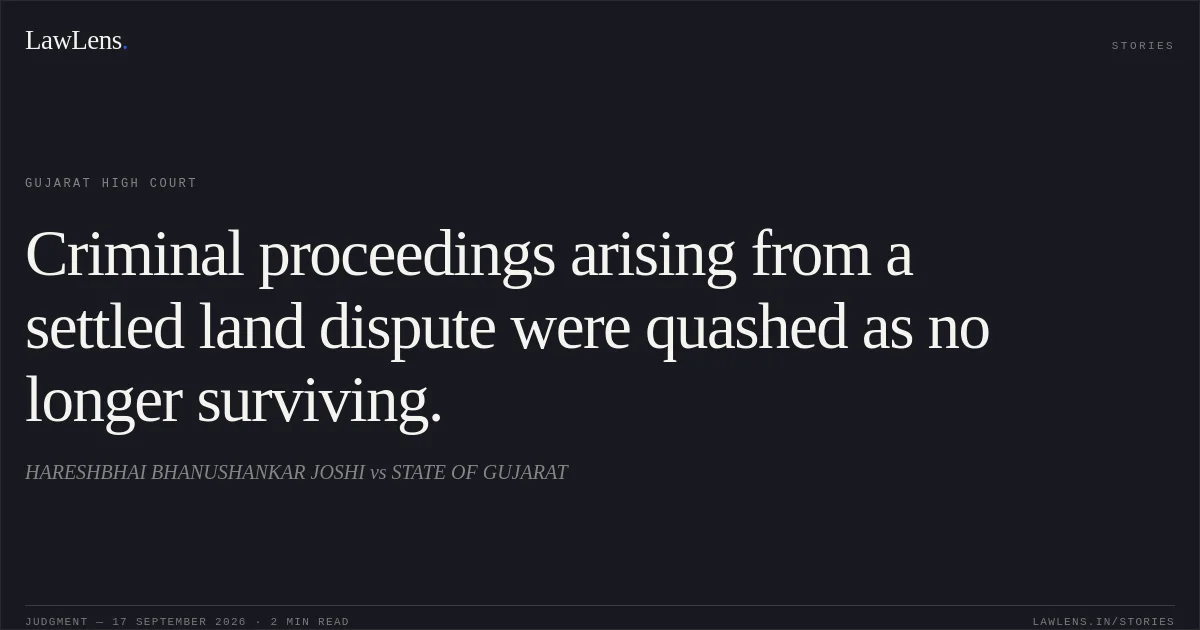
Source reference: p. 6In these circumstances, the Court concluded that the complaint no longer survived for effective prosecution and that continuation of the proceedings was unwarranted.
Source reference: no citationThe Court therefore did not decide the earlier allegations concerning delay, lack of ownership documents, or the alleged abuse of process on merits.
Source reference: pp. 2–3, 6Holding
The High Court held that, owing to the compromise between the complainant and the person concerned with possession of the disputed land and the death of the other accused, the complaint did not survive.
It accordingly quashed and set aside the complaint/FIR, disposed of the application, and discharged the notice.
Source reference: pp. 6–7Acts & Sections Cited
2 provisions across 1 statute referred to in this judgment. Each provision opens on LawLens.
Indian Penal Code, 18602
Original Court PDF
HARESHBHAI BHANUSHANKAR JOSHIvsSTATE OF GUJARAT
Click to open original judgment
Original judgment, available to read, download and summarize on LawLens.in