Facts
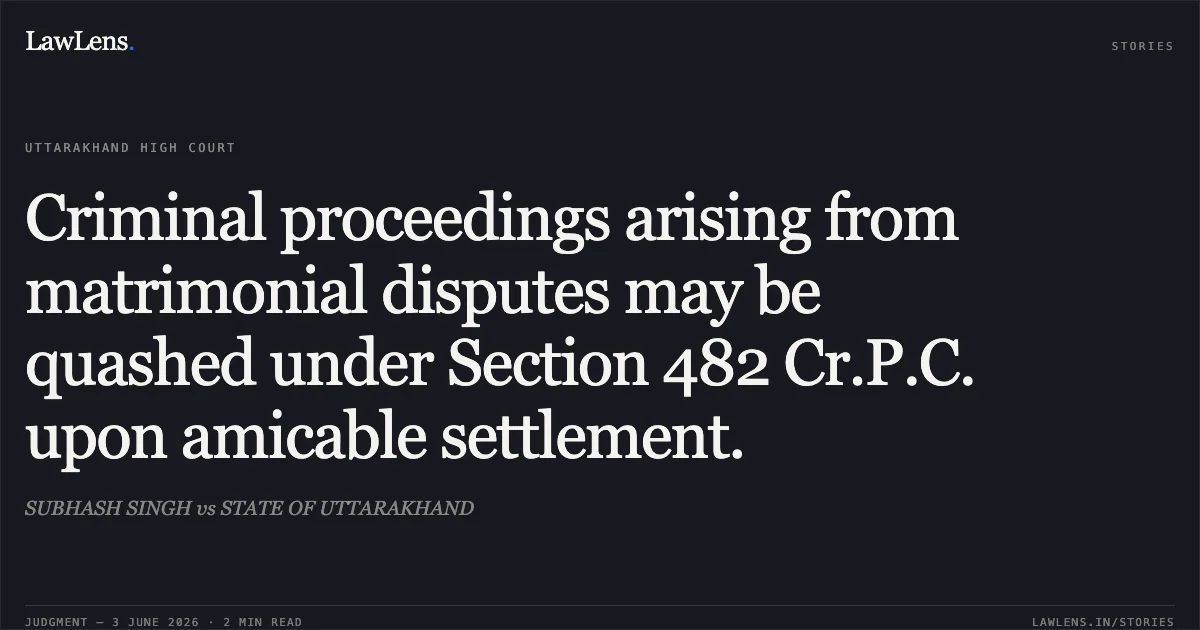
The applicants (husband, father-in-law, and mother-in-law) sought the quashing of a chargesheet and summoning order dated 07.10.2024 in Criminal Case No. 676 of 2024, arising from FIR allegations under Sections 498-A, 323, 506 IPC and Sections 3/4 of the Dowry Prohibition Act
Source reference: para. 4-5The dispute originated from matrimonial discord between the parties
Source reference: para. 5During the pendency of the proceedings, the parties reached an amicable settlement with the intervention of family members, filing for mutual divorce under Section 27 of the Uniform Civil Code (UCC), Uttarakhand
Source reference: para. 6As part of the settlement, the husband (applicant no. 1) paid ₹7,00,000/- as full and final alimony
Source reference: para. 6The complainant (respondent no. 2) appeared via video conferencing, confirming the voluntary nature of the settlement and stating she had no objection to quashing the criminal case
Source reference: para. 7Issues
Whether the High Court, in the exercise of its inherent powers under Section 482 Cr.P.C., can quash criminal proceedings involving non-compoundable offences when the dispute is matrimonial/personal in nature and has been settled by the parties.
Source reference: para. 8-9Law Applied
The court primarily applied the inherent powers of the High Court under Section 482 of the Cr.P.C.
Source reference: para. 9It relied on the landmark precedent Gian Singh v. State of Punjab, which established that the High Court may quash non-compoundable offences of a private nature if the parties have settled and there is no serious impact on society
Source reference: para. 9It further integrated the guidelines from Narinder Singh v. State of Punjab, which emphasized quashing cases of a "predominantly civil character" such as matrimonial disputes
Source reference: para. 10State of Madhya Pradesh v. Laxmi Narayan, which allows quashing unless the offences involve serious mental depravity
Source reference: para. 11Finally, it applied Parbatbhai Aahir v. State of Gujarat regarding the evaluation of whether continuing proceedings would constitute an abuse of the process of law
Source reference: para. 11Reasoning
The Court observed that while the offences charged are legally non-compoundable under Section 320 Cr.P.C., they stem purely from matrimonial discord and are personal, lacking any public interest or societal impact
Source reference: para. 8, 12The Court verified the legitimacy of the compromise through a direct interaction with respondent no. 2, who confirmed the receipt of alimony and the initiation of divorce proceedings under the UCC
Source reference: para. 7Applying the summarized principles from the Supreme Court, the Court reasoned that because the parties have resolved their entire dispute and the complainant no longer wishes to prosecute, the continuation of the criminal proceedings would be a futile exercise and would not serve the ends of justice
Source reference: para. 12-13Holding
The Court allowed the compounding application and quashed the impugned chargesheet, cognizance/summoning order dated 07.10.2024, and the entirety of the criminal proceedings in Criminal Case No. 676 of 2024
The Court held that in light of the voluntary settlement and the nature of the dispute, quashing was necessary to secure the ends of justice
Source reference: para. 13All pending applications were disposed of accordingly
Source reference: para. 14Acts & Sections Cited
6 provisions across 3 statutes referred to in this judgment. Each provision opens on LawLens.
Indian Penal Code, 18602
Code of Criminal Procedure, 19732
Original Court PDF
SUBHASH SINGHvsSTATE OF UTTARAKHAND
Click to open original judgment
Original judgment, available to read, download and summarize on LawLens.in