Facts
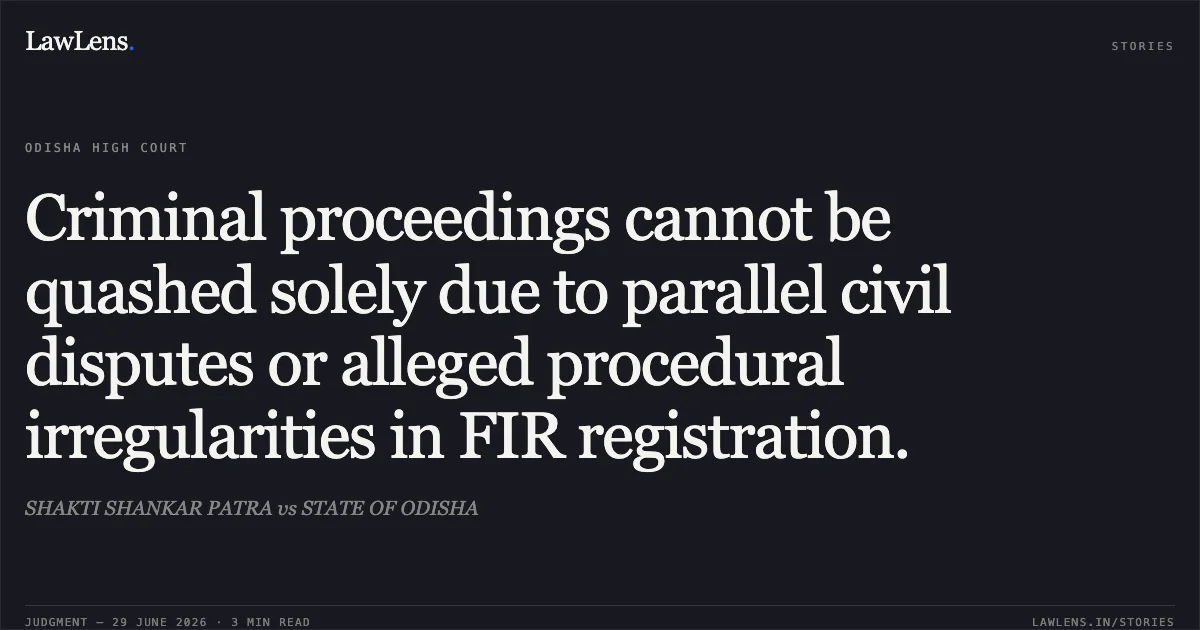
The Petitioner sought the quashing of Infocity P.S. FIR No. 61 of 2025 registered under Sections 296 (obscenity), 318(4) (cheating), 351(2) (criminal intimidation), and 3(5) (common intention) of the Bharatiya Nyaya Sanhita (BNS).
Source reference: p. 1-2The dispute originated from property transactions and a 2013 civil suit.
Source reference: p. 2The Petitioner alleged the FIR was a "malicious counterblast" to an earlier FIR (Puri FIR No. 72 of 2024) filed against the current informants regarding sale deed forgery.
Source reference: p. 3-4The Petitioner further challenged the procedural legality of the FIR, asserting it was improperly registered via the High Court’s Litigation Management System (LMS) rather than through a signed physical complaint under Section 173 of the BNSS.
Source reference: p. 3-4Issues
1. Whether an FIR is liable to be quashed if it is registered based on a complaint received through an electronic Litigation Management System (LMS) rather than a physical submission.
Source reference: p. 112. Whether the Infocity FIR constitutes an impermissible "second FIR" or a malicious "counterblast" to existing criminal proceedings.
Source reference: p. 133. Whether a criminal proceeding can be quashed under Section 528 BNSS (Section 482 CrPC) on the grounds that the dispute is civil in nature or based on defense materials.
Source reference: p. 15Law Applied
The court primarily applied Section 528 of the BNSS (pari materia with Section 482 CrPC) regarding inherent powers to prevent abuse of process.
Source reference: p. 8Section 173 of the BNSS, which permits information of cognizable offences via electronic communication provided it is signed within three days.
Source reference: p. 8The court applied the "Bhajan Lal Guidelines" from State of Haryana v. Bhajan Lal, which restrict quashing to cases where no prima facie offence is disclosed or the proceeding is manifestly mala fide.
Source reference: p. 9Lalita Kumari v. Govt. of UP regarding the mandatory duty to register FIRs upon disclosure of cognizable offences.
Source reference: p. 12Rajiv Thapar v. Madan Lal Kapoor regarding the limits of considering defense documents at the quashing stage.
Source reference: p. 15Reasoning
The Court reasoned that Section 173 BNSS expressly recognizes electronic communication as a valid mode for initiating a criminal complaint.
Source reference: p. 11It held that the method by which the complaint reached the police (LMS vs. physical) is secondary to whether the information discloses a cognizable offence.
Source reference: p. 13Regarding the "counterblast" argument, the Court observed that the Puri FIR dealt with forgery, while the Infocity FIR alleged distinct subsequent acts of blackmail and intimidation.
Source reference: p. 13Applying Zandu Pharmaceutical Works, the Court clarified that once an FIR discloses a cognizable offence, the alleged mala fides of the informant are of "secondary importance" and must be tested at trial.
Source reference: p. 14The Court rejected the "civil dispute" plea, noting that according to Indian Oil Corporation v. NEPC India Ltd., a single set of facts can provide grounds for both civil and criminal actions.
Source reference: p. 15The court declined to conduct a "mini-trial" of the Petitioner's defense materials, such as the Sub-Registrar’s inquiry report, as they were not of "sterling and impeccable quality" sufficient to summarily dismiss the prosecution.
Source reference: p. 15Holding
The Court dismissed both CRLMC petitions, holding that the FIR allegations, taken at face value, warrant investigation as they prima facie disclose cognizable offences.
The court vacated all interim orders and directed the investigating agency to proceed according to law.
Source reference: p. 17It noted that while Section 296 BNS (obscenity) appeared narrowly applicable, the FIR could not be quashed in toto at the threshold, though the police should not mechanically retain sections if ingredients are not met during investigation.
Source reference: p. 16Acts & Sections Cited
10 provisions across 3 statutes referred to in this judgment. Each provision opens on LawLens.
Bharatiya Nagarik Suraksha Sanhita, 20234
Code of Criminal Procedure, 19732
Bharatiya Nyaya Sanhita, 20234
Original Court PDF
SHAKTI SHANKAR PATRAvsSTATE OF ODISHA
Click to open original judgment
Original judgment, available to read, download and summarize on LawLens.in