Facts
The petitioner sought quashing under Section 528 of the Bharatiya Nagarik Suraksha Sanhita of FIR No. 83/2024 registered at Police Station Awadhpuri, Bhopal, for offences under Sections 294, 323, 324, 307, 336, 506 read with Section 34 IPC, and the consequential proceedings.
Source reference: para. 1, p. 1The prosecution alleged that on 7 April 2024 at approximately 4:00 p.m., the petitioner abused complainant Hanuman Prasad Pandey, attacked him on the head with a sword with an alleged intention to kill, and injured Mahesh Pandey when he intervened; the petitioner’s servant allegedly threw a flower pot from the rooftop.
Source reference: para. 2, p. 1The FIR was registered after the complainant’s report, investigation was completed, and a charge-sheet was filed. The case was pending as Sessions Trial No. 254/2025 before the III Additional Sessions Judge, Bhopal.
Source reference: para. 2, p. 2The petitioner contended that the FIR was a counterblast to Crime No. 82/2024, which he had lodged earlier on the same date, and relied on CCTV footage and a certificate under Section 65-B of the Indian Evidence Act to dispute the prosecution version.
Source reference: para. 3, p. 2The State and complainant opposed quashing, relying upon the injured witnesses’ allegations, the seizure of the sword from the petitioner, and the FSL report showing human blood on it.
Source reference: para. 4, p. 3Issues
Whether the FIR and the consequential criminal proceedings should be quashed in the exercise of the High Court’s inherent jurisdiction under Section 528 BNSS, on the ground that the allegations were false, malicious, or constituted a counterblast.
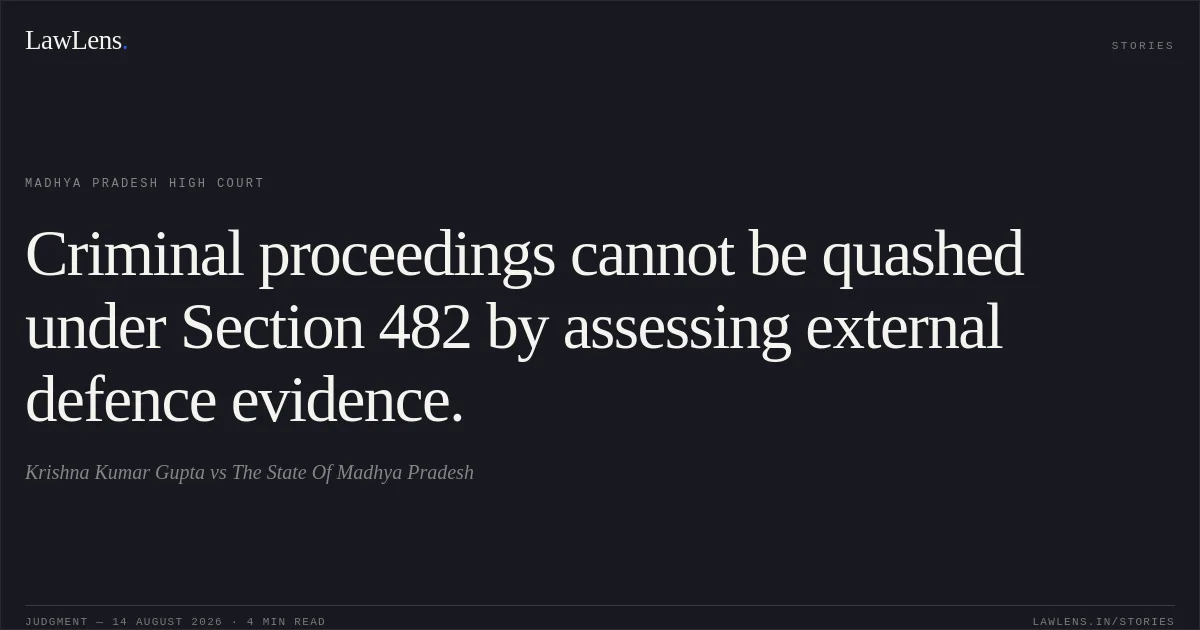
Source reference: paras. 1, 3, 16–21, pp. 1–2, 14–20Whether the High Court could consider CCTV footage and other documents produced by the petitioner, but not forming part of the prosecution charge-sheet, to determine the veracity of the allegations at the quashing stage.
Source reference: paras. 3–4, 11–16, pp. 2–3, 12–15Whether the FIR, witness statements, medical material, seizure of the sword, and FSL report disclosed sufficient prima facie material warranting continuation of the prosecution.
Source reference: paras. 19–21, pp. 19–20Law Applied
The Court applied the principles governing the exercise of inherent jurisdiction under Section 482 CrPC, as incorporated for the present petition under Section 528 BNSS, including the rule that criminal proceedings may be quashed where the allegations, taken at face value, do not constitute an offence, are absurd or inherently improbable, are legally barred, or are manifestly mala fide; however, such power must be exercised sparingly and with circumspection.
Source reference: paras. 6–7, pp. 4–10Relying on Supriya Jain v. State of Haryana, Amit Kapoor v. Ramesh Chander, and State of Haryana v. Bhajan Lal, the Court held that it must assess only whether a prima facie case is disclosed and must not conduct a mini-trial or determine the likelihood of conviction.
Source reference: paras. 6–10, pp. 4–12The Court further relied on CBI v. Aryan Singh, Abhishek v. State of M.P., Mahendra K.C. v. State of Karnataka, State of Maharashtra v. Maroti, and Manik B. v. Kadapala Sreyes Reddy for the principle that the High Court cannot test the truthfulness, reliability, sufficiency, or admissibility of prosecution evidence in quashing proceedings.
Source reference: paras. 8–10, 13, 17–18, pp. 11–18Under Ganga Bai v. Shriram and Iveco Magirus Brandschutztechnik GMBH v. Nirmal Kishore Bhartiya, fresh or external evidence produced by the accused ordinarily cannot be relied upon to introduce a defence at the quashing stage.
Source reference: paras. 11–16, pp. 13–16Where the investigation is complete and a charge-sheet has been filed, the trial court should ordinarily assess the material, including on a discharge application, as recognised in Iqbal v. State of U.P.
Source reference: para. 19, p. 19Reasoning
The FIR specifically alleged that the petitioner assaulted the complainant and the intervening witness with a sword, and the prosecution material included injury reports, witness statements, recovery of the sword from the petitioner, and an FSL report indicating human blood on the weapon.
Source reference: paras. 19–20, pp. 19–20These materials were sufficient to disclose a prima facie case for continuation of the proceedings.
Source reference: paras. 19–20, pp. 19–20The petitioner’s allegations that the FIR was a counterblast and that the CCTV footage disproved the prosecution case raised factual and evidentiary disputes.
Source reference: paras. 3–4, 11–16, 20–21, pp. 2–3, 12–16, 20Since the CCTV material was produced by the petitioner and was not part of the charge-sheet, the Court declined to examine it at that stage; its evidentiary value could be considered by the trial court.
Source reference: paras. 3–4, 11–16, 20–21, pp. 2–3, 12–16, 20Applying the rule against conducting a mini-trial or assessing the defence on merits, the Court held that the alleged falsity, mala fides, and evidentiary contradictions had to be established during trial and did not justify quashing.
Source reference: paras. 16–21, pp. 15–20Holding
The Court held that the FIR and the charge-sheet disclosed sufficient prima facie material connecting the petitioner with the alleged offences and that no exceptional ground for exercising inherent jurisdiction was made out.
The petition seeking quashing of FIR No. 83/2024 and the consequential criminal proceedings was dismissed as meritless.
Source reference: paras. 22–23, pp. 20–21The Court clarified that its observations were limited to the petition and would not prejudice the trial, which was to proceed independently and in accordance with law.
Source reference: paras. 22–23, pp. 20–21Acts & Sections Cited
19 provisions across 3 statutes referred to in this judgment. Each provision opens on LawLens.
Bharatiya Nagarik Suraksha Sanhita, 20231
Indian Penal Code, 18608
Code of Criminal Procedure, 1973
Original Court PDF
Krishna Kumar GuptavsThe State Of Madhya Pradesh
Click to open original judgment
Original judgment, available to read, download and summarize on LawLens.in