Facts
The applicants invoked Section 482 of the Code of Criminal Procedure, 1973, seeking quashment of the final report arising from FIR Crime No. 20/2024 registered at Police Station Banganga, Indore, for offences under Sections 376, 376(2)(n) and 506/34 of the IPC and Sections 5 and 6 of the POCSO Act, 2012.
Source reference: para. 1The FIR was lodged by the prosecutrix’s father, alleging that Vivek Pandey had committed penetrative sexual assault upon his daughter and that the applicants had abetted the offence.
Source reference: para. 2The applicants contended that the prosecutrix had voluntarily accompanied Vivek Pandey, that they were merely his friends, that she was not a student of the college where the incident allegedly occurred, that no CCTV footage had been collected, and that the details of the alleged penetrative sexual assault had not been established.
Source reference: para. 3The State opposed the application.
Source reference: para. 4The Court relied on the prosecutrix’s CBSE Secondary School Examination marks statement-cum-certificate, which recorded her date of birth as 8 January 2006.
Source reference: para. 5Since the FIR was lodged on 4 January 2024 and the alleged incident occurred before that date, the prosecutrix was below 18 years of age at the relevant time.
Source reference: para. 5Issues
Whether the allegations in the FIR and the material collected during investigation disclosed a prima facie case against the applicants for abetment and related offences, warranting continuation of the criminal proceedings?
Source reference: paras. 2, 6Whether the case fell within any of the categories identified in State of Haryana v. Bhajan Lal for exercise of the High Court’s inherent jurisdiction under Section 482 CrPC to quash the proceedings?
Source reference: paras. 7–8Whether the applicants’ factual objections—such as the prosecutrix’s alleged voluntary conduct, absence of CCTV footage, and disputed college affiliation—justified quashing the final report at the threshold?
Source reference: paras. 3, 6–8Law Applied
The Court applied Section 482 of the Code of Criminal Procedure, 1973, which preserves the High Court’s inherent power to prevent abuse of the process of any court and to secure the ends of justice.
Source reference: no citationIt considered the offences alleged under Sections 376 and 376(2)(n) and Section 506/34 of the IPC, along with Sections 5 and 6 of the POCSO Act, which criminalise aggravated penetrative sexual assault involving a child and prescribe punishment for such offences.
Source reference: para. 1The Court relied on State of Haryana v. Bhajan Lal, AIR 1992 SC 604, particularly paragraph 102, which identifies illustrative categories in which criminal proceedings may be quashed, including cases where the allegations do not disclose any offence, are inherently improbable, are legally barred, or are manifestly malicious.
Source reference: para. 7At the quashing stage, the Court assesses whether the allegations and collected material disclose a prima facie offence and does not ordinarily undertake a detailed evaluation of disputed evidence.
Source reference: no citationReasoning
The Court found that the documentary material established that the prosecutrix was below 18 years of age when the alleged incident occurred, making her alleged consent or voluntary conduct legally insufficient to negate the application of the POCSO Act.
Source reference: para. 5The FIR and the prosecutrix’s statement under Section 161 CrPC allegedly disclosed the applicants’ knowledge of the incident and their cooperation with Vivek Pandey, thereby providing prima facie material supporting the allegations of abetment.
Source reference: para. 6The applicants’ objections concerning the prosecutrix’s conduct, her college status, the absence of CCTV footage, and the alleged lack of proof regarding the precise details of the assault involved disputed factual matters that could not justify quashing at the preliminary stage.
Source reference: para. 3Since the allegations were neither inherently absurd nor legally insufficient and did not fall within any of the seven Bhajan Lal categories, the Court declined to exercise its inherent jurisdiction.
Source reference: paras. 7–8Holding
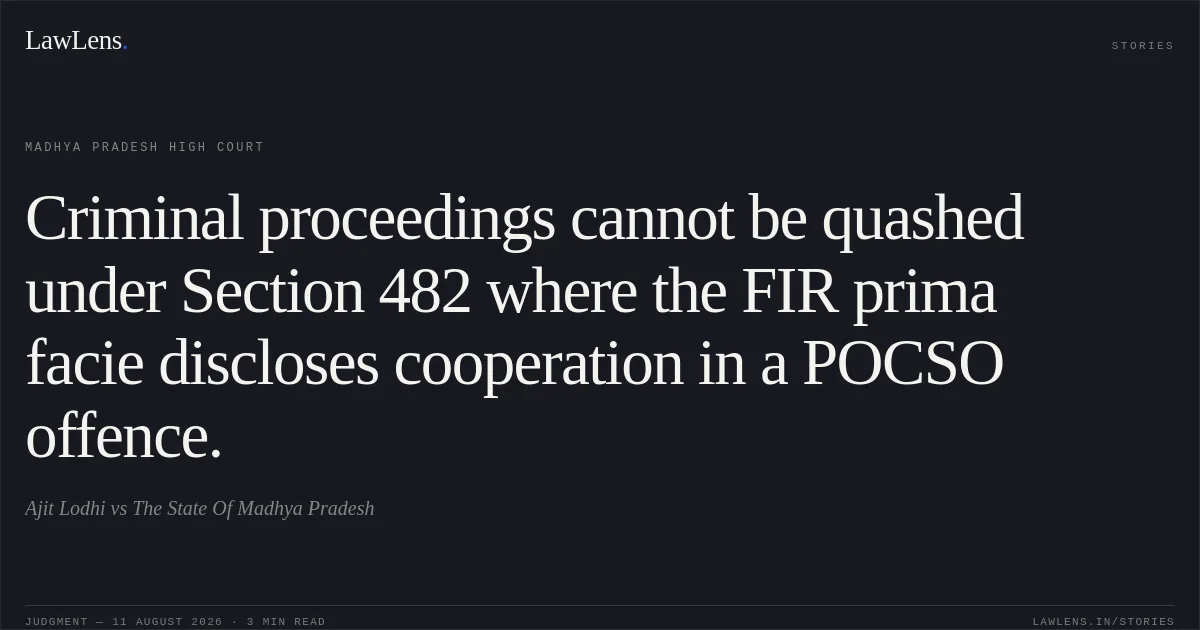
The High Court held that the material on record disclosed a prima facie case against the applicants and that the proceedings did not fall within the permissible categories for quashing under Section 482 CrPC as set out in Bhajan Lal.
The application for quashment of the final report was therefore dismissed.
Source reference: para. 9Acts & Sections Cited
9 provisions across 3 statutes referred to in this judgment. Each provision opens on LawLens.
Code of Criminal Procedure, 19734
Indian Penal Code, 18603
Original Court PDF
Ajit LodhivsThe State Of Madhya Pradesh
Click to open original judgment
Original judgment, available to read, download and summarize on LawLens.in