Facts
The second respondent alleged that he was induced to pay ₹10 lakhs in two instalments during 2019–2020 towards the purchase of a flat, but neither received the flat nor obtained a refund. He further alleged that the appellant summoned and assaulted him on the pretext of returning the money. After an earlier complaint to the Superintendent of Police on 13 March 2023 elicited no response, the second respondent instituted Complaint Case No. 3412 of 2023 before the Chief Judicial Magistrate, Unnao
Source reference: pp. 1–2, paras. 2–3During the inquiry under Section 202 of the Code of Criminal Procedure, 1973 (“CrPC”), statements of the complainant and witnesses were recorded. The police reported that no such flat existed and produced call-detail records indicating that the appellant was at Lucknow on the alleged date of assault. A proceeding under the Negotiable Instruments Act, 1881, concerning the same ₹10 lakh transaction was also pending against the wife of a land broker
Source reference: p. 2, para. 3The Chief Judicial Magistrate dismissed the complaint, finding the dispute to be civil in nature. Following a remand, the Additional Chief Judicial Magistrate reconsidered and again dismissed the complaint. The Additional District and Sessions Judge affirmed the dismissal, holding that the police inquiry and documentary material contradicted the oral testimony
Source reference: p. 3, para. 4The High Court thereafter allowed an application under Section 482 CrPC, although the appellant, who had been impleaded as a respondent, was apparently not heard
Source reference: p. 3, paras. 5–6Issues
Whether the High Court was justified in setting aside the orders refusing cognizance and remanding the matter without hearing the appellant, against whom the allegations had been made?
Source reference: p. 3, para. 6Whether a dispute arising from a money transaction, involving an alleged failure to sell a flat or refund the money, could properly be pursued through criminal proceedings rather than a civil action for recovery?
Source reference: p. 3, para. 7Whether the complaint disclosed sufficient grounds for continuation of criminal proceedings in light of the police inquiry, documentary evidence, delay, and the essentially civil nature of the dispute?
Source reference: pp. 2–3, paras. 3–4, 7Law Applied
The Court applied Section 202 CrPC, which permits the Magistrate to conduct an inquiry before issuing process, and Section 482 CrPC, which preserves the High Court’s inherent jurisdiction but must be exercised consistently with procedural fairness and the interests of justice
Source reference: pp. 2–3, paras. 3, 5–6The Court held that where a High Court sets aside an order refusing cognizance and remands the matter, the person against whom allegations are made may be prejudiced and should not ordinarily be denied an opportunity of being heard
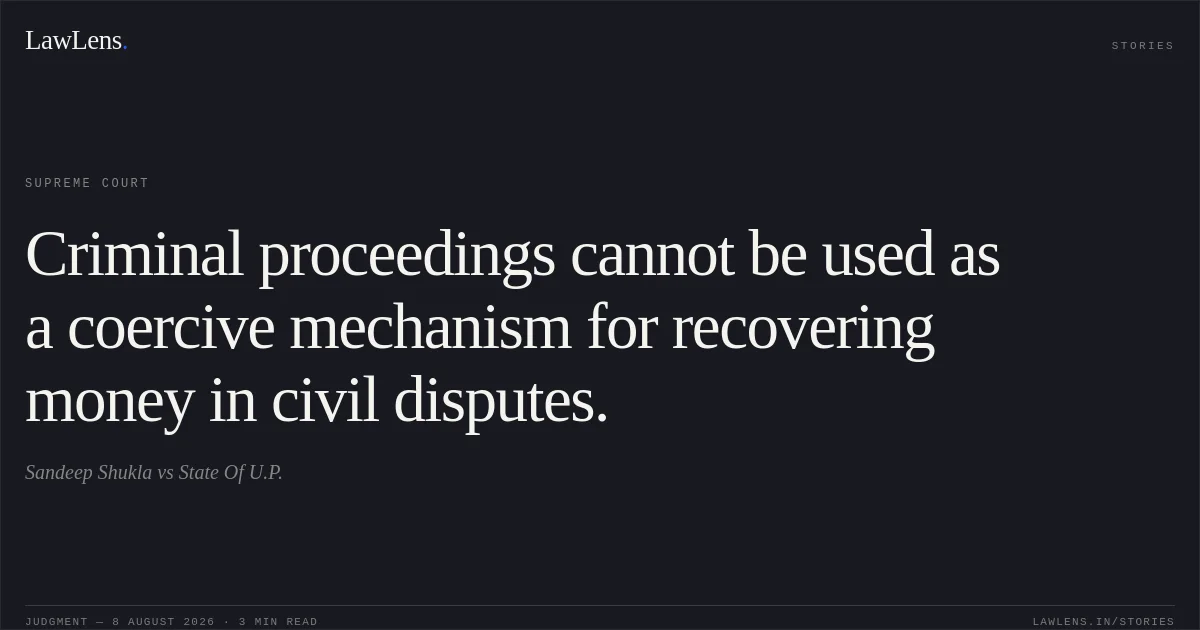
Source reference: p. 3, para. 6It further reaffirmed that criminal proceedings cannot be used as a mechanism for recovery of money or as an arm-twisting device in disputes that are essentially civil in nature; the appropriate remedy for recovery of money is a civil suit
Source reference: p. 3, para. 7The Court also took note of the limitation period for pursuing a civil recovery claim, observing that the complaint was lodged after the period for filing such a suit had expired
Source reference: p. 3, para. 7Reasoning
The Court found that the High Court’s intervention under Section 482 CrPC was unsustainable because the appellant was not heard even though setting aside the refusal of cognizance and remanding the matter directly prejudiced him
Source reference: p. 3, para. 6On the merits, the material collected during the Section 202 inquiry—including the police report that no flat existed, the call-detail records placing the appellant elsewhere on the alleged date of assault, and the existence of related proceedings concerning the same money transaction—supported the Magistrates’ conclusion that the dispute was essentially civil and that the documentary material contradicted the oral allegations
Source reference: p. 2, para. 3; p. 3, para. 4The Court further held that the alleged failure to transfer the flat or refund ₹10 lakhs could not justify converting a money-recovery dispute into a criminal prosecution, particularly when the complaint was initiated more than three years after the relevant payment and after the civil remedy had become time-barred
Source reference: p. 3, para. 7Holding
The Supreme Court allowed the appeal and set aside the High Court’s order under Section 482 CrPC.
It restored the orders refusing cognizance and dismissing the complaint, holding that the dispute was civil in nature and that criminal proceedings could not be employed to recover the alleged debt or exert pressure upon the appellant
Source reference: p. 4, para. 8Pending applications, if any, were disposed of
Source reference: p. 4, para. 9Acts & Sections Cited
2 provisions across 1 statute referred to in this judgment. Each provision opens on LawLens.
Code of Criminal Procedure, 19732
Original Court PDF
Sandeep ShuklavsState Of U.P.
Click to open original judgment
Original judgment, available to read, download and summarize on LawLens.in