Facts
The Madhya Pradesh State Mining Corporation issued a tender for sand-extraction projects in Narmadapuram, Sehore and Bhind. The petitioner, Mapaex Minerals/respondent No. 2 and M/s Anshika Builders entered into a Memorandum of Understanding dated 25.01.2020 concerning their respective financial obligations. Disputes subsequently arose regarding financial contributions, utilisation and adjustment of funds, and refund obligations under the commercial arrangement.
Source reference: para. 3Respondent No. 2 invoked arbitration, resulting in the appointment of a sole arbitrator by the High Court under Section 11(6) of the Arbitration and Conciliation Act, 1996. After both parties led evidence, the arbitrator dismissed both the claims of respondent No. 2 and the petitioner’s counter-claims by a reasoned award dated 06.07.2025. The award was under challenge under Section 34 of the Arbitration and Conciliation Act.
Source reference: paras. 3–4Separately, respondent No. 2 had lodged Complaint No. 414/2022 before the Economic Offences Wing, Bhopal, on 09.11.2022, alleging fraud, criminal breach of trust, diversion of funds and other financial irregularities. The EOW issued notices requiring the petitioner to furnish documents and participate in the inquiry. No FIR had been registered when the writ petition was considered.
Source reference: paras. 5, 9, 11The petitioner sought quashing of the complaint and consequential proceedings under Article 226 of the Constitution, contending that the dispute was purely contractual and had already been adjudicated through arbitration. Respondent No. 2 opposed the petition on the grounds of suppression of facts, prematurity, and the alleged existence of criminality independent of the contractual dispute.
Source reference: paras. 6–14Issues
Whether the writ petition was liable to be dismissed on the grounds that the complaint was not initially placed on record, the date of the complaint was incorrectly stated, respondent No. 2 was allegedly not served, and no rejoinder was filed to the reply?
Source reference: paras. 23–31Whether the absence of an FIR or completion of the EOW inquiry rendered the writ petition premature?
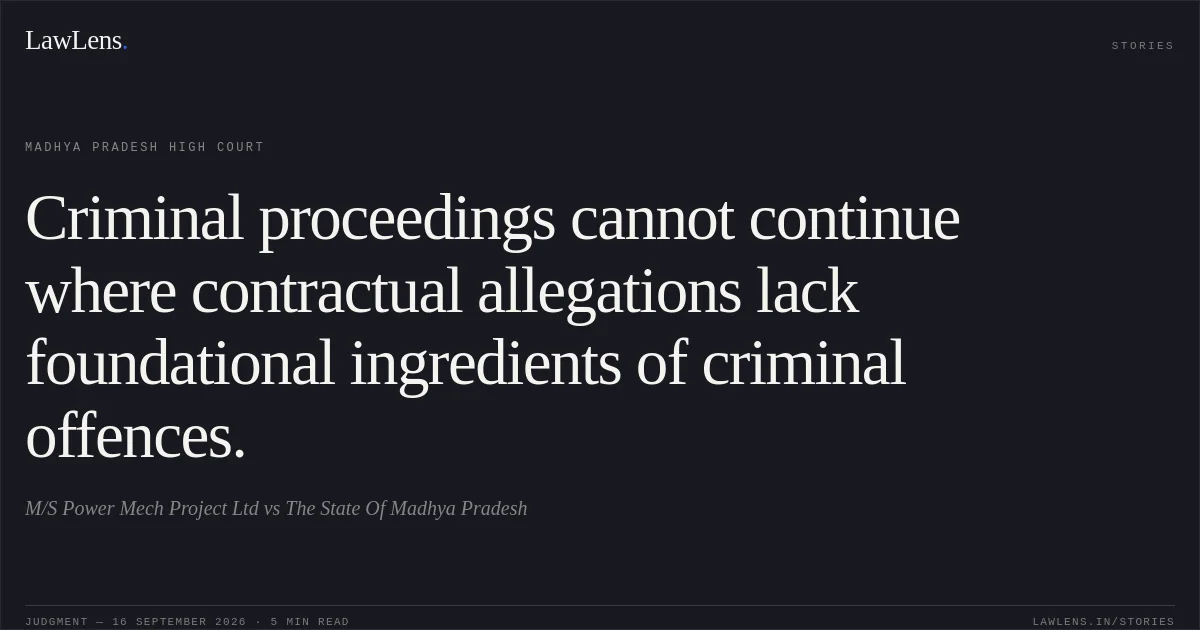
Source reference: paras. 30, 43Whether continuation of Complaint No. 414/2022 and the consequential EOW inquiry constituted an abuse of process where the allegations arose from a contractual and commercial arrangement that had been subjected to arbitration?
Source reference: paras. 32–33Whether the complaint, taken at face value, disclosed the essential ingredients of cheating, criminal breach of trust or other cognizable criminal offences, particularly the requisite dishonest intention at the inception of the transaction?
Source reference: paras. 33–38Law Applied
The Court exercised its extraordinary jurisdiction under Article 226 of the Constitution to prevent abuse of process where the foundational allegations, even if accepted at face value, did not disclose a criminal offence.
Source reference: paras. 30, 43It applied the principles governing cheating and criminal breach of trust under the IPC, holding that mere breach of contract, non-payment, failure to refund or disputed utilisation of money does not constitute cheating or criminal breach of trust without dishonest intention from the inception, inducement, entrustment and dishonest misappropriation.
Source reference: para. 33Relying on Indian Oil Corporation v. NEPC India Ltd., (2006) 6 SCC 736, Anand Kumar Mohatta v. State (NCT of Delhi), (2019) 11 SCC 706, Randheer Singh v. State of U.P., (2021) 14 SCC 626, Pushkar Jamnekar v. State of Telangana, 2024 SCC OnLine SC 2385, and particularly G. Saminathan v. State, 2026 SCC OnLine SC 1460, the Court reiterated that criminal law cannot be used to exert pressure in a purely civil or commercial dispute, although civil and criminal remedies may ordinarily coexist where independent criminality is disclosed.
Source reference: paras. 6, 33, 39–44The Court also applied the principle in S.P. Chengalvaraya Naidu v. Jagannath, (1994) 1 SCC 1, that suppression of material facts may disentitle a litigant from discretionary relief, while holding that every omission or inaccurate statement does not automatically warrant dismissal.
Source reference: paras. 23–31Reasoning
The Court rejected the preliminary objections. Although the complaint had not initially been filed with the petition and its date had been inaccurately represented, it was subsequently placed on record by respondent No. 2, and the Court found no sufficient basis to conclude that the petitioner had deliberately attempted to mislead the Court.
Source reference: paras. 24–31The “unclaimed” service status and respondent No. 2’s subsequent full participation also negated any demonstrated prejudice. Further, the absence of a rejoinder did not relieve the Court of its duty to independently assess whether the alleged offences were legally made out.
Source reference: paras. 24–31On the merits, the Court found that the dispute arose from the MoU and connected commercial arrangements and concerned financial contributions, accounts, fund utilisation, refunds, project cancellation and the induction or removal of participants—matters substantially intertwined with contractual rights and liabilities.
Source reference: paras. 34–36The alleged failure to contribute funds, inability to arrange finance, failure to refund money or disputed handling of funds did not, without specific material showing fraudulent intention at the inception, establish cheating. Similarly, the allegations did not sufficiently disclose entrustment followed by dishonest misappropriation necessary for criminal breach of trust.
Source reference: paras. 37–38The arbitral award was not treated as an automatic bar to criminal proceedings, but it was considered a relevant part of the factual matrix demonstrating that the underlying dispute had already been examined in the agreed commercial forum.
Source reference: paras. 35, 41Since the complaint did not disclose independent criminality and appeared to give a criminal colour to a contractual dispute, continuation of the EOW inquiry would amount to abuse of process.
Source reference: paras. 41–44Holding
The High Court held that the preliminary objections did not justify dismissal of the petition and that the complaint, even taken at face value, did not disclose the essential ingredients of the alleged criminal offences.
The Court therefore allowed the writ petition and quashed Complaint No. 414/2022 lodged before the EOW, Bhopal, along with all consequential proceedings and inquiry against the petitioner.
Source reference: para. 45It clarified that the order did not adjudicate or prejudice the parties’ civil or contractual rights, the pending Section 34 proceedings, or any other remedy available in law.
Source reference: para. 46All pending interlocutory applications were disposed of.
Source reference: paras. 47–48Acts & Sections Cited
7 provisions across 3 statutes referred to in this judgment. Each provision opens on LawLens.
Arbitration and Conciliation Act, 19962
Code of Criminal Procedure, 19732
Indian Penal Code, 18603
Original Court PDF
M/S Power Mech Project LtdvsThe State Of Madhya Pradesh
Click to open original judgment
Original judgment, available to read, download and summarize on LawLens.in