Facts
The dispute arose from a partnership arrangement in "The Colours Group," a real estate firm.
Source reference: para. 4-5Despite an arbitration clause in the partnership deed, Respondent No. 1 invoked jurisdiction under Section 156(3) of the Cr.P.C., leading to the registration of FIR No. 0062/2024 under Sections 420/34 of the IPC.
Source reference: para. 4-5Subsequently, the parties referred the matter to arbitration, resulting in an arbitral award dated 17.05.2024 based on a mutual settlement.
Source reference: para. 6Based on this settlement, the police submitted a closure report under Section 173 of the Cr.P.C.
Source reference: para. 6However, the Magistrate rejected the closure report and directed further investigation on 12.11.2025 after Respondent No. 1 opposed it, alleging that settlement cheques had been dishonored and an additional sum of Rs. 11,00,000 in damages remained unpaid.
Source reference: para. 6-7The petitioners moved the High Court to quash the FIR and the Magistrate's orders.
Source reference: para. 2-3Issues
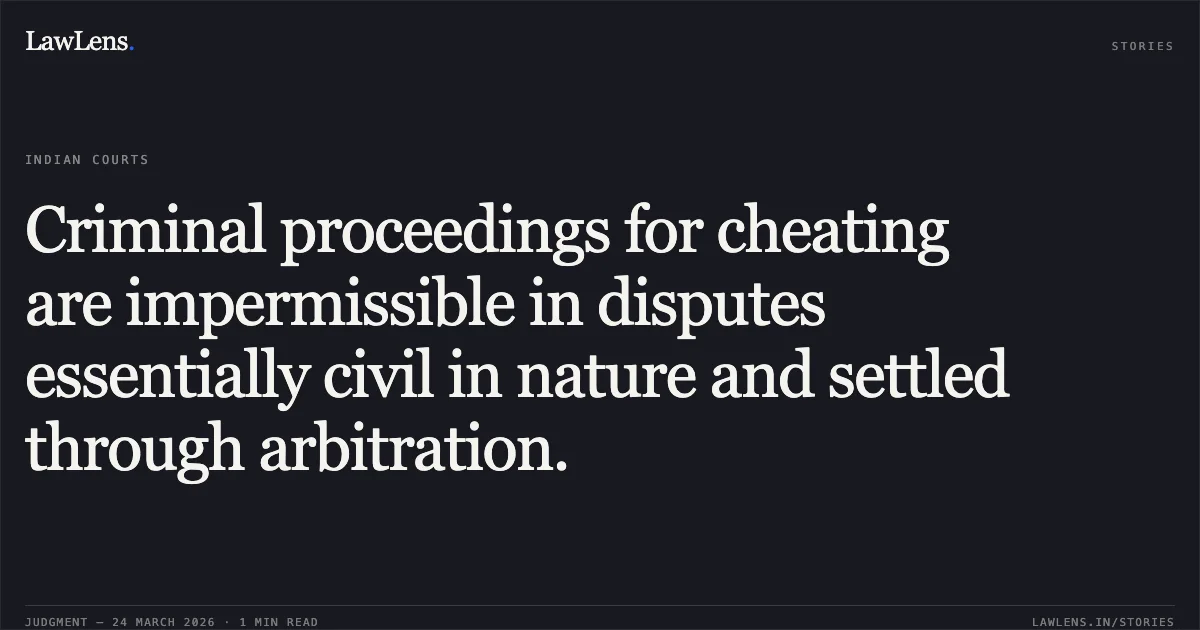
1. Whether the criminal proceedings under Section 420 IPC are maintainable when the dispute is predominantly civil/contractual and settled via an arbitral award.
Source reference: para. 10-142. Whether the Magistrate erred in rejecting the police closure report and directing further investigation despite the existence of a settlement and civil remedies for its enforcement.
Source reference: para. 19-21Law Applied
The Court applied Section 420 (Cheating) and Section 34 of the Indian Penal Code.
Source reference: para. 5It relied on the established legal principle that for an offense of cheating to be made out, there must be "dishonest intention at the inception" of the transaction.
Source reference: para. 13The Court further exercised its inherent jurisdiction (Section 482 Cr.P.C. / Section 528 BNSS) to prevent the abuse of the process of law, specifically the doctrine that civil disputes cannot be converted into criminal prosecutions to exert pressure for contractual enforcement.
Source reference: para. 14, 19Reasoning
The Court observed that the dispute was essentially civil and contractual, arising from business transactions and subsequent disagreements over settlement compliance.
Source reference: para. 10-11It noted that an arbitral award had already been passed, transforming the nature of the claim into a judgment debt.
Source reference: para. 11The Court reasoned that the essential ingredients of Section 420 IPC were missing because there was no evidence of dishonest intent at the time the partnership was formed.
Source reference: para. 13Regarding the dishonored cheques and non-compliance with the settlement, the Court held that these are enforceable through civil remedies, such as the execution of the arbitral award, rather than criminal prosecution.
Source reference: para. 12To ensure equity, the Court took note of the petitioners’ willingness to pay the remaining settlement amount (Rs. 65,00,000 via demand draft) and directed an additional payment of Rs. 11,00,000 to satisfy the respondent's claims for damages.
Source reference: para. 15-17Holding
The High Court allowed both petitions, holding that continuing the criminal proceedings would constitute an abuse of process.
The Court quashed FIR No. 0062/2024 and the Magistrate’s orders dated 05.02.2024 and 12.11.2025.
Source reference: para. 20-21The police closure report was accepted.
Source reference: para. 21The petitioners were directed to pay Rs. 11,00,000 to the respondent within one week and hand over the Rs. 65,00,000 demand draft forthwith.
Source reference: para. 17-18The Court clarified that the respondent remains free to pursue other legal remedies for any further surviving grievances.
Source reference: para. 22Acts & Sections Cited
3 provisions across 2 statutes referred to in this judgment. Each provision opens on LawLens.
Indian Penal Code, 18602
Bharatiya Nagarik Suraksha Sanhita, 20231
Original Court PDF
ATAL GODWANIvsOMPRAKASH KOTWANI
Click to open original judgment
Original judgment, available to read, download and summarize on LawLens.in


