Facts
The Petitioner was employed as a Customer Relation Officer at Nilachal Gramya Mahila Samabaya Samiti Limited since 2015
Source reference: p. 1-2An internal audit revealed that the Petitioner had collected over ₹24 lakhs from customers without depositing it into the society’s accounts and had created forged financial bonds
Source reference: p. 2An FIR was lodged leading to the registration of C.T. Case No. 1101 of 2024 for offences under Sections 409 (criminal breach of trust by agent), 506 (criminal intimidation), and 34 of the IPC
Source reference: p. 2, 6-7During the pendency of the quashing petition, the matter was referred to the High Court Mediation Centre
Source reference: p. 4On 18.03.2026, the parties reached a settlement where the Petitioner agreed to pay ₹18,65,074/- as full settlement, paying ₹5,00,000/- immediately and the balance in installments through March 2029
Source reference: p. 4, 14-15Issues
1. Whether a criminal proceeding involving allegations of financial misappropriation (Section 409 IPC) can be quashed under Section 528 of the BNSS (corresponding to Section 482 CrPC) on the basis of an amicable settlement reached through mediation
Source reference: p. 8, 14Law Applied
The court primarily applied Section 528 of the Bharatiya Nagarik Suraksha Sanhita (BNSS), 2023
Source reference: p. 1The court relied on the precedent set in Gian Singh v. State of Punjab, which permits quashing criminal proceedings of an "overwhelmingly civil flavour" involving financial or mercantile transactions if a settlement is reached and the possibility of conviction is remote
Source reference: p. 12, 16-17The court also applied principles from Parbatbhai Aahir v. State of Gujarat, holding that financial matters with essentially civil undertones are appropriate for quashing post-settlement
Source reference: p. 10, 16Contrast was drawn with serious economic offences that impact the national economy as seen in Dinesh Sharma v. Emgee Cables and Communications Ltd.
Source reference: p. 9Provisions of Sections 409 and 506 of the IPC regarding criminal breach of trust and intimidation were the underlying penal statutes
Source reference: p. 15Reasoning
The court evaluated whether the Petitioner’s acts constituted a "serious economic offence" against the state or a predominantly private financial dispute
Source reference: p. 8, 14the Court reasoned that the dispute possessed an "overwhelmingly and predominatingly civil character" arising from a financial transaction
Source reference: p. 16The court noted that the parties had voluntarily entered into a mediation agreement and the Petitioner had already commenced repayment by depositing ₹5,00,000/-
Source reference: p. 14Applying the Gian Singh criteria, the court found that since the parties resolved their dispute on equitable terms through an ADR mechanism, continuing the criminal trial would be oppressive and serve no further purpose in the interest of justice
Source reference: p. 13, 17-18Holding
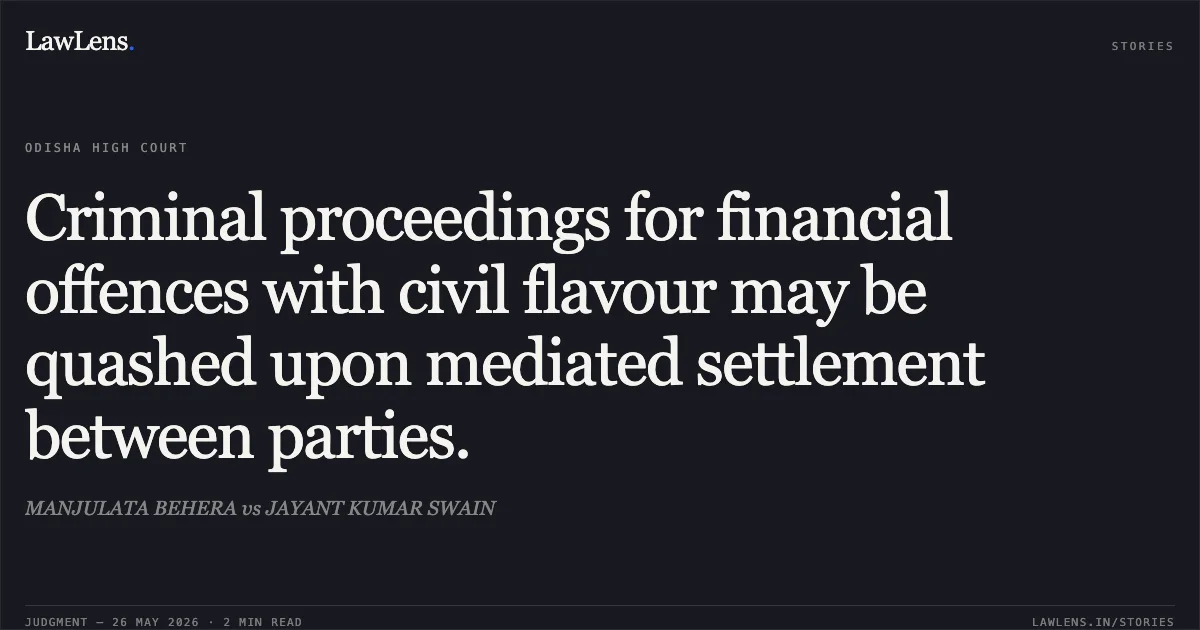
The court answered the issue in the affirmative, holding that the amicable settlement through mediation rendered further criminal proceedings unnecessary
The Court allowed the CRLMC and quashed the criminal proceedings in C.T. Case No. 1101 of 2024 (arising from Chandrasekharpur P.S. Case No. 509 of 2024), subject to the Petitioner's compliance with the mediation terms and all interim orders were vacated
Source reference: p. 18Acts & Sections Cited
13 provisions across 4 statutes referred to in this judgment. Each provision opens on LawLens.
Bharatiya Nagarik Suraksha Sanhita, 20231
Indian Penal Code, 18607
Code of Criminal Procedure, 19734
Negotiable Instruments Act, 18811
Original Court PDF
MANJULATA BEHERAvsJAYANT KUMAR SWAIN
Click to open original judgment
Original judgment, available to read, download and summarize on LawLens.in


