01Facts
The petitioners (accused Nos. 1 and 2) sought quashing of FIR No. RC0372023A0010 registered by the CBI for offences under Sections 120B, 420, 468 and 471 IPC and Sections 13(2) r/w 13(1)(d) of the Prevention of Corruption Act, 1988.
¶ 1 · ¶ 3.5The first petitioner had purchased the Jayanagar property in 2004 from a vendor whose title derived from the BDA.
¶ 3.1The petitioners obtained a term loan of ₹5 crore in 2016 and an overdraft of ₹2.5 crore in December 2016 from Punjab National Bank (Respondent No. 2), offering the Devanahalli property and the lease rentals as security.
¶ 3.2The loans defaulted. The Bank initiated proceedings before the DRT.
¶ 3.2During auction preparations, the Bank's empanelled advocate reported that the vendor's sale deed may be fake, and the Bank declared the account fraudulent on 20.03.2023.
¶ 3.3The Bank then lodged a complaint, which was transferred to the CBI.
¶ 3.4 · ¶ 3.5The petitioners offered a one-time settlement (OTS) on 22.06.2023 and again on 16.01.2026.
¶ 8 · ¶ 8.1The Bank accepted the OTS, the dues were paid, and a no-dues certificate was issued.
¶ 4.1 · ¶ 8.1 · ¶ 10The Bank did not dispute these facts.
¶ 10The CBI contended that the crime was registered on the Bank's complaint and that the settlement was immaterial.
¶ 502Issues
i.1. Whether the FIR for offences under Sections 120B, 420, 468 and 471 IPC and Sections 13(2) r/w 13(1)(d) PC Act, which is predominantly of a civil/commercial character, can be quashed under Section 482 CrPC where the borrower and the Bank have settled the loan dues and the Bank has issued a no-dues certificate.
¶ 9 · ¶ 11ii.2. Whether continuation of the investigation, in the face of the settlement, would amount to an abuse of the process of law and result in miscarriage of justice.
¶ 9 · ¶ 1203Law Applied
The Court relied on Section 482 CrPC as the source of inherent power to quash criminal proceedings to prevent abuse of process or secure the ends of justice.
¶ 11 · ¶ 12The Court followed Vijay Kumar Kela v. CBI, 2026 SCC OnLine SC 1003, which in turn followed K. Bharthi Devi v. State of Telangana, 2024 SCC OnLine SC 2695. Those decisions hold that criminal cases with an overwhelmingly civil character, particularly those arising from commercial or banking transactions, should be quashed where the parties have settled, as the possibility of conviction becomes remote and continuation causes oppression and prejudice; a belated complaint after settlement betrays lack of good faith; and permitting prosecution would undermine the sanctity of settlements.
¶ 9The Court relied on State of Haryana v. Bhajan Lal, 1992 Supp (1) SCC 335, which lays down illustrative categories for quashing under Section 482 CrPC and Article 226.
¶ 11Provisions in the judgment · 9 · Linked ones open on LawLens
Code of Criminal Procedure, 1973 Section 155Section 156Section 482
Indian Penal Code, 1860 Section 409Section 420Section 467Section 468Section 471
Prevention of Corruption Act, 1988 Section 13
04Reasoning
The Court found the controversy to be a banking dispute between a borrower and a lender, centred on the alleged production of defective title documents to obtain finance.
¶ 11Applying Kela and K. Bharthi Devi, the Court held that the settlement, its full payment, and the Bank's no-dues certificate placed the matter squarely within the settled principle.
¶ 9 · ¶ 10The Court reasoned that if the documents were truly fraudulent, the Bank would not have negotiated and accepted an OTS or issued a no-dues certificate; the subsequent prosecution therefore stood frustrated by the Bank's own conduct.
¶ 11Continuing the investigation while the Bank processed the settlement was held to be "highly unjust".
¶ 9The Court treated these circumstances as an abuse of process and a miscarriage of justice warranting obliteration of the FIR.
¶ 1205Holding
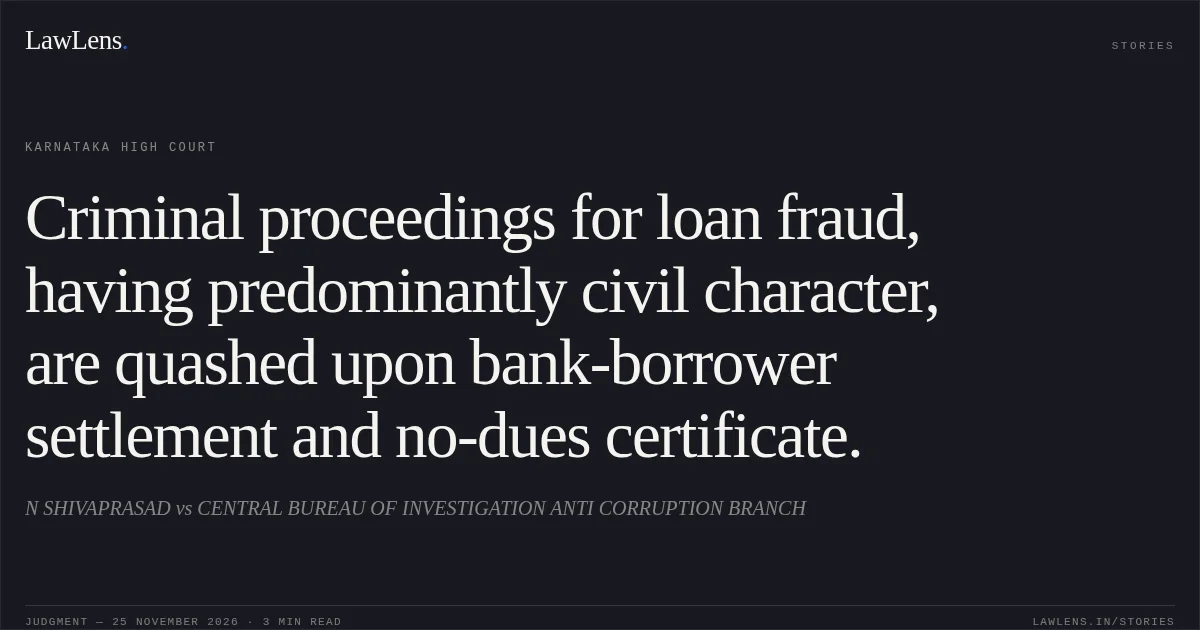
The Court answered both issues in the affirmative. Where a predominantly civil banking dispute has been settled, the Bank has accepted the OTS and issued a no-dues certificate, and the Bank has not disputed payment, continuation of the criminal proceedings would be an abuse of process and cause miscarriage of justice.
¶ 10 · ¶ 11 · ¶ 12The criminal petition is allowed, and FIR No. RC0372023A0010 registered by the CBI stands obliterated.
¶ 13(a) · ¶ 13(b)Original Court PDF
N SHIVAPRASADvsCENTRAL BUREAU OF INVESTIGATION ANTI CORRUPTION BRANCH
Click to open original judgment
Original judgment, available to read, download and summarize on LawLens.in