01Facts
The plaintiff, a security services company, was engaged by the defendant, a Central Public Sector Undertaking, under Purchase Order No. CPC/156 dated 24.06.2011, extended up to 31.01.2013 by Amendment No. 3 dated 10.07.2012.
¶ 3The plaintiff claimed that bonus for FY 2011–12 was reimbursable by the defendant and raised Bill No. 5673A dated 31.08.2012 for ₹2,05,767.
¶ 3The defendant paid ₹96,021 and withheld ₹1,09,746.
¶ 3After a legal notice dated 20.06.2014, the plaintiff sued for ₹1,52,900 with pre-suit interest and notice charges.
¶ 3The defendant filed a written statement raising a Section 80 CPC objection and contending that bonus reimbursement was governed by the Payment of Bonus Act, 1965.
¶ 4The Trial Court (O.S. No. 8729/2014) decreed the suit on 12.09.2018 for ₹1,52,900 with 18% interest and costs.
¶ 1, 10The Trial Court held that the vakalath and written statement lacked an authorization letter from the Chairman and Managing Director, treated the defendant as unrepresented, and disregarded the cross-examination of PW-1 and the evidence of DW-1, DW-2, Ex. D1 and Ex. D2.
¶ 10The defendant appealed, and during the appeal produced the authorization letter.
¶ 7, 1202Issues
i.1. Whether the Trial Court was justified in excluding the defence evidence and cross-examination, and decreeing the suit, on the sole ground of the defendant's representative lacking authorization from the Chairman and Managing Director, when it had allowed that representative to participate fully.
¶ 7, 10, 11ii.2. Whether, in light of the authorization letter produced in appeal, the matter should be remanded to the Trial Court for fresh adjudication on the merits, and if so, to what extent.
¶ 12, 1303Law Applied
The judgment does not cite any specific statutory provision or precedent for its reasoning. The court's approach rests on the general principle that a party's evidence should not be discarded at the final stage after it has been admitted and tested in the trial, and that where a question of authority arises, the proper course is to address it at the stage it arises, so that the trial court can reach a full decision on the merits.
¶ 11, 12The court relies on the principle that questions of fact and evidence are to be decided first by the Trial Court rather than the appellate court.
¶ 12The appellate remand is ordered under the Court's power to set aside a decree and remit the matter, though the provision is not expressly identified in the text.
¶ 13, 15 (Order) no citationThe defendant's reliance on Section 80 CPC and the Payment of Bonus Act, 1965 is recorded as contentions only, with no reasoned finding on them in this appeal.
¶ 4, no citationProvisions in the judgment · 2 · Linked ones open on LawLens
Code of Civil Procedure, 1908 Section 96Section 80
04Reasoning
The Trial Court refused to consider the defence case solely because the representative lacked a CMD authorization letter shown in the cause title.
¶ 10The High Court found this approach internally inconsistent: the Trial Court had permitted the same representative to file the written statement, cross-examine PW-1, examine DW-1 and DW-2, and mark documents, and only later ignored that evidence.
¶ 11If authority was doubtful, the Trial Court could have stopped the representative at the outset.
¶ 11Ignoring the entire defence evidence at the judgment stage prevented a decision on the merits.
¶ 11Because the authorization letter now produced directly addresses the sole reason for excluding the defence, the High Court held it relevant to the core defect.
¶ 12The court declined to examine the merits of the bonus claim, stating that such factual questions should first be determined by the Trial Court.
¶ 1205Holding
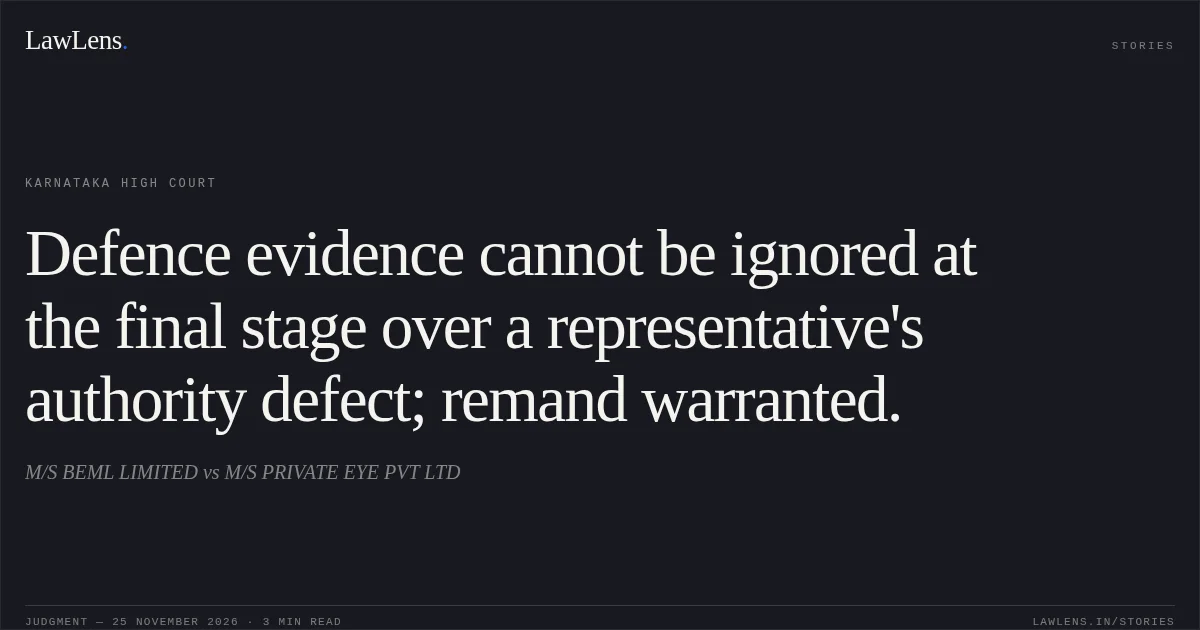
The High Court held that the Trial Court's exclusion of the defence evidence on the ground of lack of authorization, after permitting full participation, was not sustainable, and that the merits could not be decided on the existing record.
¶ 11, 12The appeal was allowed in part and remanded. The judgment and decree dated 12.09.2018 in O.S. No. 8729/2014 were set aside. The Trial Court is directed to consider the authorization letter, permit the defendant to produce it, and decide the matter afresh in accordance with law. The parties are to appear before the Trial Court on 11.01.2027 without further notice, and the Trial Court is directed to dispose of the matter expeditiously. The Trial Court may consider interest for the period spent in the appeal and fresh proceedings while passing the final decree. The court expressed no opinion on the merits.
¶ 13, 14, 15 (Order (i) to (v))Original Court PDF
M/S BEML LIMITEDvsM/S PRIVATE EYE PVT LTD
Click to open original judgment
Original judgment, available to read, download and summarize on LawLens.in