Facts
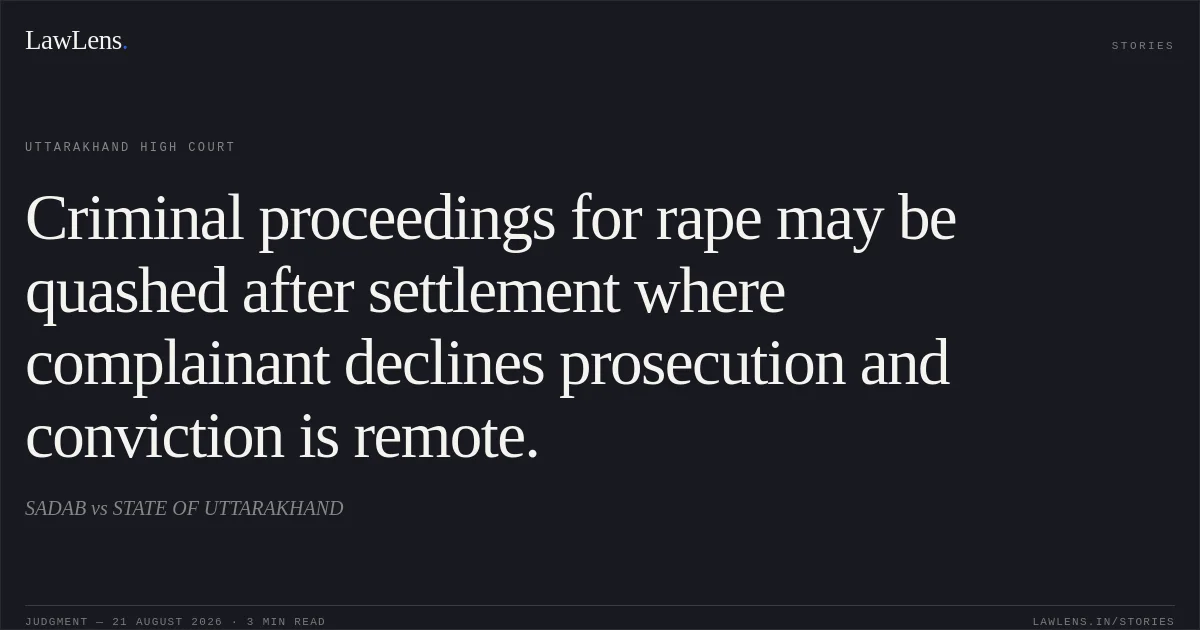
The petitioner sought quashing of FIR/Case Crime No. 640 of 2025, registered at Police Station SIIDCUL, District Haridwar, under Sections 376(2)(n) and 506 IPC.
Source reference: para. 2The complainant alleged that she and the petitioner became acquainted through Instagram in 2023 and, during the course of their friendship, the petitioner took her to various places and stayed with her in hotels, where he allegedly committed rape upon her on several occasions.
Source reference: para. 3The petitioner contended that the allegations were vague and omnibus because no specific dates, times, or particular occasions had been mentioned.
Source reference: para. 4During the proceedings, the parties submitted a joint compounding application supported by affidavits, stating that they had amicably settled their dispute.
Source reference: para. 4The complainant stated that her marriage had been fixed with another person and that she did not wish to pursue the prosecution.
Source reference: para. 4Both parties appeared before the Court and reiterated the settlement; the State opposed the application.
Source reference: paras. 6–8Issues
Whether the High Court could quash the FIR and criminal proceedings arising under Sections 376(2)(n) and 506 IPC on the basis of an amicable settlement between the petitioner and the complainant?
Source reference: paras. 4–5, 9–11Whether continuation of the criminal proceedings, in view of the complainant’s categorical unwillingness to support the prosecution and the settlement between the parties, would amount to an abuse of the process of law?
Source reference: paras. 5, 9–10Law Applied
The Court considered the principles governing exercise of the High Court’s jurisdiction to quash criminal proceedings on the basis of settlement, relying principally on Gian Singh v. State of Punjab, (2012) 10 SCC 303, and Narinder Singh v. State of Punjab, (2014) 6 SCC 466.
Source reference: para. 9These decisions recognise that, notwithstanding the non-compoundable nature of an offence, the High Court may quash criminal proceedings in an appropriate case where the dispute is essentially personal, the parties have genuinely settled their differences, the possibility of conviction is remote, and continuation of the proceedings would amount to oppression, prejudice, injustice, or abuse of process.
Source reference: para. 9The Court also considered the allegations under Sections 376(2)(n) and 506 IPC and the complainant’s categorical statement that she did not wish to pursue the prosecution.
Source reference: paras. 3–5, 9–10Reasoning
The Court treated the complainant’s affidavit, her statement before the Court, and the parties’ joint request to close the matter as demonstrating a genuine and unequivocal settlement.
Source reference: paras. 4, 6–7Although the FIR alleged the serious offence of repeated rape under Section 376(2)(n) IPC, the Court noted that the complainant no longer wished to support the prosecution and that continuation of the case could cause her further distress and adversely affect her personal well-being.
Source reference: para. 5Applying the principles in Gian Singh and Narinder Singh, the Court concluded that the likelihood of conviction had become remote and bleak, and that continuing the prosecution would cause oppression and prejudice to the petitioner while serving no fruitful purpose.
Source reference: paras. 9–10It therefore considered the proceedings to be an abuse of the process of law and held that the ends of justice would be served by giving effect to the settlement.
Source reference: paras. 9–10Holding
The High Court allowed the writ petition and quashed FIR/Case Crime No. 640 of 2025, registered at Police Station SIIDCUL, District Haridwar, under Sections 376(2)(n) and 506 IPC, together with all proceedings emanating from it.
The compounding application was consequently disposed of.
Source reference: para. 12Acts & Sections Cited
2 provisions across 1 statute referred to in this judgment. Each provision opens on LawLens.
Indian Penal Code, 18602
Original Court PDF
SADABvsSTATE OF UTTARAKHAND
Click to open original judgment
Original judgment, available to read, download and summarize on LawLens.in