Facts
The petitioner and Opposite Party No. 2 became acquainted through Facebook in 2018.
Source reference: para. 2The informant alleged that the petitioner established a physical relationship with her on the promise of marriage, subsequently refused to marry her, demanded ₹25 lakh, and threatened her and her family.
Source reference: para. 2On the basis of her written report, Mahila P.S. Case No. 39 of 2023 was registered under Sections 376, 506, 509 and 34 of the IPC and Section 4 of the Dowry Prohibition Act.
Source reference: para. 3A charge-sheet was subsequently submitted under Sections 376, 377, 506 and 509 of the IPC.
Source reference: para. 3The petitioner sought quashing of the FIR and charge-sheet, asserting that the relationship was consensual.
Source reference: para. 4During the proceedings, the parties filed a compromise, stating that they had married their respective spouses, were living separate and happy conjugal lives, and would not interfere with each other’s marital lives.
Source reference: paras. 5–6Opposite Party No. 2 stated that she did not wish to pursue the criminal case and had no objection to its quashing.
Source reference: paras. 5–6Issues
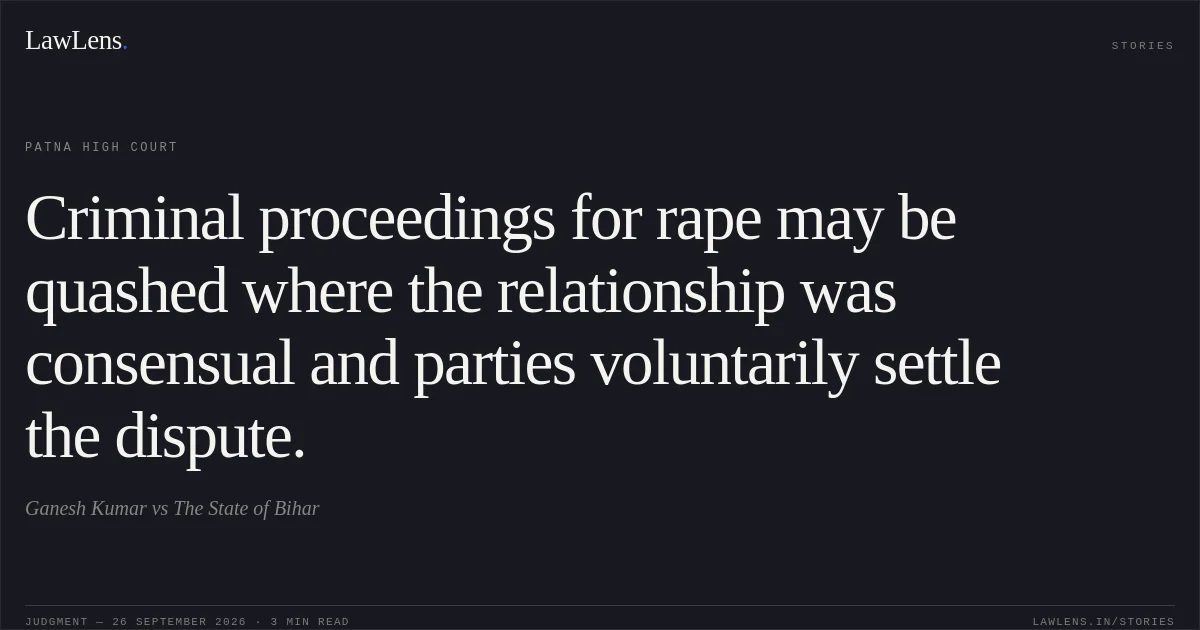
Whether the criminal prosecution arising from the FIR and charge-sheet should be quashed where the alleged physical relationship was consensual and the relationship did not culminate in marriage.
Source reference: paras. 4, 7, 9Whether, in view of the voluntary settlement between the parties and the informant’s unwillingness to pursue the case, continuation of the proceedings would amount to an abuse of the process of court.
Source reference: paras. 5–10Law Applied
The Court considered the offences alleged under Sections 376, 506, 509 and 34 of the Indian Penal Code, Section 4 of the Dowry Prohibition Act, and the offences included in the charge-sheet under Section 377 of the IPC.
Source reference: paras. 2–3Relying on Prashant v. State of NCT of Delhi, (2025) 5 SCC 764, the Court applied the principle that a consensual relationship, which later breaks down or does not culminate in marriage, cannot automatically be given a criminal character.
Source reference: para. 7Relying on Naushey Ali v. State of U.P., (2025) 4 SCC 78, the Court further held that where parties have amicably and voluntarily resolved a private dispute, continuation of the criminal proceedings may be futile and may constitute an abuse of the process of court; in such circumstances, the ends of justice may require quashing of the proceedings.
Source reference: para. 8Reasoning
The Court accepted the petitioner’s case that the relationship was consensual and noted that the parties had voluntarily settled their dispute without threat or coercion.
Source reference: paras. 4, 8The subsequent marriages of both parties and their undertaking not to interfere in each other’s lives demonstrated that the dispute had acquired a private character and that the informant was no longer interested in prosecuting the case.
Source reference: paras. 5–6Applying the principle in Prashant, the Court held that the failure of the relationship to result in marriage did not, by itself, justify continued criminal prosecution for rape.
Source reference: para. 7In light of the compromise and the informant’s lack of opposition, the Court concluded that continuation of the proceedings would serve no legitimate purpose, would consume judicial time, and would cause further harassment to the parties.
Source reference: para. 9Holding
The High Court held that continuation of the criminal proceedings was unnecessary and amounted to an abuse of process in the circumstances of the case.
It quashed the entire prosecution arising from Mahila P.S. Case No. 39 of 2023 dated 29 April 2023, including Charge-Sheet No. 177 of 2023 dated 29 December 2023.
Source reference: para. 10The criminal miscellaneous application was accordingly allowed.
Source reference: para. 11Acts & Sections Cited
6 provisions across 2 statutes referred to in this judgment. Each provision opens on LawLens.
Indian Penal Code, 18605
Dowry Prohibition Act, 19611
Original Court PDF
Ganesh KumarvsThe State of Bihar
Click to open original judgment
Original judgment, available to read, download and summarize on LawLens.in