Facts
The prosecutrix alleged that she met the petitioner at a gym in March 2025 and that, after developing a relationship, the petitioner represented that he was unmarried and would marry her.
Source reference: para. 2On that representation, he allegedly established physical relations with her at various locations. When she became pregnant and sought marriage, the petitioner allegedly refused, proposed abortion, and threatened to kill her and her parents.
Source reference: para. 2She later learned that the petitioner was already married and had two children.
Source reference: para. 2An FIR was registered at Police Station Gola Ka Mandir, Gwalior, as Crime No. 234/2026 for offences under Sections 69 and 351(3) of the Bharatiya Nyaya Sanhita, 2023.
Source reference: para. 2The petitioner invoked Section 528 of the Bharatiya Nagarik Suraksha Sanhita, 2023, seeking quashing of the FIR and consequential proceedings on the basis of a compromise.
Source reference: para. 1The parties filed a compromise application and affidavits, and the Principal Registrar verified their identities, signatures, and voluntariness of the settlement.
Source reference: paras. 3–4Issues
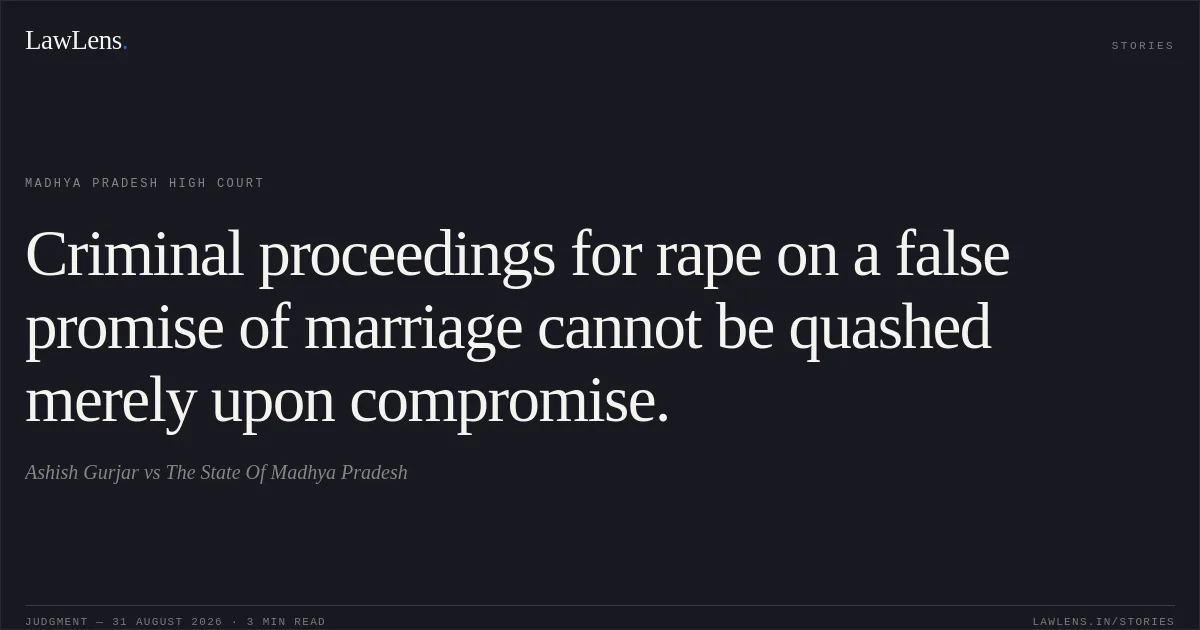
Whether the High Court should exercise its inherent jurisdiction under Section 528 of the BNSS to quash the FIR and consequential criminal proceedings on the basis of a compromise between the accused and the prosecutrix.
Source reference: para. 1Whether the alleged offences arising from physical relations obtained on a false promise of marriage, coupled with alleged threats, were of such a heinous and serious nature that they could not appropriately be quashed merely because the parties had settled the dispute.
Source reference: para. 11Law Applied
Section 528 of the BNSS preserves the High Court’s inherent power to quash criminal proceedings to secure the ends of justice or prevent abuse of process.
Source reference: para. 1Relying on Gian Singh v. State of Punjab, (2012) 10 SCC 303, the Court held that the power to quash is distinct from statutory compounding under Section 320 CrPC and, although broad, must be exercised having regard to the nature and gravity of the offence; heinous offences such as rape ordinarily cannot be quashed merely on the basis of compromise, whereas offences possessing an overwhelmingly private or civil character may be quashed where the possibility of conviction is remote and continuation of proceedings would cause injustice.
Source reference: para. 9The Court further relied on Narinder Singh v. State of Punjab, (2014) 6 SCC 466, and State of M.P. v. Madanlal, (2015) 7 SCC 681, applying the principle that prosecution for rape or attempted rape should not generally be terminated on the basis of settlement.
Source reference: para. 10The principles reiterated from Shimbhu v. State of Haryana, (2014) 13 SCC 318, emphasize that rape is an offence against society and that compromise, including a proposed marriage, cannot ordinarily constitute a basis for leniency or quashing.
Source reference: para. 10Reasoning
Although the compromise was verified as voluntary and supported by affidavits, the Court assessed the substance and gravity of the allegations rather than treating settlement as determinative.
Source reference: paras. 3–4The allegations indicated that the petitioner obtained physical relations by representing that he was unmarried and intended to marry the prosecutrix, while he was allegedly already married and had two children; he also allegedly threatened her and her parents when she sought recourse to law.
Source reference: para. 2Applying Gian Singh, Narinder Singh, and Madanlal, the Court held that the case did not have a predominantly private or civil character.
Source reference: para. 11In view of the seriousness of the allegations, the possibility of conviction could not be considered remote or bleak, and the possibility that the compromise resulted from pressure, inducement, or compulsion could not be excluded.
Source reference: para. 11Consequently, continuation of the prosecution was not regarded as an abuse of process warranting exercise of inherent jurisdiction.
Source reference: para. 11Holding
The Court answered the issues against the petitioner and declined to quash the FIR or the consequential proceedings under Section 528 of the BNSS.
It held that the alleged rape on the false promise of marriage and accompanying threats constituted serious and heinous conduct for which a compromise could not justify quashing.
Source reference: para. 11The petition was dismissed, and all pending interlocutory applications, if any, were disposed of.
Source reference: paras. 12–13Acts & Sections Cited
5 provisions across 4 statutes referred to in this judgment. Each provision opens on LawLens.
Bharatiya Nagarik Suraksha Sanhita, 20231
Bharatiya Nyaya Sanhita, 20232
Code of Criminal Procedure, 19731
Indian Penal Code, 18601
Original Court PDF
Ashish GurjarvsThe State Of Madhya Pradesh
Click to open original judgment
Original judgment, available to read, download and summarize on LawLens.in