Facts
The complainant alleged that, while he was sitting at his door, the petitioners abused him, caught hold of his collar, assaulted him pursuant to petitioner no. 1 allegedly directing his sons to kill him, and thereafter forcibly entered his house and committed theft of cash, documents, a mobile phone, gold ornaments and a passbook
Source reference: p. 2, para. 3After an inquiry under Section 202 of the Code of Criminal Procedure, the Magistrate took cognizance of offences under Sections 323, 504 and 379 of the Indian Penal Code by order dated 15 January 2019
Source reference: p. 2, paras. 2, 4The petitioners sought quashing of the cognizance order, contending that the parties were related agnates and that the criminal case arose from a long-standing property dispute involving a pending partition suit, mutation proceedings, mutation revision and proceedings under Section 144 of the Code of Criminal Procedure
Source reference: pp. 3–4, paras. 5–6Issues
Whether the cognizance order under Sections 323, 504 and 379 of the Indian Penal Code could be quashed where the complaint arose against the backdrop of a long-standing civil property dispute between related parties?
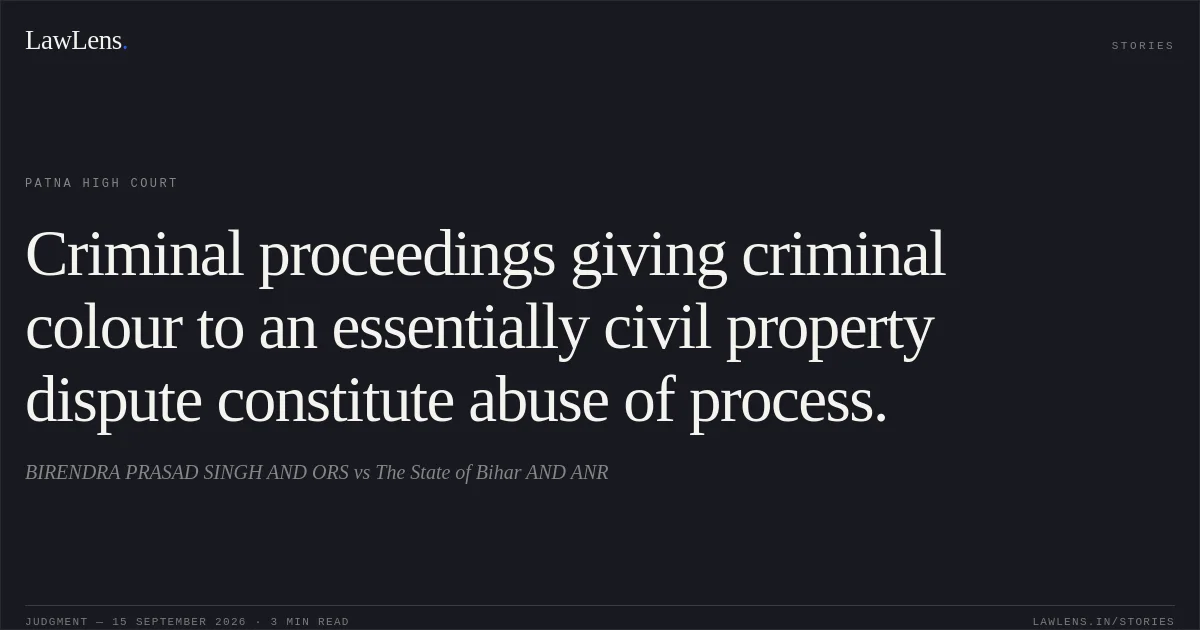
Source reference: pp. 2, 5–6, paras. 2, 9–11Whether continuation of the criminal proceeding would amount to an abuse of the process of the Court because the allegations of assault, abuse and theft allegedly gave a criminal colour to an essentially civil dispute?
Source reference: pp. 5–6, paras. 10–11Law Applied
The Court considered the offences under Sections 323, 504 and 379 of the Indian Penal Code, concerning voluntarily causing hurt, intentional insult and theft, respectively
Source reference: p. 2, para. 2The Court also considered the procedural inquiry under Section 202 of the Code of Criminal Procedure preceding issuance of process
Source reference: p. 2, para. 4The Court applied the principle governing the High Court’s inherent jurisdiction to prevent abuse of the process of law, holding that the mere existence of a civil dispute does not automatically justify quashing a criminal case where the allegations independently disclose an offence; however, criminal proceedings may be quashed where the allegations are found to be a device to give a criminal colour to an essentially civil dispute or to exert pressure in relation to property rights
Source reference: p. 5, para. 10The Court relied on Rikhab Birani & Anr. v. State of Uttar Pradesh & Anr., 2025 SCC OnLine SC 823, which reiterates that criminal proceedings should not be used as a means of settling or exerting pressure in disputes that are essentially civil in nature
Source reference: p. 6, para. 10Reasoning
The Court observed that the parties were closely related agnates and that several civil and preventive proceedings concerning their competing property rights were pending, including a partition suit, mutation proceedings, mutation revision and a proceeding under Section 144 of the Code of Criminal Procedure
Source reference: pp. 3–5, paras. 5, 9Although the complaint alleged assault, abuse and theft, the Court assessed those allegations in the context of the continuing property dispute. It concluded that, in the circumstances, the allegations appeared to have been introduced to cloak the property dispute with criminality and exert pressure on the petitioners. Applying the principle in Rikhab Birani, the Court held that continuation of the prosecution would constitute an abuse of the process of the Court
Source reference: pp. 5–6, paras. 9–11Holding
The High Court held that the criminal proceeding had been initiated by giving a criminal colour to an essentially civil dispute between the parties
It accordingly set aside and quashed the cognizance order dated 15 January 2019 in Trial/Complaint Case No. 1670 of 2019 arising from Complaint Case Registration No. 278 of 2017, together with all consequential proceedings, insofar as they related to the petitioners
Source reference: pp. 6–7, para. 12The petition was allowed, and a copy of the judgment was directed to be transmitted to the trial court with the lower-court record, if any
Source reference: p. 7, paras. 13–14Acts & Sections Cited
5 provisions across 2 statutes referred to in this judgment. Each provision opens on LawLens.
Indian Penal Code, 18603
Code of Criminal Procedure, 19732
Original Court PDF
BIRENDRA PRASAD SINGH AND ORSvsThe State of Bihar AND ANR
Click to open original judgment
Original judgment, available to read, download and summarize on LawLens.in