Facts
The petitioners sought to quash the FIR and criminal proceedings in Chirkunda (Panchet) P.S. Case No. 289 of 2024, registered under Sections 127(1), 115(2), 117(2), 109, 303(2) and 3(5) of the Bharatiya Nyaya Sanhita, 2023, and Sections 3(1)(r) and 3(1)(s) of the Scheduled Castes and Scheduled Tribes (Prevention of Atrocities) Act, 1989.
Source reference: p.2At the time of the petition, investigation was ongoing and no charge-sheet had been filed.
Source reference: p.2The petitioners, informant and injured victim had entered into an amicable compromise, supported by affidavits; the informant and victim did not wish to pursue the case.
Source reference: pp.2–3The State did not oppose the quashing petition.
Source reference: p.3Issues
1. Whether the High Court should exercise its inherent jurisdiction under Section 528 of the Bharatiya Nagarik Suraksha Sanhita, 2023, to quash the criminal proceedings on the basis of the parties’ compromise.
Source reference: pp.2–3, 72. Whether, in light of the nature and stage of the case, continuation of the proceedings would amount to an abuse of process or cause injustice to the petitioners.
Source reference: pp.6–7Law Applied
Section 528 of the Bharatiya Nagarik Suraksha Sanhita, 2023, was invoked as the source of the High Court’s inherent jurisdiction to prevent abuse of process and secure the ends of justice.
Source reference: p.2Relying on Narinder Singh v. State of Punjab, (2014) 6 SCC 466, the Court applied the principles that this power may be used to quash even non-compoundable offences following settlement, but must be exercised sparingly; the Court should consider the nature and gravity of the offence, whether conviction is remote, the prejudice caused by continuation, and the stage of the proceedings.
Source reference: pp.3–6Serious offences affecting society generally should not be quashed merely because the parties have settled; an early-stage settlement may, however, weigh in favour of quashing.
Source reference: pp.3–6Reasoning
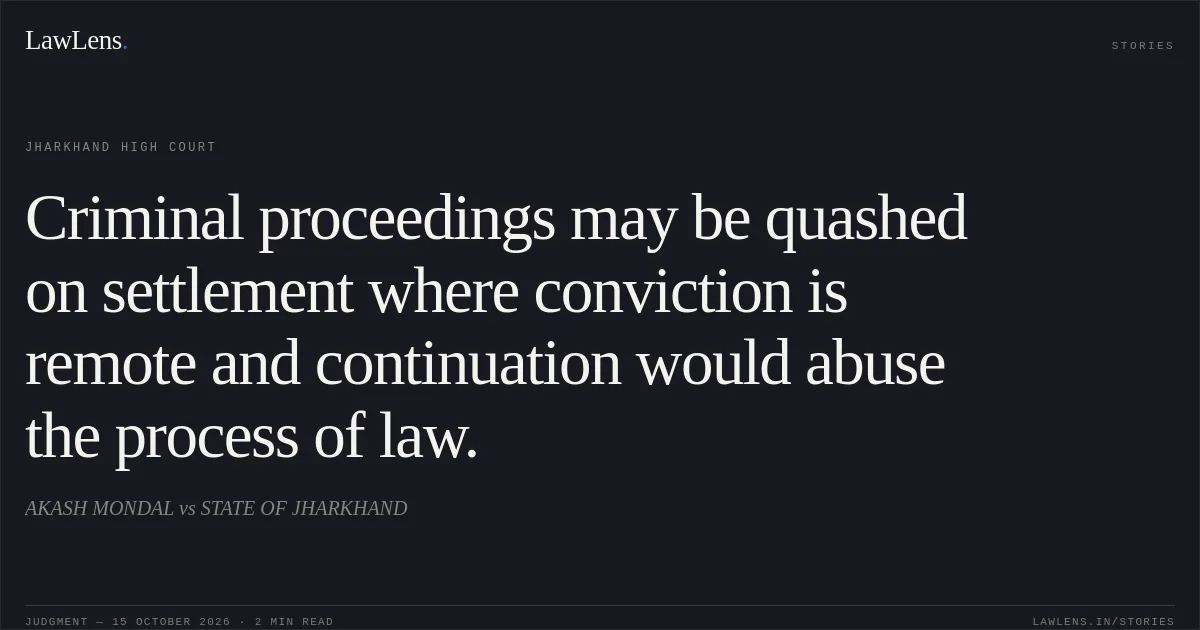
The Court considered that the case arose from a misunderstanding, the allegations were described as general and omnibus, and the parties had reached a voluntary compromise.
Source reference: pp.2–3, 6–7It also noted that the investigation remained ongoing, the charge-sheet had not been filed, and Section 109 of the BNS was not made out on the facts.
Source reference: pp.2–3, 6–7In those circumstances, the Court found the likelihood of conviction remote and bleak and concluded that continuing the proceedings would cause oppression and prejudice to the petitioners and constitute an abuse of process.
Source reference: p.7Holding
The Court allowed the petition and quashed the FIR and entire criminal proceedings in Chirkunda (Panchet) P.S. Case No. 289 of 2024 qua the petitioners only.
The connected interlocutory application was disposed of.
Source reference: pp.6–7Acts & Sections Cited
11 provisions across 5 statutes referred to in this judgment. Each provision opens on LawLens.
Bharatiya Nagarik Suraksha Sanhita, 20231
Bharatiya Nyaya Sanhita, 20236
Scheduled Castes and the Scheduled Tribes (Prevention of Atrocities) Act, 19891
Code of Criminal Procedure, 19732
Indian Penal Code, 18601
Original Court PDF
AKASH MONDALvsSTATE OF JHARKHAND
Click to open original judgment
Original judgment, available to read, download and summarize on LawLens.in