01Facts
Respondent No. 2 (GPA holder of the owner of Sy. No. 19, Mailsandra Village, Kengeri Hobli) alleged that the Society, BEML Employees Co-operative Housing Society Ltd., had agreed to leave 39 guntas for a road on the property.
¶ 2A road was later formed without his consent, and the BBMP has since taken it over and maintains it.
¶ 2On 28.10.2014, the petitioner and associates allegedly entered the property claiming to be Society officers, damaged the barbed fencing, threatened respondent No. 2, and formed a road for access to the main road.
¶ 2That complaint was registered as Crime No. 311/2014.
¶ 8Respondent No. 2 lodged a second complaint alleging that on 28.01.2015 the petitioner and others cut the fence, formed a road using a JCB, and stole six fence poles and barbed wire.
¶ 3Police registered Crime No. 33/2015, filed a charge sheet against the petitioner as accused No. 2 under Sections 143, 447 and 427 read with Section 149 IPC, and the Magistrate took cognizance.
¶ 3 · p. 5The petitioner sought quashing under Section 482 CrPC of C.C. No. 12471/2015.
¶ 1The HCGP opposed, relying on witness statements that the petitioner trespassed and removed wires and poles.
¶ 602Issues
i.1. Whether the dispute between the parties is essentially civil in nature, such that continuing criminal proceedings amounts to abuse of process.
¶ 8 · ¶ 11ii.2. Whether the allegations in the complaint and charge sheet, taken at face value, disclose the essential ingredients of offences under Sections 143, 447 and 427 read with Section 149 IPC against the petitioner.
¶ 9 · ¶ 11iii.3. Whether the second complaint was lodged with ulterior motive to give a criminal colour to a civil dispute, warranting quashing under Section 482 CrPC.
¶ 8 · ¶ 1103Law Applied
The Court relied on Section 427 IPC, whose ingredients it held were not attracted on the facts.
¶ 9Criminal process cannot be used as a weapon of harassment in civil property disputes, and inherent jurisdiction under Section 482 CrPC must be exercised where a dispute is predominantly civil, the allegations do not disclose the essential ingredients, or proceedings are mala fide, as laid down in Bikku Bhai Govinda Bhai v. State of Gujarat (SLP (Crl) No. 15537/2023, dated 22.05.2026).
¶ 9The categories in State of Haryana v. Bhajan Lal (AIR 1992 SC 604), including no prima facie case, absurd or improbable allegations, and mala fide or vengeful proceedings, were reaffirmed in Mohammed Ali v. State of U.P. (2023) 15 SCC 488.
¶ 10Where proceedings are frivolous or vexatious, the court may look beyond the averments to the surrounding circumstances, including multiple FIRs.
¶ 10Quashing is permitted where continuation amounts to abuse of process or where the complaint discloses no offence on accepted facts, as held in State of A.P. v. Golconda Linga Swamy, (2004) 6 SCC 522.
¶ 10Provisions in the judgment · 7 · Linked ones open on LawLens
Indian Penal Code, 1860 Section 143Section 149Section 427Section 447
Code of Criminal Procedure, 1973 Section 155Section 156Section 482
04Reasoning
The Court first treated the dispute as civil, noting that respondent No. 2 admitted in his own complaint that the owner had executed an agreement with the Society for the road, and that the road was formed and is now maintained by the BBMP.
¶ 8The Court held that the earlier 2014 complaint and the 2015 complaint rested on similar allegations concerning the same road, and that the road was used by the petitioner and the public, and therefore the second complaint was a repetition intended to convert a civil grievance into criminal proceedings.
¶ 8 · ¶ 9Applying the Section 427 IPC ingredients, the Court concluded that the offence was not made out on the allegations.
¶ 9Relying on Bhajan Lal and Mohammed Ali, the Court found that even accepting the complaint and charge sheet at face value, no prima facie case existed against the petitioner, and that the complaint was lodged out of vengeance to give a criminal colour to a civil dispute.
¶ 11Because the petitioner's contentions on the civil character of the dispute were supported by the complainant's own averments, the Court did not need to weigh contested evidence.
¶ 5, 805Holding
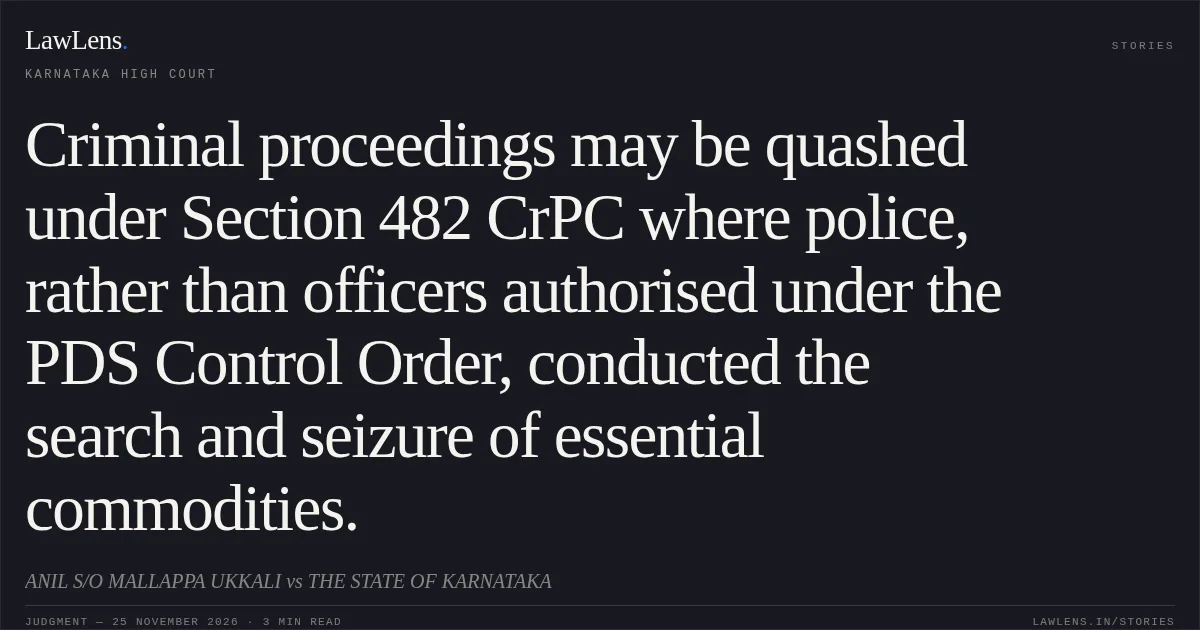
The Court held that the dispute is purely civil and that the second complaint was filed out of vengeance, so continuing C.C. No. 12471/2015 is an abuse of process.
¶ 11The petition is allowed, and the proceedings against the petitioner (accused No. 2) in C.C. No. 12471/2015, arising out of Crime No. 33/2015 under Sections 143, 447 and 427 read with Section 149 IPC, before the XLVI Addl. Chief Metropolitan Magistrate, Bengaluru, are quashed.
¶ 11 · order · p. 15Original Court PDF
AMASA BHUPATHI RAO @ BHUPATHI RAOvsSTATE OF KARNATAKA
Click to open original judgment
Original judgment, available to read, download and summarize on LawLens.in