Facts
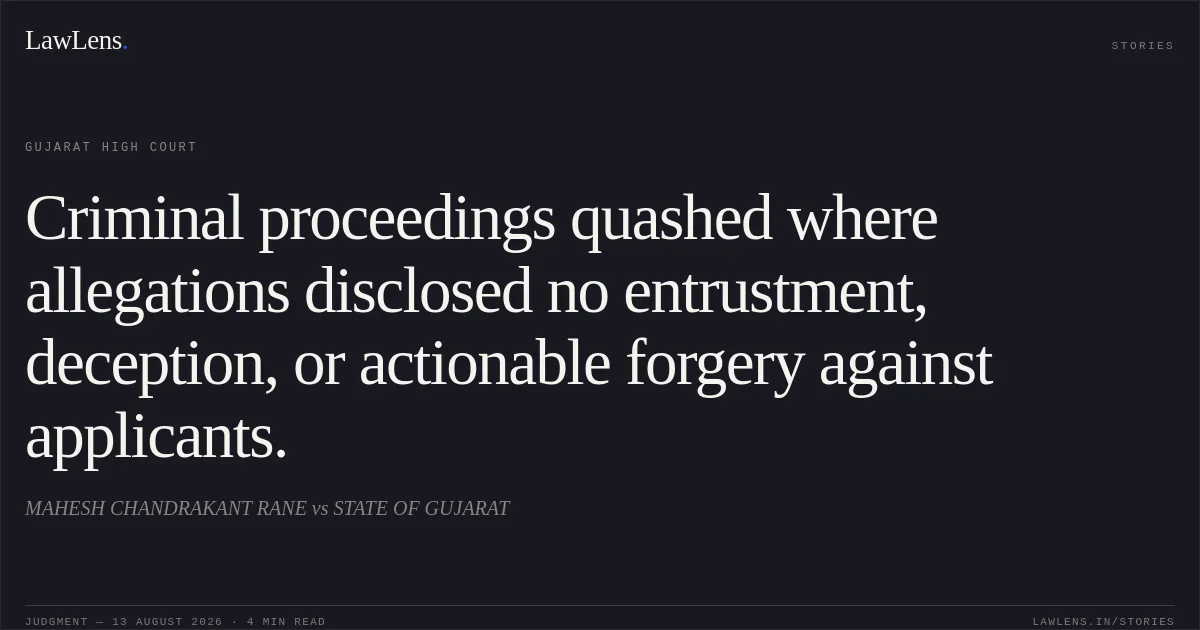
The complainant, Ashwinbhai Laxmanbhai Pethani, alleged that stamp papers purchased in his name and in the name of Giriraj Industries were used to create forged lease agreements concerning godowns where cotton pledged to HDFC Bank was stored.
Source reference: p.2–5He alleged that the documents contained forged signatures and were produced before the Gujarat High Court and the Manavadar Civil Court as genuine documents by officers of HDFC Bank, NCMSL, and other persons.
Source reference: p.2–5The allegations arose in the background of HDFC Bank’s recovery and auction proceedings concerning pledged cotton bales, following borrowers’ default and partial release of goods after payment of approximately Rs.2.75 crores.
Source reference: p.8–10The applicants—Mahesh Chandrakant Rane, an authorised officer of HDFC Bank, and Neelesh Dhalani, who allegedly purchased stamp papers and signed as a witness—sought quashing of FIR C.R. No. I-10 of 2017 registered at Manavadar Police Station for offences under Sections 406, 409, 420, 423, 465, 466, 467, 468, 471 and 472 of the IPC under Section 482 CrPC.
Source reference: para. 2–3Issues
Whether the allegations in the FIR disclosed the ingredients of criminal breach of trust under Section 406 IPC or cheating under Section 420 IPC against the applicants, particularly when the relevant lease arrangement was between the complainant and NCMSL rather than HDFC Bank or its officers.
Source reference: p.14–19; para. 9–10Whether the alleged lease agreements and stamp papers constituted forged documents attracting Sections 423, 465, 466, 467, 468, 471 or 472 IPC against the applicants.
Source reference: p.19–23; para. 11–18Whether continuation of the FIR and consequential criminal proceedings against the applicants amounted to an abuse of the process of law warranting exercise of the High Court’s inherent jurisdiction under Section 482 CrPC.
Source reference: para. 19Law Applied
The Court exercised its inherent jurisdiction under Section 482 CrPC to prevent abuse of process and relied on the principles governing quashing of criminal proceedings stated in State of Haryana v. Bhajan Lal, 1992 Supp (1) SCC 335.
Source reference: para. 6For Sections 406 and 420 IPC, it relied on Delhi Race Club (1940) Ltd. v. State of Uttar Pradesh, (2024) 10 SCC 690, which reiterated from S.W. Palanitkar v. State of Bihar, (2002) 1 SCC 241, that criminal breach of trust requires entrustment or dominion over property followed by dishonest misappropriation or use in violation of law or contract, whereas cheating requires deception, fraudulent or dishonest inducement, and resulting delivery, retention, or harmful omission; dishonest intention in cheating must exist from the inception.
Source reference: p.14–18The Court further applied Sections 463 and 465 IPC, requiring the making of a false document with the specified fraudulent or injurious intent; Section 466 IPC, concerning forgery of court records or public documents; Section 467 IPC, concerning forgery of valuable securities, wills and specified instruments; Section 468 IPC, concerning forgery for the purpose of cheating; Section 471 IPC, concerning use of a forged document as genuine; and Section 472 IPC, concerning counterfeit seals made or possessed for committing forgery punishable under Section 467 IPC.
Source reference: p.20–23Reasoning
The Court held that no entrustment of property by the complainant to HDFC Bank or its officers was shown; the alleged contractual relationship was between the complainant and NCMSL, which acted as the Bank’s collateral manager. Consequently, the essential element of entrustment under Section 406 IPC was absent.
Source reference: para. 9Section 420 IPC was also not made out because the complainant had released goods pursuant to the Bank’s release orders without contemporaneous objection, thereby undermining the allegation that he had been deceived or fraudulently induced by the applicants.
Source reference: para. 10The Court considered the dispute to be connected with commercial transactions and the subsequent auction, observing that the complainant challenged the documents only after the auction proceedings commenced.
Source reference: p.19–23; para. 11, 16–17It further found that Section 423 was inapplicable because no qualifying transfer of property or creation of charge was alleged; Sections 466 and 467 were inapplicable because the disputed lease agreement was neither a court record, public register, valuable security, will, nor any other specified instrument.
Source reference: para. 11, 13–15Since the foundational offence of forgery and the purpose of cheating were not established prima facie, Sections 468, 471 and 472 also could not be sustained.
Source reference: para. 16–18The separate Master Collateral Management Agreement between HDFC Bank and NCMSL did not establish the applicants’ involvement in the alleged agreement between NCMSL and the complainant, making continuation of the prosecution an abuse of process.
Source reference: para. 19Holding
The Court answered the issues in favour of the applicants. It held that the FIR did not prima facie disclose the ingredients of criminal breach of trust, cheating, or the alleged forgery-related offences against Mahesh Chandrakant Rane and Neelesh Dhalani.
The applications were allowed, and FIR C.R. No. I-10 of 2017 registered with Manavadar Police Station, District Junagadh, was quashed and set aside qua the applicants.
Source reference: para. 21–22All consequential proceedings were likewise quashed qua them, and the rule was made absolute.
Source reference: para. 21–22Acts & Sections Cited
16 provisions across 2 statutes referred to in this judgment. Each provision opens on LawLens.
Code of Criminal Procedure, 19732
Original Court PDF
MAHESH CHANDRAKANT RANEvsSTATE OF GUJARAT
Click to open original judgment
Original judgment, available to read, download and summarize on LawLens.in