Facts
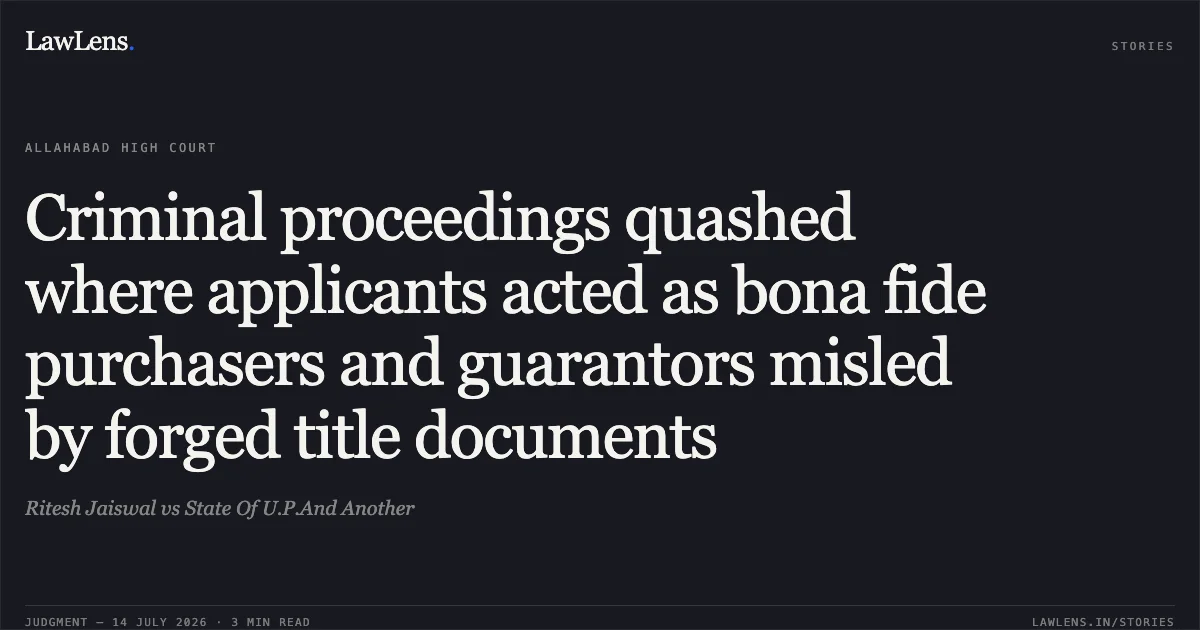
The applicant, Ritesh Jaiswal, sought to quash a chargesheet filed under Sections 420, 467, 468, and 471 of the IPC.
Source reference: para. 1The prosecution alleged that the applicant’s parents (Vinod and Aarti Jaiswal) attempted to obtain a loan of ₹10 lakhs from the State Bank of Patiala using forged land documents belonging to deceased persons (Moolchand and others).
Source reference: para. 2, 20The applicant was named as a guarantor in the loan application.
Source reference: para. 13, 20An individual named Vikram Asthana claimed to be the power-of-attorney holder for the deceased Moolchand and entered into an agreement to sell with Aarti Jaiswal.
Source reference: para. 6, 22When the bank manager conducted a site visit, he discovered the original owners had died in 1990 and their heirs had not authorized any sale.
Source reference: para. 20-21A co-accused, Thakurji, allegedly impersonated the deceased Moolchand at the bank.
Source reference: para. 21, 36Issues
1. Whether the allegations in the FIR and evidence collected prima facie constitute an offence against the applicant under Sections 420, 467, 468, and 471 of the IPC.
Source reference: para. 4, 392. Whether the applicant can be held liable for forgery and cheating when he was a proposed guarantor and allegedly acted under a bona fide belief in the genuineness of documents provided by a third party.
Source reference: para. 32-35Law Applied
The Court applied Section 482 of the CrPC regarding inherent powers to prevent abuse of process, citing State of Haryana v. Bhajan Lal.
Source reference: para. 30For forgery (Sections 463, 464, 467 IPC), it relied on Sheila Sebastian v. R. Jawaharaj, holding that a person cannot be charged with forgery unless they are the "maker" of the false document.
Source reference: para. 29For cheating (Section 420 IPC), it applied principles from Mariam Fasihuddin v. State, requiring the existence of fraudulent or dishonest intention (mens rea) from the inception of the transaction.
Source reference: para. 31The Court noted that mere execution of a deed by a person without title does not constitute forgery unless there is impersonation or unauthorized execution on behalf of another.
Source reference: para. 29Reasoning
The Court found that the primary perpetrator of the fraud was Vikram Asthana, who fabricated a power-of-attorney from a man deceased for 17 years.
Source reference: para. 33, 39The applicant and his parents were deemed to be "befooled" by Asthana, as evidenced by the fact that they paid an advance of ₹50,000 and sought a bank loan which would have resulted in no valid title being transferred to them.
Source reference: para. 33Crucially, the bank’s own advocate, Shri Ashutosh Garga, had vetted the documents and certified them as genuine in a legal opinion, failing to detect the forgery himself.
Source reference: para. 26, 34The Court reasoned that if a legal professional could not detect the fabrication, a layman borrower/guarantor cannot be attributed with criminal intent.
Source reference: para. 34-35As the applicant did not sign the forged family settlement and did not impersonate anyone, the essential ingredients of forgery and cheating were missing.
Source reference: para. 36-39Holding
The continuation of proceedings would be an abuse of process as no prima facie case was established against the applicant.
The Court allowed the application and quashed the chargesheet against Ritesh Jaiswal.
Source reference: para. 40The trial court was directed to proceed against the remaining surviving accused.
Source reference: para. 41The Court granted the applicant’s mother (Aarti Jaiswal) liberty to move a discharge application, noting her case stood on the same footing.
Source reference: para. 42Acts & Sections Cited
11 provisions across 2 statutes referred to in this judgment. Each provision opens on LawLens.
Code of Criminal Procedure, 19732
Original Court PDF
Ritesh JaiswalvsState Of U.P.And Another
Click to open original judgment
Original judgment, available to read, download and summarize on LawLens.in