Facts
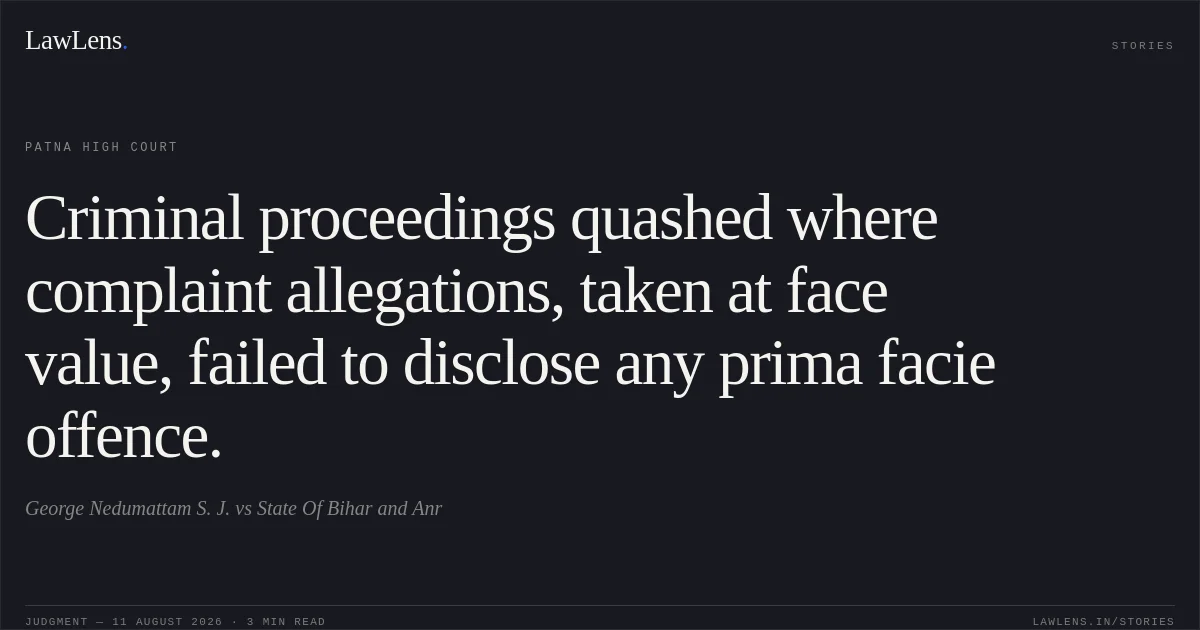
The petitioner challenged the order dated 3 May 2018 by which the Chief Judicial Magistrate, Bettiah, took cognizance against him under Sections 341, 323, 420, 406, 504, 295 and 298 of the Indian Penal Code and directed issuance of summons in Complaint Case No. 560(C) of 2018.
Source reference: p.1, para. 2The complainant, an advocate, alleged that the petitioner, stated to be the Principal of a school, demanded and accepted a donation of ₹1 lakh for admission of the complainant’s son to Class VI without issuing a receipt.
Source reference: p.2, para. 3It was further alleged that, when the complainant and his son returned with a recommendation letter, the petitioner abused them on religious grounds, demanded that they remove the “red chandan” and convert to Christianity, threatened forfeiture of the money, and assaulted the complainant with a pen.
Source reference: p.2, para. 3The petitioner denied the allegations, asserting that no seat was available, the child did not satisfy the admission criteria, no money had been demanded or received, and the prosecution was malicious and intended to settle a personal dispute.
Source reference: pp.2–3, paras. 4–4.2He also relied on a compromise petition filed by the complainant under Section 320 Cr.P.C., as well as an inquiry witness’s statement acknowledging that the parties had compromised.
Source reference: pp.3–5, paras. 4–4.2The complainant and the State opposed quashing, contending that a prima facie case was disclosed and that a mini-trial could not be conducted at the cognizance stage.
Source reference: p.6, para. 5Issues
Whether the allegations in the complaint, solemn affirmation and inquiry-witness statements prima facie disclosed the offences under Sections 341, 323, 420, 406, 504, 295 and 298 IPC against the petitioner?
Source reference: p.6, para. 7Whether the High Court should exercise its inherent jurisdiction under Section 482 Cr.P.C. to quash the cognizance order where the proceedings appeared unsupported by the record, malicious, and followed by a compromise between the parties?
Source reference: pp.3–5, paras. 4.1–4.3; p.6, para. 7Law Applied
The Court considered the inherent jurisdiction under Section 482 Cr.P.C., which may be exercised to prevent abuse of the process of court and secure the ends of justice.
Source reference: pp.4–5, paras. 4.1–4.3It applied the principles in State of Haryana v. Bhajan Lal, 1992 Supp (1) SCC 335, particularly the categories permitting quashing where the allegations, even if accepted in their entirety, do not constitute an offence, or where the proceeding is manifestly attended with mala fides and instituted to wreak private vengeance.
Source reference: pp.4–5, paras. 4.1–4.3The Court also referred to Murari Lal Gupta v. Gopi Singh, (2005) 13 SCC 699 and Nagawwa v. V.S. Konjalgi, (1976) 3 SCC 736, concerning interference where uncontroverted allegations do not constitute an offence, and Zandu Pharmaceutical Works Ltd. v. Mohd. Sharaful Haque, (2005) 1 SCC 122, on quashing proceedings initiated as a counterblast or for harassment.
Source reference: pp.4–5, paras. 4.1–4.2The Court further took note of the compromise application under Section 320 Cr.P.C.
Source reference: p.3, para. 4Reasoning
Although the complainant alleged specific acts of cheating, breach of trust, assault and religious abuse, the Court assessed the complaint and the materials supporting cognizance and found that they did not prima facie inspire confidence or disclose the ingredients of the alleged criminal offences.
Source reference: p.6, para. 7The dispute substantially arose from the petitioner’s refusal to admit the complainant’s son to the school. The subsequent compromise petition filed by the complainant, corroborated by an inquiry witness, further weakened the basis for continuing the prosecution.
Source reference: p.6, para. 7Applying the Bhajan Lal categories, the Court concluded that the allegations, even when taken on their face, did not establish a prima facie criminal case and that continuation of the proceedings would amount to abuse of process.
Source reference: p.6, para. 7The Court therefore found it unnecessary to conduct a mini-trial or undertake an extensive evaluation of the petitioner’s defence.
Source reference: pp.5–6, paras. 5–7Holding
The High Court answered the issues in favour of the petitioner. It held that the materials on record did not prima facie disclose the alleged offences and that continuation of the complaint proceedings was unjustified.
Accordingly, the cognizance order dated 3 May 2018 passed by the Chief Judicial Magistrate, Bettiah, in Complaint Case No. 560(C) of 2018 was quashed, and the criminal miscellaneous application was allowed.
Source reference: p.7, paras. 8–9Acts & Sections Cited
9 provisions across 2 statutes referred to in this judgment. Each provision opens on LawLens.
Indian Penal Code, 18607
Code of Criminal Procedure, 19732
Original Court PDF
George Nedumattam S. J.vsState Of Bihar and Anr
Click to open original judgment
Original judgment, available to read, download and summarize on LawLens.in