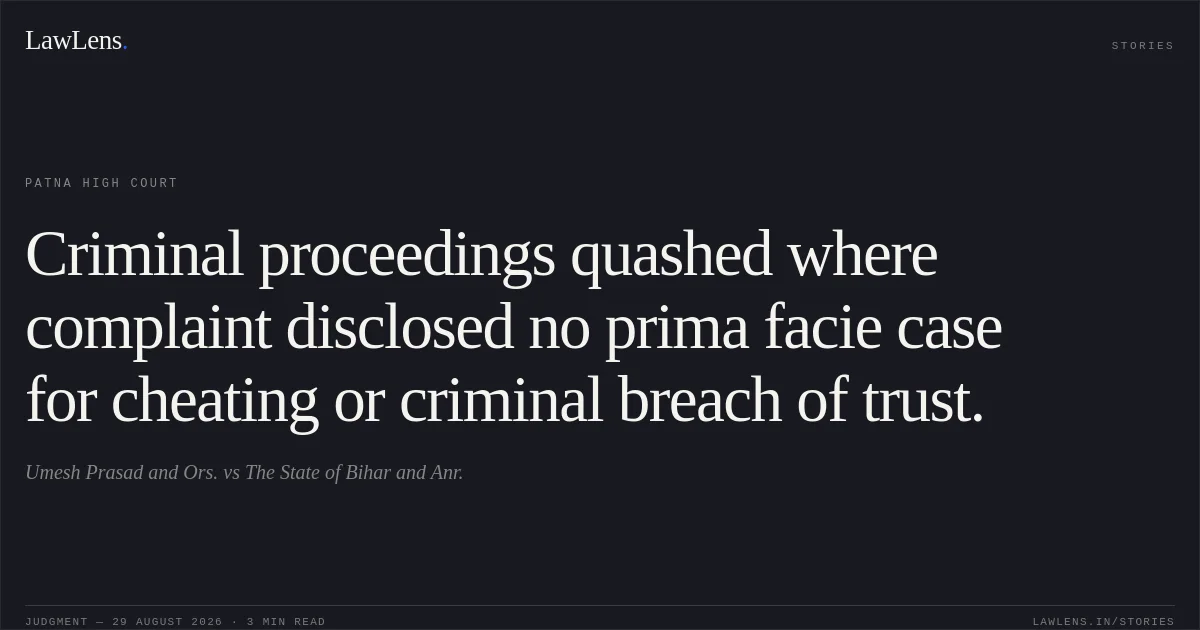
Facts
The complainant, Dinesh Kumar, alleged that he entered into a land transaction after coming into contact with Shambhu Narayan Rai, the alleged landowner, and co-accused Prakash Kumar and Sanjay Kumar, who acted as intermediaries. He allegedly paid an advance of ₹9 lakhs, but the land transaction was not completed, leading to allegations of cheating and criminal breach of trust.
Source reference: p.2, para. 3The complaint also contained allegations that the present petitioners assaulted the complainant, snatched his wristwatch, and took ₹3,000 from his pocket.
Source reference: p.2, para. 5After considering the complainant’s solemn affirmation and the statements of the inquiry witnesses, the learned A.C.J.M., Patna, took cognizance on 4 August 2017 of offences under Sections 406 and 420 of the Indian Penal Code against the petitioners and other accused persons.
Source reference: p.2, para. 4The petitioners approached the High Court under its inherent jurisdiction seeking quashing of the cognizance order and consequential proceedings. Petitioner Nos. 2 and 3 were the sons of co-accused Shambhu Narayan Rai, who was alleged to have executed the agreement.
Source reference: p.3, para. 6Issues
Whether the allegations in the complaint, even if accepted at face value, disclosed the commission of offences under Sections 406 and 420 IPC against the petitioners?
Source reference: pp.2–3, paras. 5–6Whether continuation of the criminal proceedings against the petitioners amounted to an abuse of the process of law, warranting exercise of the High Court’s inherent jurisdiction to quash the cognizance order?
Source reference: pp.3–6, paras. 6, 8Whether the petitioners’ implication, particularly that of Petitioner Nos. 2 and 3, was prima facie motivated by an oblique or mala fide purpose because of their relationship with the principal accused?
Source reference: p.6, para. 8Law Applied
The Court considered Sections 406 and 420 IPC, concerning criminal breach of trust and cheating, respectively. It applied the principles governing the High Court’s inherent power to prevent abuse of process and secure the ends of justice under Section 482 of the Code of Criminal Procedure.
Source reference: pp.3–5, para. 7The Court relied on State of Haryana v. Bhajan Lal, 1992 Supp. (1) SCC 335, particularly categories (1), (3), and (7) of paragraph 102: quashing is justified where allegations, even if accepted in their entirety, do not prima facie constitute an offence; where the uncontroverted allegations and supporting material do not disclose commission of an offence; or where the proceeding is manifestly mala fide and instituted with an ulterior motive.
Source reference: pp.3–5, para. 7The Court also noted that the Magistrate had not taken cognizance of the alleged offences under Sections 323 and 379 IPC.
Source reference: p.6, para. 8Reasoning
The Court found that the allegations concerning the land transaction and cheating were directed principally against co-accused Shambhu Narayan Rai, who was alleged to be the person responsible for executing the agreement.
Source reference: pp.2–3, paras. 5–6The material allegations against the petitioners related primarily to the alleged assault and snatching, but the Magistrate had not found sufficient grounds to take cognizance under Sections 323 and 379 IPC.
Source reference: pp.2–3, paras. 5–6In the Court’s view, the complaint did not disclose the necessary factual basis for offences under Sections 406 or 420 IPC against the petitioners.
Source reference: pp.2–3, paras. 5–6The implication of Petitioner Nos. 2 and 3 appeared prima facie connected with their status as the sons of Shambhu Narayan Rai and was considered to reflect an oblique motive to implicate and harass them.
Source reference: p.6, para. 8Applying the Bhajan Lal categories relating to absence of a prima facie offence, lack of supporting material, and mala fide institution, the Court held that continuation of the proceedings would amount to abuse of the process of law.
Source reference: p.6, para. 8Holding
The High Court answered the issues in favour of the petitioners. It held that the complaint and supporting material did not prima facie establish offences under Sections 406 and 420 IPC against them and that their continued prosecution was an abuse of the process of court.
Accordingly, the cognizance order dated 4 August 2017 passed by the learned A.C.J.M., Patna, in Complaint Case No. 1090(C) of 2017, together with all consequential proceedings against Umesh Prasad, Navneet Ranjan @ Navneet Kumar, and Ritesh Ranjan @ Ritesh Kumar, was quashed and set aside.
Source reference: p.6, paras. 8–10The petition was allowed, and the judgment was directed to be communicated to the trial court.
Source reference: p.6, paras. 8–10Acts & Sections Cited
7 provisions across 2 statutes referred to in this judgment. Each provision opens on LawLens.
Indian Penal Code, 18604
Code of Criminal Procedure, 19733
Original Court PDF
Umesh Prasad and Ors.vsThe State of Bihar and Anr.
Click to open original judgment
Original judgment, available to read, download and summarize on LawLens.in
![A police constable cannot be removed for unauthorized absence without a Rule 359-compliant inquiry.. Mohammad Sidiq Khan vs D/o Home Ut Of Jammu & Kashmir. CAT - ['Srinagar']. LawLens](/stories/thumbnails/a-police-constable-cannot-be-removed-for-unauthorized-absence-without-a-rule-359-compliant-7b43fc316bd94f22a62676153bbc9d54.webp)
![A Review DPC lacks authority to determine or alter inter se seniority.. SAURABH KUMAR vs REVENUE. CAT - ['Patna']. LawLens](/stories/thumbnails/a-review-dpc-lacks-authority-to-determine-or-alter-inter-se-seniority-4b21640f20af46fcabdfc8273d2ce959.webp)