Facts
The petitioner invoked the High Court’s inherent jurisdiction under Section 482 of the Code of Criminal Procedure, 1973, seeking quashing of FIR C.R. No. I-55 of 2016 registered at Rajula Police Station, Amreli, for offences under Sections 363 and 366 of the Indian Penal Code, 1860, and Section 18 of the POCSO Act.
Source reference: p.1The FIR alleged that the complainant’s daughter, Lalita, had left the family residence during the night and that the petitioner had taken or lured her away with an intention to marry her; the FIR described her as being 17 years old.
Source reference: p.1–2The petitioner relied on the victim’s affidavit stating that she had voluntarily left her parental home, subsequently married the petitioner after attaining majority, and had children from the marriage.
Source reference: p.2–3The victim’s advocate did not oppose quashing and did not dispute the marriage and children.
Source reference: p.3The Additional Public Prosecutor submitted that, according to the victim’s birth certificate, her date of birth was 4 April 1998 and that she was therefore above 18 years on the date of the alleged offence, 13 May 2016.
Source reference: p.3It was also submitted that the marriage was solemnised on 25 November 2017 and registered on 19 December 2017.
Source reference: p.3The complainant remained absent despite service.
Source reference: p.3–4Issues
Whether the FIR and consequential criminal proceedings alleging offences under Sections 363 and 366 IPC and Section 18 of the POCSO Act should be quashed in exercise of the High Court’s inherent jurisdiction under Section 482 CrPC, particularly when the victim was above 18 years of age on the date of the alleged offence.
Source reference: p.1, p.3–4Whether continuation of the prosecution would serve any useful purpose when the victim voluntarily accompanied the petitioner, later married him, had children with him, and the chances of conviction were considered bleak.
Source reference: p.2–4Law Applied
The Court applied Section 482 CrPC, which preserves the High Court’s inherent power to prevent abuse of the process of law and secure the ends of justice.
Source reference: no citationThe alleged substantive offences were under Sections 363 and 366 IPC, concerning kidnapping and kidnapping or abduction for purposes including marriage, and Section 18 of the POCSO Act.
Source reference: p.1The Court relied principally on Madhavrao Jiwaji Rao Scindia v. Sambhajirao Chandrojirao Angre, AIR 1988 SC 709, which holds that, while considering quashing at the initial stage, the Court must examine whether the uncontroverted allegations prima facie establish the offence and may also consider special circumstances showing that continuation of the prosecution would be inexpedient, particularly where the likelihood of conviction is bleak and no useful purpose would be served.
Source reference: p.4Reasoning
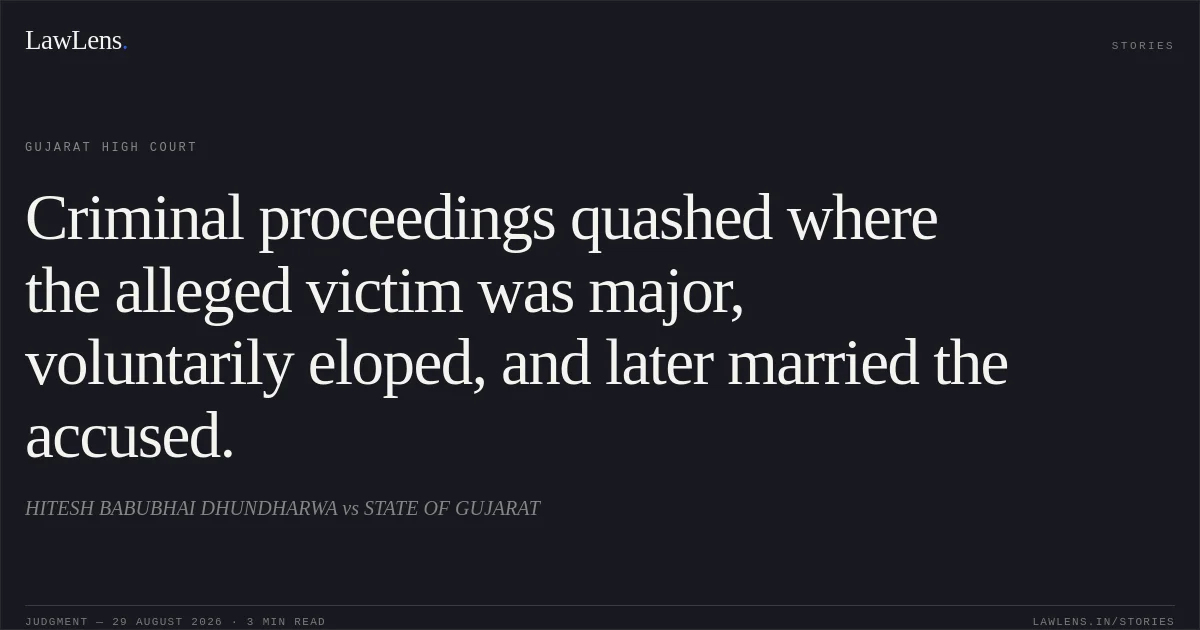
The Court found it undisputed, on the basis of the victim’s birth certificate, that she was more than 18 years old when the alleged incident occurred.
Source reference: p.3–4This materially undermined the allegation that she was a minor and weakened the statutory basis of the kidnapping and POCSO allegations.
Source reference: no citationThe Court further considered that the victim had voluntarily accompanied the petitioner, had married him, and that they had children from the wedlock.
Source reference: no citationSince the victim’s representative did not oppose quashing, the complainant was absent despite service, and the prosecution itself accepted the victim’s majority, the Court concluded that the possibility of conviction was bleak.
Source reference: p.3–4Applying the principle in Madhavrao Scindia, it held that allowing the prosecution to continue would not serve a useful purpose and would be contrary to the interests of justice.
Source reference: p.3–4Holding
The Court answered the issues in favour of the petitioner.
It allowed the petition and quashed and set aside FIR C.R. No. I-55 of 2016 dated 20 August 2016, registered at Rajula Police Station, Amreli, together with all consequential proceedings arising from it.
Source reference: p.5Rule was made absolute to that extent, and direct service was permitted.
Source reference: p.5Acts & Sections Cited
4 provisions across 3 statutes referred to in this judgment. Each provision opens on LawLens.
Code of Criminal Procedure, 19731
Indian Penal Code, 18602
Protection of Children from Sexual Offences Act, 20121
Original Court PDF
HITESH BABUBHAI DHUNDHARWAvsSTATE OF GUJARAT
Click to open original judgment
Original judgment, available to read, download and summarize on LawLens.in
![Courts will not interfere with transfers absent mala fides or violation of statutory rules.. M Ramya vs EMPLOYEES STATE INSURANCE CORPORATION (ESIC). CAT - ['Chennai']. LawLens](/stories/thumbnails/courts-will-not-interfere-with-transfers-absent-mala-fides-or-violation-of-statutory-rules-a6845e9ca6f548fca284c51c8351957f.webp)
![Courts cannot direct one-time recruitment age relaxation absent authority in the governing rules or advertisement.. UT OF PUDUCHERRY vs M ANDAL. CAT - ['Chennai']. LawLens](/stories/thumbnails/courts-cannot-direct-one-time-recruitment-age-relaxation-absent-authority-in-the-governing-895d78fde47143e2a8ed0207c4b6a44f.webp)
![A review cannot correct an allegedly erroneous decision absent an error apparent on the record.. Ajit Kumar Jha vs RAILWAY BOARD. CAT - ['Delhi']. LawLens](/stories/thumbnails/a-review-cannot-correct-an-allegedly-erroneous-decision-absent-an-error-apparent-on-the-re-8ac952fd4eba470c92f7da20af72a220.webp)