Facts
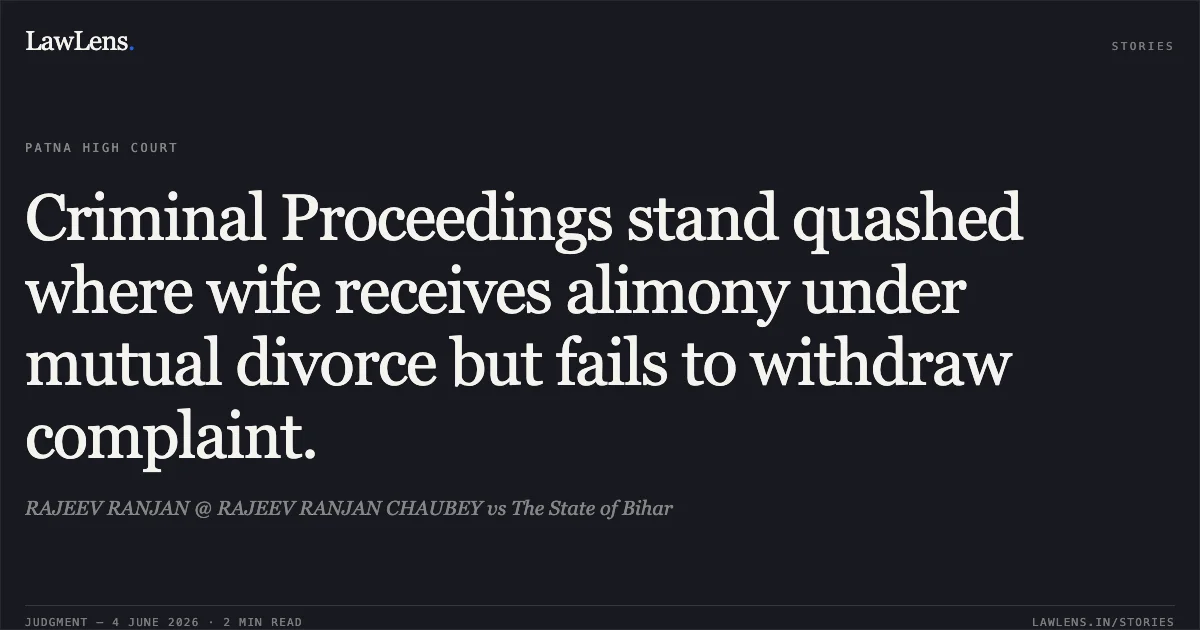
The complainant (O.P. No. 2) filed Complaint Case No. 573 of 2010 against her husband (the petitioner) and his family members alleging cruelty and dowry demands
Source reference: para. 2, 3On 09.07.2010, the Sub Divisional Judicial Magistrate, Gaya, took cognizance under Section 498A IPC and Sections 3 & 4 of the Dowry Prohibition Act
Source reference: para. 2On 05.02.2024, the Family Court at Patna granted a divorce by mutual consent, wherein the husband paid a settlement of Rs. 86 lakhs to the wife
Source reference: para. 4Despite receiving the amount and undertaking to assist in quashing the criminal case, the wife failed to appear before the High Court
Source reference: para. 4, 9Issues
1. Whether the criminal proceedings against the husband and his relatives should be quashed under Section 482 Cr.P.C. in light of a mutual divorce settlement and payment of alimony, where the complainant fails to honor her undertaking to withdraw the case.
Source reference: para. 9Law Applied
Section 482 of the Code of Criminal Procedure, 1973 (now Section 528 of the Bharatiya Nagarik Suraksha Sanhita, 2023) regarding the inherent power of the High Court to prevent abuse of the process of law
Source reference: para. 9Supreme Court precedents of Ruchi Agarwal vs. Amit Kumar Agrawal (2005) and Dhananjay Rathi vs. Ruchika Rathi (2024), which establish that once a party receives the benefits of a compromise (such as a divorce and alimony), they cannot resile from the obligation to withdraw related criminal proceedings
Source reference: para. 5, 7, 9Principle from Anurag Vijaykumar Goel vs. State of Maharashtra (2025) regarding the quashing of proceedings when a marriage has irretrievably broken down and allegations are vague
Source reference: para. 6Reasoning
The Court observed that the marriage between the parties was legally dissolved by mutual consent and a substantial financial settlement of Rs. 86 lakhs was paid and received through banking channels
Source reference: para. 9The Court reasoned that the petitioner had fulfilled his part of the compromise, whereas the complainant-wife, after securing the relief she sought, was intentionally absenting herself from the proceedings despite her previous undertaking
Source reference: para. 4, 9Following the rationale in Ruchi Agarwal, the Court found that allowing the criminal trial to continue after a full and final settlement would constitute a gross abuse of the judicial process and serve only to harass the petitioner
Source reference: para. 9The Court further noted that proceedings against the elderly parents had already abated due to their death
Source reference: para. 3Holding
The Court answered the issue in the affirmative and allowed the petition, quashing the order of cognizance dated 09.07.2010 and all subsequent proceedings in Complaint Case No. 573 of 2010
The relief was extended not only to the petitioner-husband but also to the sister-in-law and brother-in-law (Accused Nos. 4 and 5)
Source reference: para. 10The complainant was granted liberty to file a review petition if she possessed relevant information
Source reference: para. 11Acts & Sections Cited
7 provisions across 4 statutes referred to in this judgment. Each provision opens on LawLens.
Indian Penal Code, 18602
Code of Criminal Procedure, 19732
Bharatiya Nagarik Suraksha Sanhita, 20231
Original Court PDF
RAJEEV RANJAN @ RAJEEV RANJAN CHAUBEYvsThe State of Bihar
Click to open original judgment
Original judgment, available to read, download and summarize on LawLens.in