Facts
The petitioner sought quashing of the entire criminal proceedings, including the FIR in Kenduadih P.S. Case No. 37 of 2022, registered under Sections 341, 323, 379, 307 and 504/34 IPC and Section 27 of the Arms Act, pending before the Judicial Magistrate-I, Dhanbad, by invoking Section 528 of the Bharatiya Nagarik Suraksha Sanhita, 2023 (“BNSS”).
Source reference: para. 2At the time of hearing, investigation was continuing and no charge-sheet had been filed.
Source reference: para. 3The petitioner and the informant jointly submitted that, through the intervention of well-wishers and common friends, they had amicably settled the dispute; the petitioner claimed mistaken identity and asserted that he was not present at the place of occurrence.
Source reference: para. 4The informant stated that he no longer wished to pursue the case. The State raised no objection to quashing the proceedings in view of the compromise.
Source reference: para. 5Issues
Whether the High Court should exercise its inherent jurisdiction under Section 528 BNSS to quash the FIR and pending criminal proceedings on the basis of a settlement between the petitioner and the informant, notwithstanding the allegation under Section 307 IPC and Section 27 of the Arms Act?
Source reference: paras. 2, 6–9Whether continuation of the criminal proceedings, after the parties’ complete settlement and during the stage of investigation, would constitute an abuse of the process of law where the likelihood of conviction is remote and bleak?
Source reference: paras. 3–4, 8Law Applied
The Court applied Section 528 BNSS, 2023, which corresponds to Section 482 of the Code of Criminal Procedure and preserves the High Court’s inherent power to prevent abuse of process and secure the ends of justice.
Source reference: para. 6Relying on Narinder Singh v. State of Punjab, (2014) 6 SCC 466, the Court reiterated that inherent powers may be exercised to quash even non-compoundable offences after settlement, but only sparingly and with caution; offences that are heinous, involve mental depravity, or have a serious societal impact ordinarily should not be quashed merely on compromise.
Source reference: para. 6The Court further applied the principle that although Section 307 IPC is generally treated as a serious offence against society, the High Court may examine the nature of the injuries, the body part affected, the weapon used, the medical material, and the stage of the proceedings to determine whether the allegation under Section 307 IPC is substantial or merely formal.
Source reference: para. 6Settlement reached while investigation is still pending, before filing of the charge-sheet, may receive more liberal consideration where the possibility of conviction is remote and continuation of the prosecution would cause oppression, prejudice or injustice.
Source reference: para. 6Reasoning
The Court found that the dispute was essentially private in character and that no public policy or wider societal interest was implicated.
Source reference: para. 7Although Section 307 IPC was included in the FIR, the Court did not treat its mere invocation as determinative; it assessed the overall circumstances, including the parties’ complete settlement, the informant’s unwillingness to proceed, the petitioner’s assertion of mistaken identity, and the fact that investigation was still pending without a charge-sheet.
Source reference: paras. 3–4, 7–8In these circumstances, the Court concluded that the likelihood of conviction was remote and bleak and that continuing the prosecution would subject the petitioner to oppression and prejudice despite the compromise.
Source reference: para. 8Quashing the proceedings was therefore considered necessary both to secure the ends of justice and to prevent abuse of the process of law.
Source reference: paras. 6, 8Holding
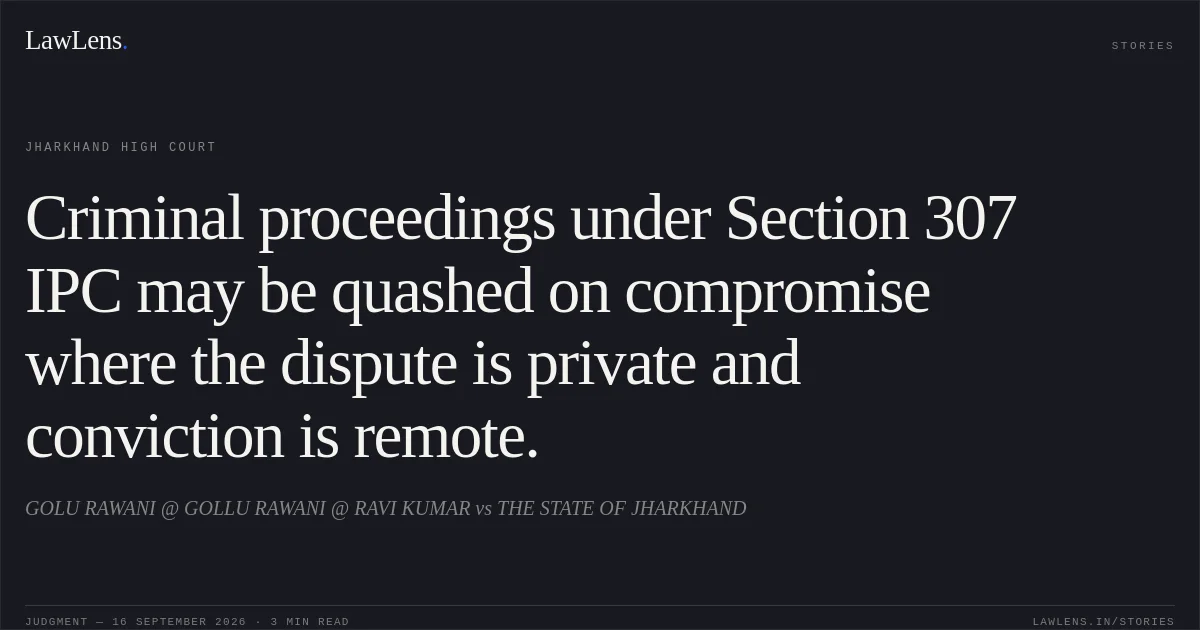
The High Court held that the case was a fit one for exercise of its inherent jurisdiction under Section 528 BNSS.
It quashed and set aside the entire criminal proceedings, including the FIR in Kenduadih P.S. Case No. 37 of 2022, pending before the Judicial Magistrate-I, Dhanbad, qua the petitioner.
Source reference: paras. 9–10The Criminal Miscellaneous Petition was allowed, and the connected interlocutory application was disposed of accordingly.
Source reference: paras. 11–12Acts & Sections Cited
10 provisions across 4 statutes referred to in this judgment. Each provision opens on LawLens.
Bharatiya Nagarik Suraksha Sanhita, 20231
Indian Penal Code, 18606
Arms Act, 19591
Code of Criminal Procedure, 19732
Original Court PDF
GOLU RAWANI @ GOLLU RAWANI @ RAVI KUMARvsTHE STATE OF JHARKHAND
Click to open original judgment
Original judgment, available to read, download and summarize on LawLens.in
![Frequent premature transfers do not warrant judicial interference absent mala fides or statutory violation.. mukhtar ahmad khuroo vs REVENUE DEPARTMENT. CAT - ['Srinagar']. LawLens](/stories/thumbnails/frequent-premature-transfers-do-not-warrant-judicial-interference-absent-mala-fides-or-sta-4c2b6d056d6242a5b5b0063672599c7e.webp)
![Application dismissed for want of instructions after applicants failed to communicate with counsel despite repeated opportunities.. K S ASHOKAN vs Central Excise & Customs. CAT - ['Chennai']. LawLens](/stories/thumbnails/application-dismissed-for-want-of-instructions-after-applicants-failed-to-communicate-with-763df4711ed74022be7765bf03dd42b5.webp)
![Authorities must decide pensionary claims by reasoned order within eight weeks and release admissible benefits within four further weeks.. Bashir ahmad zargar vs POWER DEVELOPMENT DEPARTMENT. CAT - ['Srinagar']. LawLens](/stories/thumbnails/authorities-must-decide-pensionary-claims-by-reasoned-order-within-eight-weeks-and-release-d9aa2bb3508d499a9d960e70f0b4d6a9.webp)