Facts
The opposite party no. 2 alleged that, on 08 September 2021, the petitioner, a police constable, accompanied by two unidentified persons, came to her and pressured her to withdraw an earlier case filed against him. It was further alleged that the unidentified persons took away her purse containing gold earrings and ₹6,000, while the petitioner and others abused and assaulted her and her family members, and threatened them with death.
Source reference: para. 4The complaint was instituted on 23 November 2021. On 19 May 2022, the learned Magistrate took cognizance of offences under Sections 323 and 379 of the Indian Penal Code and directed issuance of summons. The petitioner’s criminal revision against that order was dismissed by the Additional Sessions Judge, Rohtas, on 21 July 2023.
Source reference: para. 3The petitioner therefore invoked the High Court’s inherent jurisdiction to quash both orders. He contended that the complaint was delayed, vague, motivated by an earlier dispute, and unsupported by independent witnesses.
Source reference: paras. 5–7The complainant opposed the application and defended the orders below.
Source reference: para. 8Issues
Whether the complaint and the materials collected during inquiry disclosed the essential ingredients of offences under Sections 323 and 379 IPC so as to justify taking cognizance and issuing summons?
Source reference: paras. 3, 9–12Whether continuation of the criminal proceeding amounted to an abuse of the process of law because the allegations were absurd, inherently improbable, mala fide, and fell within categories (5) and (7) of State of Haryana v. Bhajan Lal?
Source reference: paras. 9–13Law Applied
The Court considered Sections 323 and 379 of the Indian Penal Code, relating respectively to voluntarily causing hurt and theft. It exercised the inherent jurisdiction under Section 482 CrPC to prevent abuse of the process of court and secure the ends of justice.
Source reference: no citationThe Court held that although a Magistrate is not expected to conduct a detailed or roving inquiry at the stage of taking cognizance, the court cannot mechanically act upon allegations that are vague, absurd, or inherently improbable.
Source reference: para. 10Relying on Manoj Mahavir Prasad Khaitan v. Ram Gopal Poddar, reported in 2011 (1) PLJR 23 (SC), the Court reaffirmed that proceedings may be quashed under Section 482 CrPC where the complaint is absurd and lacks bona fides.
Source reference: para. 11It further applied categories (5) and (7) of State of Haryana v. Bhajan Lal, 1992 Supp. (1) SCC 335, covering allegations that are so absurd and inherently improbable that no reasonable person could accept them, and proceedings manifestly attended with mala fide or instituted for an ulterior purpose.
Source reference: para. 12Reasoning
The Court found the complaint inherently improbable because the alleged incident occurred in the court premises, where the complainant allegedly consumed tea with the petitioner despite their prior litigation, while an unidentified person supposedly removed her bag at the petitioner’s instigation.
Source reference: para. 9The Court also noted the absence of any specific allegation showing that the complainant suffered “hurt” within the meaning of Section 323 IPC.
Source reference: para. 9The inquiry witnesses were the complainant’s mother and sister; the Court found that their statements did not consistently support the alleged taking of the bag and that no independent witness from the court premises had been examined.
Source reference: paras. 6, 12The delayed filing, the earlier case between the parties, the petitioner’s grant of anticipatory bail in that case, and the alleged mala fide motive further undermined the complaint’s credibility.
Source reference: paras. 5, 7, 9Applying the principles in Manoj Mahavir Prasad Khaitan and Bhajan Lal, the Court concluded that the allegations did not disclose the commission of the alleged offences and that continuation of the prosecution would constitute an abuse of process.
Source reference: paras. 11–13Holding
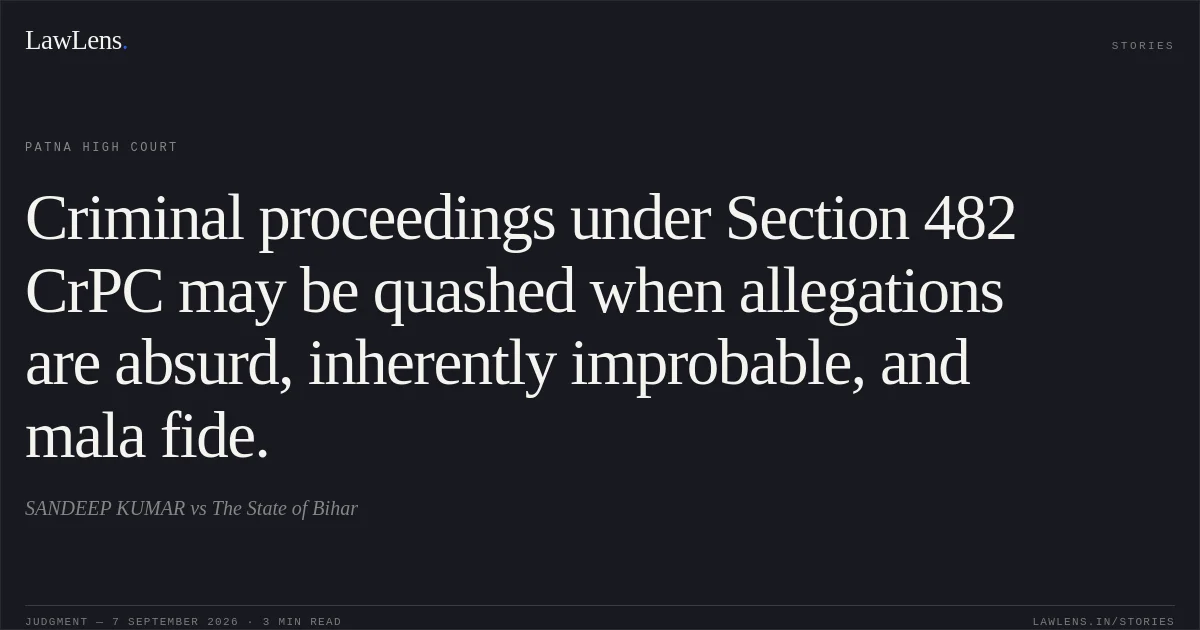
The High Court held that the complaint contained vague, absurd, inherently improbable, and mala fide allegations and did not prima facie establish the offences under Sections 323 or 379 IPC.
The order taking cognizance dated 19 May 2022 and the revisional order dated 21 July 2023 were quashed.
Source reference: paras. 13–14The application under Section 482 CrPC was accordingly allowed.
Source reference: paras. 13–14Acts & Sections Cited
4 provisions across 2 statutes referred to in this judgment. Each provision opens on LawLens.
Indian Penal Code, 18603
Code of Criminal Procedure, 19731
Original Court PDF
SANDEEP KUMARvsThe State of Bihar
Click to open original judgment
Original judgment, available to read, download and summarize on LawLens.in