Facts
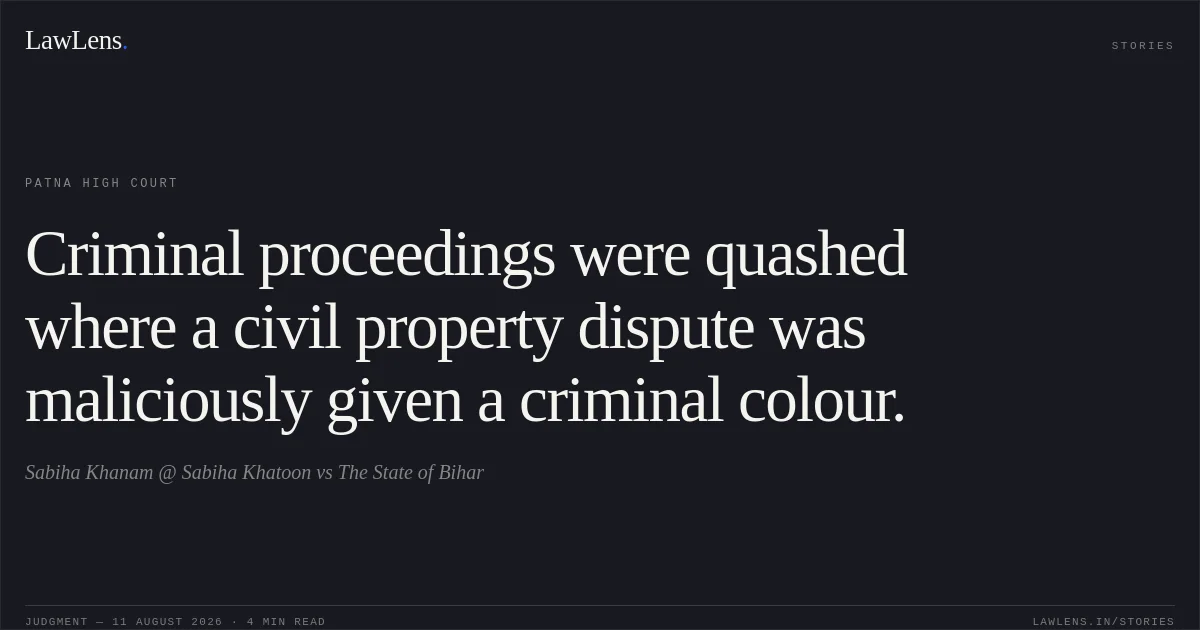
The petitioners invoked Section 482 of the Code of Criminal Procedure, 1973, seeking quashing of the order dated 3 August 2024 by which the Chief Judicial Magistrate, Darbhanga, took cognizance of offences under Sections 341, 323, 447, 427, 504, 506 and 34 IPC in Laheriasarai P.S. Case No. 679 of 2022.
Source reference: p.2The informant alleged that the petitioners, who were his close relatives, interfered with his possession of disputed land, demolished part of a house, attempted construction, abused and assaulted his brother, and subsequently attempted encroachment on 6 December 2022.
Source reference: pp.2–4The petitioners contended that the prosecution arose out of a family property dispute concerning approximately one katha of land and an alleged gift deed, and that the civil dispute had been given a criminal colour.
Source reference: pp.4–7A Division Bench had earlier held that the competing claims concerning title, construction and access were matters for adjudication before the appropriate civil forum.
Source reference: pp.17–19The State and the informant opposed quashing, arguing that the FIR and charge-sheet disclosed a prima facie case and that the availability of civil remedies did not bar criminal proceedings.
Source reference: pp.19–20Issues
Whether the High Court should exercise its inherent jurisdiction under Section 482 CrPC to quash the order taking cognizance where the prosecution allegedly arose from a civil property dispute and was instituted with mala fide intent?
Source reference: pp.4–7, 20–22Whether the allegations and materials in the FIR and charge-sheet disclosed a genuine prima facie criminal case, or whether continuation of the prosecution would amount to abuse of the process of law?
Source reference: pp.19–22Whether the repeated registration of FIRs against the petitioners and their family members constituted a relevant attending circumstance demonstrating harassment and abuse of criminal process?
Source reference: pp.20–22Law Applied
The Court applied Section 482 CrPC, which preserves the High Court’s inherent power to prevent abuse of the process of any court and secure the ends of justice.
Source reference: p.2It recognised that the existence of a civil dispute does not, by itself, bar criminal prosecution where the allegations independently disclose criminal offences; however, criminal proceedings may be quashed where a purely civil dispute is given a criminal colour or where the prosecution is manifestly mala fide.
Source reference: no citationRelying on Mohd. Wajid v. State of U.P., (2023) 20 SCC 219, the Court held that, in an alleged vexatious prosecution, it may examine the FIR together with the surrounding circumstances and materials collected during investigation, including multiple FIRs.
Source reference: pp.7–8It relied on Ankul Singh v. State of Uttar Pradesh, 2025 SCC OnLine SC 2060, for the principle that Section 482 jurisdiction must be exercised sparingly but should be invoked where continuation of proceedings would abuse the process of law or where a civil dispute has been artificially converted into a criminal case.
Source reference: pp.8–9The Court also referred to T.T. Antony v. State of Kerala, (2001) 6 SCC 181, concerning the impermissibility of successive FIRs arising from the same transaction, and State of Haryana v. Bhajan Lal, particularly the category of proceedings instituted maliciously with an ulterior motive for wreaking vengeance.
Source reference: pp.9–15The principles in G. Sagar Suri v. State of U.P., (2000) 2 SCC 636, and Pepsi Foods Ltd. v. Special Judicial Magistrate, (1998) 5 SCC 749, were also noted regarding misuse of criminal proceedings for civil disputes and the requirement of judicial application of mind before summoning an accused.
Source reference: pp.15–17Reasoning
The Court found that the dispute was fundamentally between family members concerning title, possession, construction and access to immovable property.
Source reference: pp.17–19The earlier Division Bench order had expressly characterised the competing claims as matters requiring adjudication before a civil forum, where evidence regarding title and identification of the property could be led and tested.
Source reference: pp.17–19Against this background, the informant’s failure to pursue the appropriate civil remedy, coupled with the registration of the present FIR shortly after institution of the writ proceedings and the filing of five further FIRs in 2023 against the petitioners and their relatives, was treated as a significant attending circumstance.
Source reference: pp.20–22The Court concluded that the repeated criminal cases indicated an attempt to exert pressure and compel the petitioners to abandon their property claims.
Source reference: pp.20–22Thus, notwithstanding the formal allegation of offences under the IPC, the prosecution was found to be a civil dispute dressed in criminal form and motivated by malice, attracting the High Court’s inherent jurisdiction under Section 482 CrPC.
Source reference: pp.20–22Holding
The High Court held that continuation of the criminal proceedings would amount to an abuse of the process of law because the prosecution was rooted in a civil property dispute and had been initiated with malicious intent to harass and pressure the petitioners.
Accordingly, the order dated 3 August 2024 taking cognizance in Laheriasarai P.S. Case No. 679 of 2022 was set aside, and the Section 482 CrPC application was allowed.
Source reference: paras. 8–9; p.22Acts & Sections Cited
19 provisions across 2 statutes referred to in this judgment. Each provision opens on LawLens.
Code of Criminal Procedure, 1973
Original Court PDF
Sabiha Khanam @ Sabiha KhatoonvsThe State of Bihar
Click to open original judgment
Original judgment, available to read, download and summarize on LawLens.in