Facts
The complainant (Opposite Party No. 2) entered into an agreement to purchase 1.5 katha of land from one Sudhir Prasad Singh (Accused No. 1).
Source reference: para. 2(a)Out of a total consideration of Rs. 70 lakhs, Rs. 50 lakhs were allegedly paid into the bank accounts of Lilawati Devi and the petitioner, Prabhat Kumar.
Source reference: para. 2(b)The complainant alleged that despite payment, the sale deed was not executed, nor was the money returned.
Source reference: para. 2(c)Furthermore, it was alleged that on 26.05.2014, the accused persons assaulted the complainant and snatched cash, specifically alleging the petitioner took Rs. 2,000 from the complainant's deceased brother.
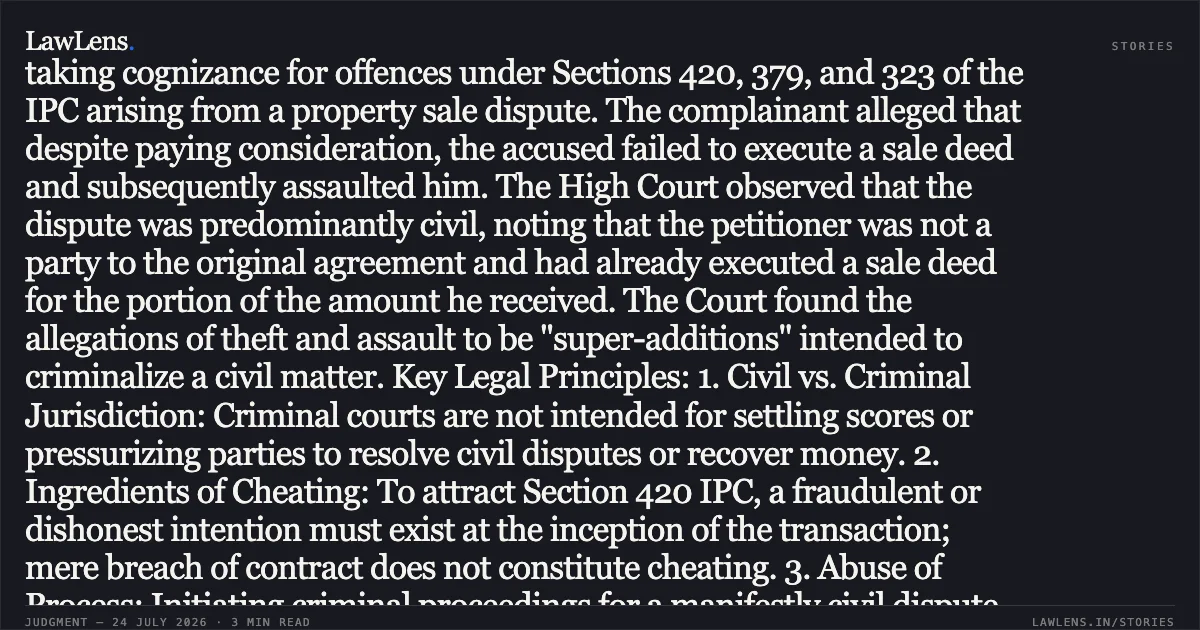
Source reference: para. 2(e)The Magistrate took cognizance of the offences under Sections 420, 379, and 323 of the IPC on 12.09.2014.
Source reference: para. 1The petitioner challenged this order, asserting that he was not a party to the agreement and had already executed a sale deed for the portion of money he received.
Source reference: para. 10Issues
1. Whether the allegations in the complaint constitute the criminal offence of cheating under Section 420 IPC or if the dispute is purely of a civil nature arising from a breach of contract.
Source reference: para. 6, 162. Whether the criminal proceedings initiated against the petitioner amount to an abuse of the process of the court warranting interference under Section 482 Cr.P.C.
Source reference: para. 17, 23Law Applied
The court primarily applied Section 415 and 420 of the IPC, which require fraudulent or dishonest inducement at the inception of the transaction to constitute cheating.
Source reference: para. 14It relied on the principles from State of Haryana v. Bhajan Lal, specifically Category 7, which justifies quashing proceedings instituted maliciously with ulterior motives.
Source reference: para. 21-22It further cited Sarabjit Kaur v. State of Punjab and Inder Mohan Goswami v. State of Uttaranchal, holding that criminal law cannot be used as a shortcut to settle civil disputes or as an instrument of harassment.
Source reference: para. 18-19The court also referenced Anukul Singh v. State of Uttar Pradesh regarding the duty of the High Court to intervene when a civil dispute is artificially given a criminal color.
Source reference: para. 20Reasoning
The court found that the petitioner was not a party to the original sale agreement dated 28.04.2013.
Source reference: para. 13(iii)While money was transferred to his account, he had already executed a sale deed for that specific amount in favor of the broker (Accused No. 1).
Source reference: para. 10, 13(iv)The court observed that there was no evidence of "fraudulent or dishonest intention" existing at the start of the transaction, which is a prerequisite for a Section 420 IPC charge.
Source reference: para. 16, 24The allegations regarding the snatching of money (Sections 379 and 323 IPC) were dismissed as "super-addition" intended to criminalize a civil breach of contract.
Source reference: para. 13(v)The court reasoned that the complainant was attempting to use criminal prosecution as a pressure tactic to recover money or coarse the execution of a sale deed, which constitutes an abuse of the judicial process.
Source reference: para. 17-18Holding
The court answered the issues in favor of the petitioner, holding that the dispute was manifestly civil in nature and the criminal proceedings were maliciously instituted.
The court quashed and set aside the order of cognizance dated 12.09.2014 passed by the Judicial Magistrate 1st Class, Patna, in Complaint Case No. 27267 (C) of 2014 with respect to the petitioner only.
Source reference: para. 26The application was allowed.
Source reference: para. 27Acts & Sections Cited
5 provisions across 2 statutes referred to in this judgment. Each provision opens on LawLens.
Code of Criminal Procedure, 19731
Indian Penal Code, 18604
Original Court PDF
Prabhat KumarvsState Of Bihar and Anr
Click to open original judgment
Original judgment, available to read, download and summarize on LawLens.in