Facts
The petitioner, a Junior Engineer (JE) with the Delhi Jal Board (DJB), was arraigned as an accused in FIR No. 354/2017 following the death of three labourers by asphyxiation while cleaning a sewer on August 6, 2017
Source reference: p. 1-3The prosecution alleged criminal negligence under Section 304 IPC, forgery of logbooks under Sections 467/468/471 IPC, and violations of the Manual Scavengers Act and the SC/ST Act
Source reference: p. 2-6Simultaneously, disciplinary proceedings were initiated against the petitioner on identical charges
Source reference: p. 4-5On August 17, 2020, the Inquiry Officer exonerated the petitioner on merits, finding that the incident site was outside his jurisdiction, no work order was issued by him, and the alleged logbook manipulation was committed by third parties without his involvement
Source reference: p. 13-17The petitioner subsequently moved the High Court to quash the criminal proceedings based on his departmental exoneration
Source reference: p. 8Issues
1. Whether criminal proceedings premised on identical allegations as departmental proceedings are liable to be quashed if the accused has been exonerated in the disciplinary proceedings on merits.
Source reference: p. 9 / para. 18Law Applied
The court primarily relied on the doctrine established in P.S. Rajya v. State of Bihar, which holds that if a charge cannot be established in departmental proceedings, it cannot be pursued in criminal proceedings where the standard of proof is higher
Source reference: p. 17-18It further applied the yardsticks from Radheshyam Kejriwal v. State of West Bengal, specifically that criminal prosecution on the same set of facts cannot continue if the exoneration in adjudication proceedings was on merits and the allegations are found unsustainable
Source reference: p. 19-21The court also cited Ashoo Surendranath Tewari v. Deputy Superintendent of Police, reinforcing that once a person is held innocent on merits in a departmental inquiry, conviction in a criminal trial—requiring "proof beyond reasonable doubt"—becomes bleak and constitutes an abuse of process
Source reference: p. 21-22Reasoning
The court engaged in a comparative analysis of the Article of Charges in the disciplinary memorandum and the allegations in the police chargesheet, concluding that they were "in essence identical"
Source reference: p. 10-13The court observed that the Inquiry Officer had specifically found as a matter of fact that no work order was issued by the petitioner and that he had no role in the forgery of the logbooks
Source reference: p. 13-17Applying the Radheshyam Kejriwal test, the court noted that the exoneration was not on technical grounds but on merits
Source reference: p. 22The court reasoned that since the standard of proof in disciplinary proceedings (preponderance of probability) is lower than in criminal trials (beyond reasonable doubt), the failure to prove the charges in the former makes conviction in the latter legally improbable
Source reference: p. 25Furthermore, the court noted that the petitioner’s superiors (AE and EE) had already had the FIR quashed against them by a coordinate bench on similar grounds
Source reference: p. 22-26Holding
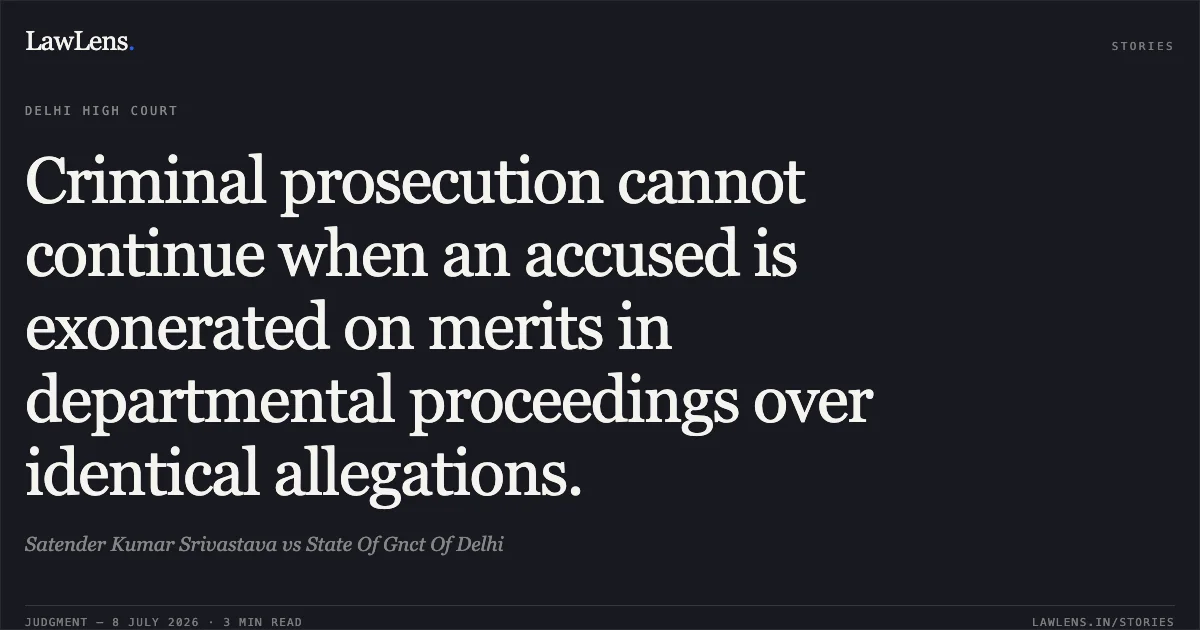
The court answered the issue in the affirmative, holding that continuing the criminal trial would be an abuse of the process of the court
It further held that once the primary substantive offences (IPC) fall, the ancillary charges under the Manual Scavengers Act and SC/ST Act also become untenable
Source reference: p. 26-27The court allowed the petition and quashed FIR No. 354/2017 and all emanating proceedings against the petitioner
Source reference: p. 27Acts & Sections Cited
13 provisions across 4 statutes referred to in this judgment. Each provision opens on LawLens.
Indian Penal Code, 18606
Prohibition of Employment as Manual Scavengers and their Rehabilitation Act, 20132
Scheduled Castes and the Scheduled Tribes (Prevention of Atrocities) Act, 19891
Code of Criminal Procedure, 19734
Original Court PDF
Satender Kumar SrivastavavsState Of Gnct Of Delhi
Click to open original judgment
Original judgment, available to read, download and summarize on LawLens.in