Facts
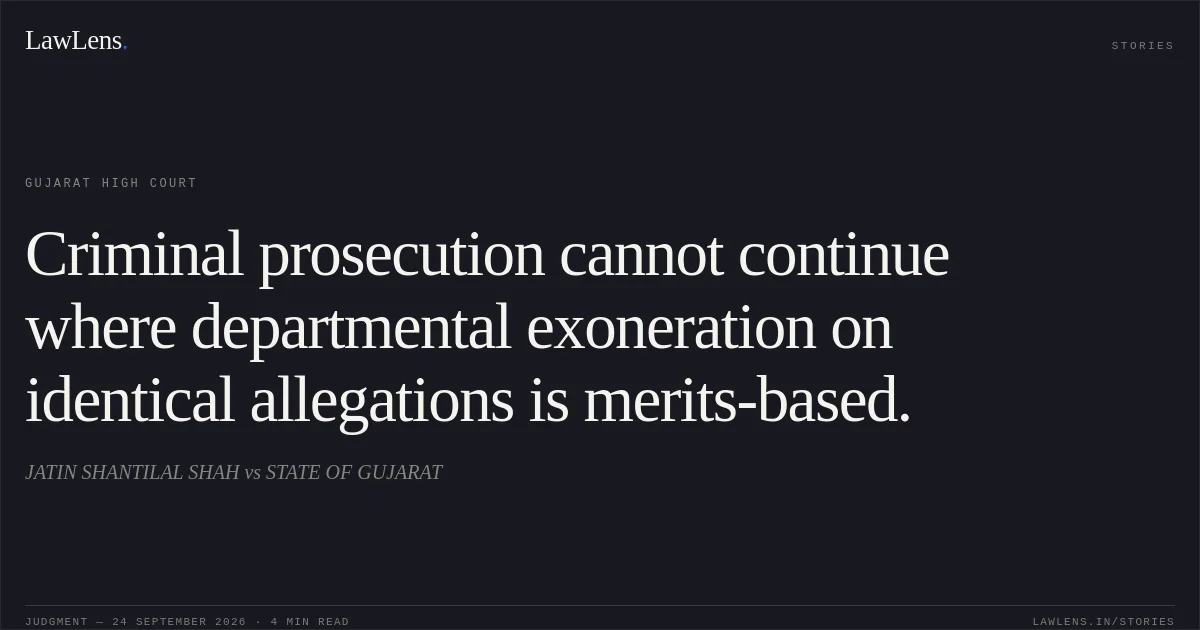
The applicants were accused No. 1, Shri J.S. Shah, a Principal Senior Civil Judge and JMFC, Dhandhuka, and accused No. 2, Dipakkumar K. Raval, a bailiff attached to the same court. They invoked Section 482 of the Code of Criminal Procedure seeking quashing of FIR being C.R. No. I-1/2014 registered with the Gujarat High Court Vigilance Cell Police Station for offences under Sections 7 and 12 of the Prevention of Corruption Act, 1988.
Source reference: p.1, para. 1.1The FIR alleged that the judicial officer demanded ₹5,000 from the complainant in connection with Regular Civil Suit No. 74 of 2012, allegedly for granting an injunction. It was further alleged that the bailiff made a follow-up demand through a telephone call. The FIR relied, inter alia, on call-detail records showing communication between the complainant and the bailiff.
Source reference: pp.2–4, para. 2The applicants contended that there was no demand, acceptance or recovery of any bribe and that they had been exonerated on merits in departmental proceedings arising from the same allegations. The respondents argued that departmental proceedings and criminal prosecution serve distinct purposes and may proceed simultaneously.
Source reference: pp.4–5, paras. 3–4.2The High Court noted that the departmental exoneration had been accepted by the Full Court and communicated to the judicial officer.
Source reference: p.8, para. 5.5Issues
1. Whether the FIR and consequential criminal proceedings under Sections 7 and 12 of the Prevention of Corruption Act could continue when the applicants had been exonerated on merits in departmental proceedings arising from the identical allegations?
Source reference: pp.6–10, paras. 5.2–5.82. Whether the allegations and material in the FIR disclosed a prima facie case of bribery against the judicial officer and the bailiff, particularly in the absence of recovery and with the alleged case against the bailiff resting substantially on call-detail records?
Source reference: pp.4, 8–10, paras. 3.2, 5.6–5.83. Whether continuation of the prosecution would amount to an abuse of the process of court warranting exercise of the High Court’s inherent jurisdiction under Section 482 CrPC?
Source reference: pp.6–10, paras. 5.3–6Law Applied
The Court exercised its inherent jurisdiction under Section 482 CrPC to prevent abuse of process and secure the ends of justice.
Source reference: p.1, para. 1.1Sections 7 and 12 of the Prevention of Corruption Act, 1988 were the substantive provisions invoked in the FIR concerning demand of illegal gratification and abetment, respectively.
Source reference: p.1, para. 1.1Relying on Karnataka Lokayukta, Bagalkote District, Bagalkot v. Chandrashekar, the Court recognised that departmental proceedings and criminal prosecution are generally independent and that exoneration in departmental proceedings does not automatically bar criminal prosecution.
Source reference: p.6, para. 5.1However, applying Radheshyam Kejriwal v. State of West Bengal, (2011) 3 SCC 581, the Court held that where the allegations in the departmental/adjudicatory proceedings and the criminal prosecution are identical, and the accused has been exonerated on merits—meaning that the foundational allegations are found unsustainable rather than rejected on a technical or procedural ground—continuation of the criminal prosecution would constitute an abuse of process.
Source reference: pp.6–7, paras. 5.2–5.3Reasoning
The Court found that the departmental proceedings concerned the same alleged demand of ₹5,000 and the same alleged conduct attributed to both applicants as formed the basis of the FIR.
Source reference: pp.8–10, paras. 5.5, 5.8The judicial officer’s exoneration was on merits, had been accepted by the High Court’s Full Court, and was not based on technicalities or witness non-attendance.
Source reference: pp.8–10, paras. 5.5, 5.8The Court also considered the factual weaknesses in the prosecution case: the complainant had not referred to the alleged bribe demand in earlier proceedings before the electricity authorities, the police and the High Court, despite being an advocate; the alleged demand was reported after a substantial delay; and the materials against the bailiff primarily consisted of call records establishing communication, not the substance of any incriminating conversation or independent proof of demand.
Source reference: pp.8–10, paras. 5.6–5.8Applying the rule in Radheshyam Kejriwal, the Court concluded that the identical allegations had failed in departmental adjudication on merits and that allowing the criminal prosecution to continue would be oppressive and an abuse of the court’s process.
Source reference: pp.7–10, paras. 5.4–5.8Holding
The High Court answered the issues in favour of the applicants. It held that, in the circumstances, the applicants’ merits-based exoneration in departmental proceedings, coupled with the absence of sufficient independent material supporting the alleged bribery demand, rendered continuation of the criminal case impermissible.
The FIR being C.R. No. I-1/2014 registered with the Gujarat High Court Vigilance Cell Police Station, Ahmedabad, for offences under Sections 7 and 12 of the Prevention of Corruption Act, 1988, together with all consequential proceedings against both applicants, was quashed and set aside. Both applications were allowed and the rule was made absolute.
Source reference: p.10, paras. 6–7Acts & Sections Cited
12 provisions across 4 statutes referred to in this judgment. Each provision opens on LawLens.
Code of Criminal Procedure, 19732
Prevention of Corruption Act, 19882
Indian Penal Code, 18607
Electricity Act, 20031
Original Court PDF
JATIN SHANTILAL SHAHvsSTATE OF GUJARAT
Click to open original judgment
Original judgment, available to read, download and summarize on LawLens.in