Facts
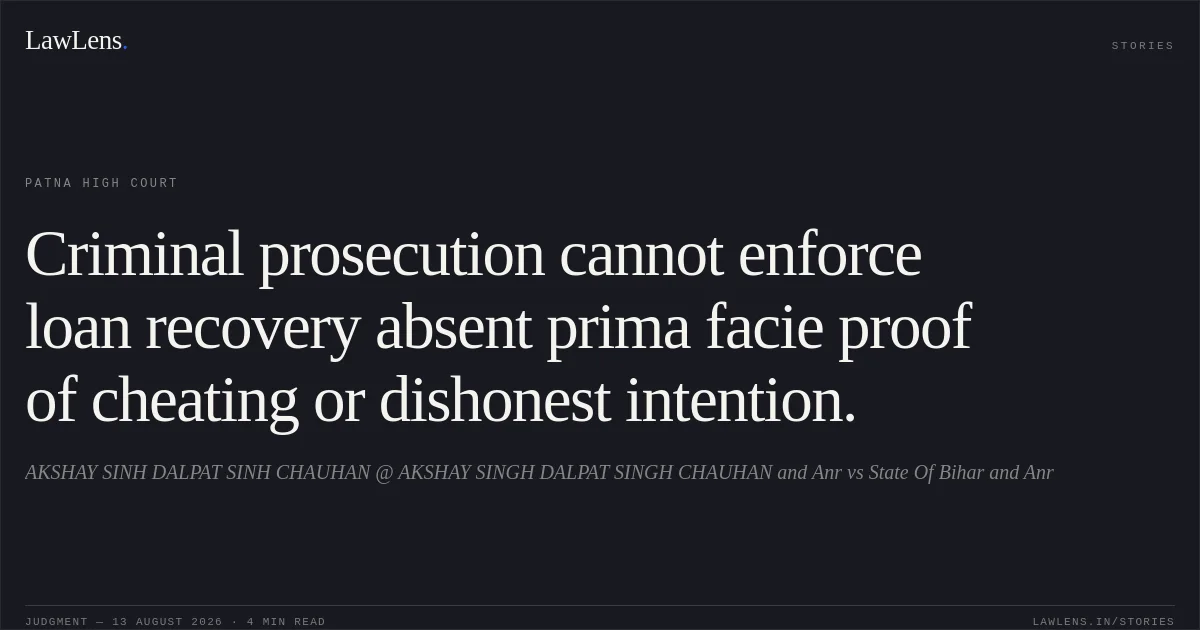
The complainant alleged that the petitioners, a husband and wife whom he had met at Surat through their common devotion to Sant Param Jee Maharaj, persuaded him to invest ₹2,00,000 in their business.
Source reference: pp. 2–3, paras. 2–3According to the complaint, the petitioners visited the complainant’s house at Chapra on 20 April 2014 and received the amount in cash from his father, promising to return it within six months.
Source reference: pp. 2–3, paras. 2–3The complaint was filed on 19 November 2014 under Complaint Case No. 3415 of 2014.
Source reference: pp. 3–5, paras. 4–5After recording the complainant’s solemn affirmation and the statements of two enquiry witnesses, the Magistrate, by order dated 3 October 2015, found a prima facie case under Sections 403 and 417 of the IPC and issued process against the petitioners.
Source reference: pp. 3–5, paras. 4–5The petitioners challenged the order under Section 482 CrPC, asserting that they had never visited Chapra on the alleged date and that the complaint was maliciously instituted to extort money.
Source reference: pp. 4–5, paras. 7–9They relied on a certificate issued by the Director of their Surat-based employer stating that petitioner No. 1 was present at the office during the relevant period.
Source reference: pp. 4–5, paras. 7–9Issues
Whether the allegations and materials on record disclosed the ingredients of dishonest misappropriation under Section 403 IPC against the petitioners?
Source reference: pp. 11–13, paras. 23–28Whether the allegations disclosed the offence of cheating punishable under Section 417 IPC, particularly in the absence of proof of the alleged payment and any material showing fraudulent or dishonest intention at the inception?
Source reference: pp. 13–15, paras. 29–33Whether the criminal proceeding and the Magistrate’s order issuing process constituted an abuse of the process of law, warranting interference under Section 482 CrPC?
Source reference: pp. 15–18, paras. 34–42Law Applied
The Court exercised its inherent jurisdiction under Section 482 CrPC to prevent abuse of process and secure the ends of justice.
Source reference: no citationSection 403 IPC requires dishonest misappropriation or conversion of movable property belonging to another, accompanied by dishonest intention.
Source reference: pp. 11–12, paras. 24–25Section 415 IPC defines cheating as deception followed by fraudulent or dishonest inducement to deliver property, consent to its retention, or to undertake or omit an act causing or likely to cause harm; Section 417 IPC prescribes the punishment for cheating.
Source reference: pp. 13–14, paras. 29–30The Court relied on Indian Oil Corporation v. NEPC India Ltd. , (2006) 6 SCC 736, concerning the ingredients of dishonest misappropriation and the impermissibility of using criminal law to settle civil or monetary disputes.
Source reference: pp. 12–13, 15–16, paras. 27, 35It also referred to Ram Jas v. State of U.P. , (1970) 2 SCC 740, Mohammed Ibrahim v. State of Bihar , (2009) 8 SCC 751, and Payal Sharma v. State of Punjab , 2024 SCC OnLine SC 3473, on the ingredients of cheating.
Source reference: p. 15, para. 32The Court further relied on Inder Mohan Goswami v. State of Uttaranchal , (2007) 12 SCC 1, Ganga Dhar Kalita v. State of Assam , (2015) 9 SCC 647, and the categories in State of Haryana v. Bhajan Lal , 1992 Supp (1) SCC 335, particularly where the allegations do not constitute an offence, are inherently improbable, or the proceeding is manifestly mala fide.
Source reference: pp. 16–18, paras. 35–41Reasoning
The Court found that the complaint contained only general and uncorroborated assertions regarding the alleged demand and payment of ₹2,00,000; there was no receipt, acknowledgment, or other documentary material evidencing the transaction.
Source reference: pp. 7–8, paras. 15–16The employment certificate produced by petitioner No. 1 recorded his presence at the Surat workplace during the period covering 20 April 2014, materially contradicting the allegation that the petitioners had travelled to Chapra and received the money there.
Source reference: pp. 8–9, paras. 17–19Consequently, the Court held that the essential element of property belonging to another, dishonestly misappropriated or converted, was not established for Section 403 IPC.
Source reference: pp. 11–13, paras. 24–28It further held that the allegations did not prima facie show deception or dishonest intention at the inception of the transaction, and that the alleged loan/recovery dispute, even if assumed to exist, was essentially civil in nature.
Source reference: pp. 13–17, paras. 30–38The Magistrate was therefore found to have issued process mechanically, without adequately scrutinising the absence of supporting material and the contradictory presence certificate.
Source reference: pp. 9–10, para. 21The proceeding was consequently characterised as a malicious attempt to use criminal law for recovery of money and as falling within the Bhajan Lal categories warranting quashing.
Source reference: pp. 16–18, paras. 39–42Holding
The High Court held that the materials did not disclose the ingredients of Sections 403 or 417 IPC and that the complaint was manifestly attended with mala fide, arising from an essentially monetary or civil dispute.
In exercise of jurisdiction under Section 482 CrPC, it quashed and set aside the Magistrate’s order dated 3 October 2015 in Complaint Case No. 3415 of 2014, along with all criminal proceedings emanating from it.
Source reference: p. 19, para. 43The application was allowed and any pending interlocutory applications were disposed of.
Source reference: p. 19, paras. 44–45Acts & Sections Cited
5 provisions across 2 statutes referred to in this judgment. Each provision opens on LawLens.
Code of Criminal Procedure, 19731
Indian Penal Code, 18604
Original Court PDF
AKSHAY SINH DALPAT SINH CHAUHAN @ AKSHAY SINGH DALPAT SINGH CHAUHAN and AnrvsState Of Bihar and Anr
Click to open original judgment
Original judgment, available to read, download and summarize on LawLens.in