Facts
The Petitioner company, a licensee of "Goodyear" lubricants, entered into a distributorship agreement with Respondent No. 2 (Complainant) in January 2021.
Source reference: p. 2The Complainant alleged that the Petitioner induced him to place orders worth ₹1.75 crores by misrepresenting an association with Goodyear USA and claiming the products met high international quality (API) standards.
Source reference: p. 3It was further alleged that the products were inferior, "dead stock," and that the Petitioner committed criminal intimidation upon termination of the distributorship.
Source reference: p. 3Following investigation, a chargesheet was filed under Sections 420, 406, 120-B, and 34 of the IPC.
Source reference: p. 12The Petitioner sought quashing of the FIR, arguing the dispute was purely commercial and the allegations of fraud were belied by a valid trademark license and lab reports.
Source reference: p. 8-10Issues
1. Whether the filing of a chargesheet during the pendency of a Section 482 petition bars the High Court from quashing the FIR.
Source reference: p. 16 / para. 36-382. Whether the allegations and material collected during investigation prima facie disclose the ingredients of cheating (S. 420) and criminal breach of trust (S. 406).
Source reference: p. 21 / para. 41-423. Whether the parallel filing of multiple complaints across different jurisdictions constitutes an abuse of the process of law.
Source reference: p. 31 / para. 61Law Applied
Section 482 of the CrPC regarding the inherent powers of the High Court to prevent abuse of process.
Source reference: p. 1The criteria for quashing established in State of Haryana v. Bhajan Lal, emphasizing that proceedings may be quashed if allegations are absurd or attended with mala fides.
Source reference: p. 13-14Shaileshbhai Ranchhodbhai Patel v. State of Gujarat and Mukesh v. State of Uttar Pradesh, holding that the power to quash remains available even after a chargesheet is filed.
Source reference: p. 17-18Sections 405/406 (Criminal Breach of Trust) and 415/420 (Cheating) of the IPC, noting that the absence of dishonest intention at the inception of a transaction distinguishes a breach of contract from a criminal offense.
Source reference: p. 20-21Reasoning
The Court observed that the Petitioner provided an authorization letter and a trademark license agreement dated 09.04.2020, which were verified by the Trademark Registry and Goodyear India, thus negating the allegation of fraudulent misrepresentation regarding the Goodyear brand.
Source reference: p. 22-25Regarding product quality, Shri Ram Laboratory reports confirmed the lubricants met Indian Standards (IS), were synthetic-based, and had permissible water content, failing to prove the products were "spurious" or "reused".
Source reference: p. 26-27The Court found that the placement of 40+ purchase orders over 15 months contradicted the plea of deception from the inception.
Source reference: p. 29It reasoned that disputes over credit notes and "dead stock" were matters of account reconciliation/civil recovery.
Source reference: p. 29The Complainant’s act of "forum shopping" by filing identical complaints in Delhi and Haryana—withdrawing the latter only after the Delhi FIR was registered—was deemed a design to harass the Petitioner.
Source reference: p. 30-31Holding
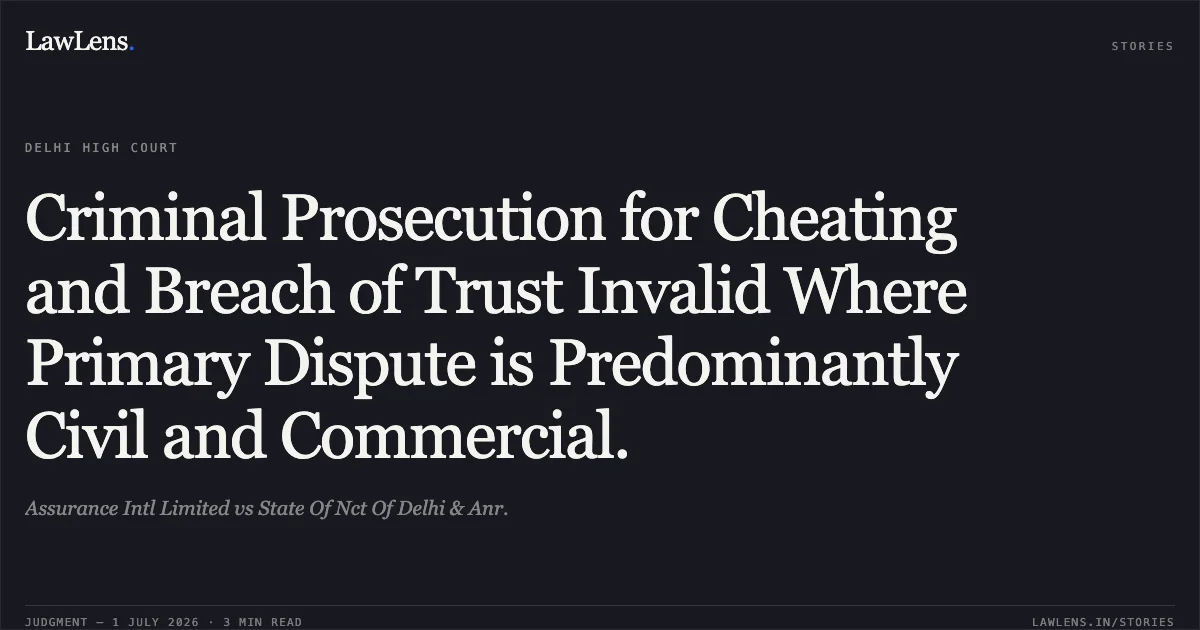
The Court held that the dispute was fundamentally commercial and civil in nature, lacking the "grave suspicion" required to sustain criminal charges.
The filing of a chargesheet does not preclude quashing under Section 482 if the ingredients of the offense are absent.
Source reference: p. 18-19Since no substantive offense under Section 406 or 420 was made out, the charge of criminal conspiracy under Section 120-B could not stand.
Source reference: p. 31-32The High Court quashed FIR No. 294/2022 and all consequential proceedings to prevent the abuse of the process of law.
Source reference: p. 33Acts & Sections Cited
2 provisions across 2 statutes referred to in this judgment. Linked provisions open on LawLens.
Code of Criminal Procedure, 19731
Indian Penal Code, 18601
Original Court PDF
Assurance Intl LimitedvsState Of Nct Of Delhi & Anr.
Click to open original judgment
Original judgment, available to read, download and summarize on LawLens.in