Facts
The appellants are the brothers, father, and sister (Appellant No. 4) of Manish Kumar’s wife.
Source reference: para. 2, 22Respondent No. 2 (Informant) is a caretaker/domestic help for Manish Kumar.
Source reference: para. 2, 22The Informant alleged that on 29.06.2020, the appellants arrived from Vaishali to Saran, assaulted her, used caste-based slurs, and attempted to outrage her modesty to force her to vacate the premises.
Source reference: para. 3The Appellants contended the case was a malicious counter-blast to a dowry harassment/torture FIR (Section 498A IPC) filed by Appellant No. 4 against her husband (the Informant’s employer) in Jaipur in January 2020.
Source reference: para. 5, 9Evidence was presented showing the Appellants were residents of Jaipur, and Appellant No. 1 was at his workplace in Jaipur on the date of the alleged occurrence.
Source reference: para. 6, 7Issues
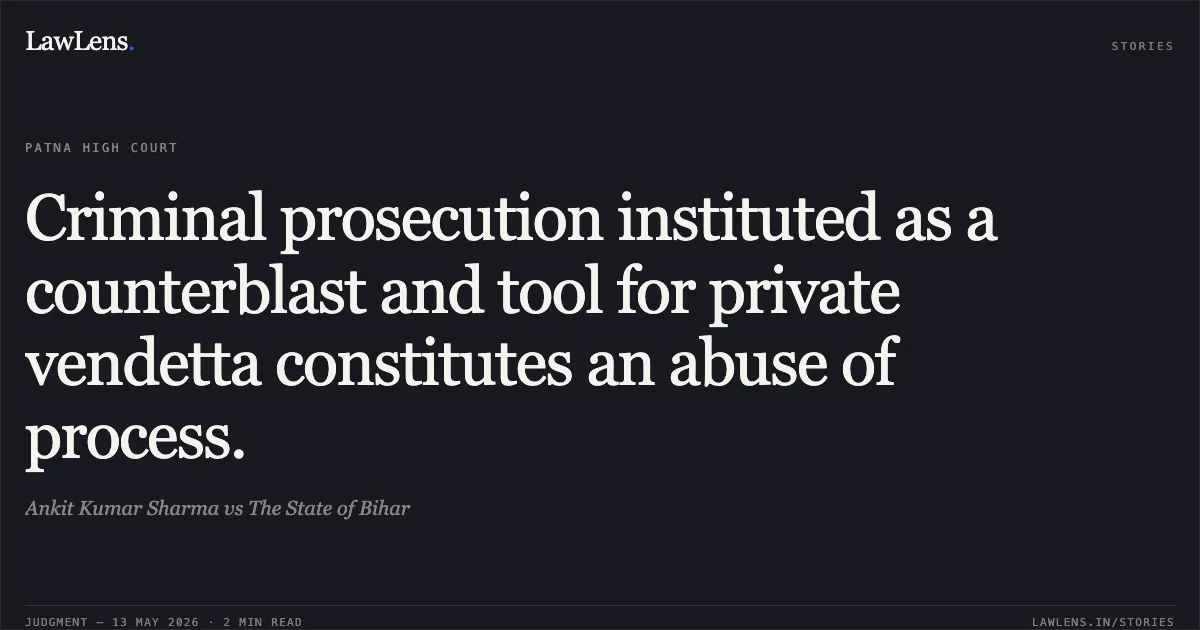
1. Whether the criminal proceedings and the order of cognizance against the appellants constitute an abuse of the process of law initiated with an ulterior motive for wreaking vengeance.
Source reference: para. 15, 232. Whether the allegations under the SC/ST (Prevention of Atrocities) Act are sustainable when the incident is alleged to have occurred during a nationwide COVID-19 lockdown and lacks evidence of being in "public view."
Source reference: para. 14, 18Law Applied
The Court applied Section 482 of the Cr.P.C. regarding the inherent power of the High Court to quash proceedings to prevent abuse of process or secure the ends of justice.
Source reference: para. 15, 24It relied on Salib Alias Shalu alias Salim v. State of UP and Mohd. Wajid v. State of U.P., which mandate courts to look beyond the FIR averments in potentially frivolous or vexatious litigations.
Source reference: para. 15, 16It further utilized the four-step analytical framework from Pradeep Kumar Kesarwani v. State of UP to test the indubitable quality of the accused's evidence (alibi/residence) against the factual assertions of the complaint.
Source reference: para. 20Principles from State of Haryana v. Bhajan Lal were applied regarding the quashing of malicious prosecutions.
Source reference: para. 10Reasoning
The Court observed that the FIR was a "counterblast" orchestrated by the Informant’s employers (the husband’s family) to pressure Appellant No. 4 into withdrawing her previous matrimonial case.
Source reference: para. 23, 27The Court found the allegations factually "dubious" because the date of occurrence coincided with a nationwide COVID-19 lockdown, making it improbable for the appellants to travel 1,000 km from Jaipur to Saran.
Source reference: para. 18Electronic evidence (CCTV and biometrics) of Appellant No. 1’s presence in Jaipur was deemed "unimpeachable".
Source reference: para. 17Furthermore, the investigation was criticized as "cryptic and perfunctory," failing to establish that the alleged caste-based slurs were made in "full public view" to denigrate the Informant’s prestige as required under Sections 3(r) and (s) of the SC/ST Act.
Source reference: para. 14, 18Holding
The High Court allowed the appeal and quashed the order of cognizance dated 27.09.2023 and the entire prosecution arising out of Garkha P.S. Case No. 298 of 2020.
The Court held that the prosecution was a "vexatious, frivolous and malicious" exercise of private vendetta and that allowing it to continue would result in a miscarriage of justice.
Source reference: para. 27No order as to costs was made.
Source reference: para. 29Acts & Sections Cited
9 provisions across 3 statutes referred to in this judgment. Each provision opens on LawLens.
Indian Penal Code, 18607
Scheduled Castes and the Scheduled Tribes (Prevention of Atrocities) Act, 19891
Code of Criminal Procedure, 19731
Original Court PDF
Ankit Kumar SharmavsThe State of Bihar
Click to open original judgment
Original judgment, available to read, download and summarize on LawLens.in