Facts
The Petitioner, a surgeon, performed a Cesarean section on Opposite Party No. 2 (O.P. No. 2) in July 2014
Source reference: para. 3O.P. No. 2 subsequently developed abdominal complications and underwent further treatments at S.K.M.C.H. and other facilities
Source reference: paras. 6-7She later filed an F.I.R. alleging that the Petitioner negligently left a surgical towel in her abdomen, which was purportedly removed by another doctor in February 2015
Source reference: paras. 3, 7Diagnostic reports (ultrasounds) between July 2014 and February 2015 did not show any foreign body
Source reference: paras. 15-16The police filed a chargesheet under Sections 337, 338, and 506 of the IPC
Source reference: para. 3The Trial Court took cognizance on 29.02.2016
Source reference: para. 4Notably, the Investigating Officer sought a medical opinion, but the chargesheet was filed before the Medical Board’s report—which eventually found no proof of a recovered towel—was received
Source reference: paras. 5, 25Issues
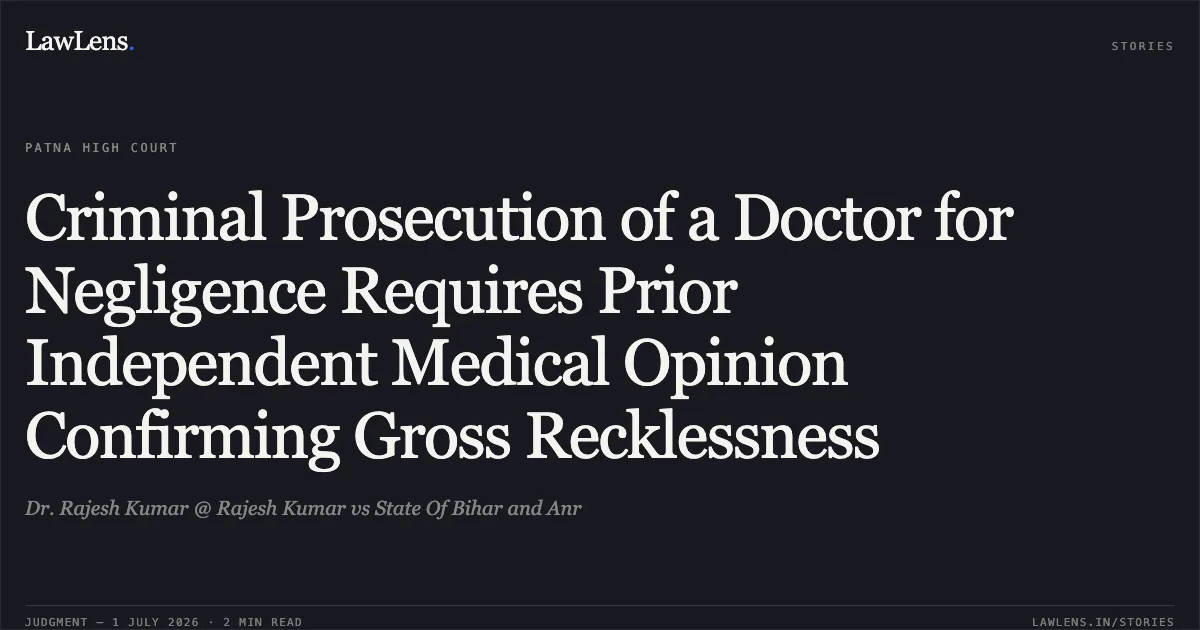
1. Whether the criminal prosecution against a medical professional can be sustained without a credible expert medical opinion establishing gross negligence
Source reference: paras. 5, 222. Whether the allegations and materials on record prima facie constitute offences under Sections 337, 338, and 506 of the IPC
Source reference: paras. 14, 27Law Applied
The court primarily applied the standard of "gross negligence" required for criminal liability of doctors as established in Jacob Mathew v. State of Punjab, which mandates that a medical practitioner is only liable if their conduct falls below the standard of a reasonably competent practitioner and requires a "credible opinion" from a competent doctor before entertaining a complaint
Source reference: paras. 18-19, 22It followed Kusum Sharma v. Batra Hospital, emphasizing that an error of judgment or unsuccessful treatment does not ipso facto amount to negligence
Source reference: para. 21Additionally, it relied on State of Haryana v. Bhajan Lal regarding the High Court's inherent power under Section 482 of the Cr.P.C. to quash proceedings to prevent abuse of the process of law
Source reference: para. 28Reasoning
The court reasoned that medical professionals are protected from frivolous prosecution unless the negligence is "gross" and "culpable"
Source reference: paras. 13, 21In this case, the court noted a significant lack of medical evidence: multiple ultrasound reports and surgical notes from subsequent government hospitals (S.K.M.C.H.) failed to mention any foreign body
Source reference: paras. 15-16, 26Crucially, the court found that the Trial Court took cognizance in a mechanical manner without waiting for the Medical Board's report, which ultimately exonerated the Petitioner by stating there was no proof of a recovered surgical towel
Source reference: paras. 17, 25Furthermore, the court observed that the ingredients for "criminal intimidation" under Section 506 IPC were entirely absent from the F.I.R.
Source reference: para. 27Since the expert opinion required by the Jacob Mathew guidelines did not support the prosecution, the court determined that continuing the trial would be an abuse of process
Source reference: paras. 27-28Holding
The court answered both issues in the negative and held that in the absence of cogent medical evidence or an expert opinion establishing gross negligence, the criminal proceedings could not be sustained
The court allowed the application and quashed the order of cognizance dated 29.02.2016 and the entire criminal proceeding arising from Brahampura P.S. Case No. 314 of 2015
Source reference: paras. 29-30Acts & Sections Cited
4 provisions across 2 statutes referred to in this judgment. Each provision opens on LawLens.
Code of Criminal Procedure, 19731
Indian Penal Code, 18603
Original Court PDF
Dr. Rajesh Kumar @ Rajesh KumarvsState Of Bihar and Anr
Click to open original judgment
Original judgment, available to read, download and summarize on LawLens.in