Facts
The petitioners, the mother-in-law and father-in-law of Opposite Party No. 2, sought quashing of the cognizance order dated 22 March 2024 passed by the learned S.D.J.M., West Champaran at Bettiah, in G.R. No. 1039 of 2022 arising from Bettiah Nagar P.S. Case No. 198 of 2022.
Source reference: para. 2Cognizance had been taken for offences under Sections 323, 341, 504 and 498A read with Section 34 of the IPC and Sections 3/4 of the Dowry Prohibition Act.
Source reference: para. 2The prosecution alleged dowry demands, cruelty, an attempt by Petitioner No. 2 and the sister-in-law to assault or kill the complainant by pressing her against an iron rod, removal of jewellery, and threats concerning the husband’s second marriage.
Source reference: para. 3The petitioners contended that the allegations against them were general and omnibus, that the complainant lived with her husband at Patna where the principal incident occurred, and that the petitioners resided in Samastipur, where only a panchayati had taken place; consequently, no material cause of action arose at Bettiah.
Source reference: paras. 5–6The complainant opposed the petition, relying on the existence of specific allegations, the limited scope of scrutiny at the cognizance stage, and the continuing nature of an offence under Section 498A IPC.
Source reference: para. 7Issues
Whether the criminal prosecution and cognizance order against the petitioners could be quashed under Section 482 Cr.P.C. where the allegations against them were general, omnibus and unsupported by specific, proximate particulars.
Source reference: paras. 8–13Whether the territorial-jurisdiction objection—namely, that the alleged incidents occurred at Patna or Samastipur rather than Bettiah—required interference with the proceedings.
Source reference: para. 9Law Applied
The Court exercised its inherent jurisdiction under Section 482 of the Cr.P.C. to prevent abuse of the process of court and miscarriage of justice.
Source reference: para. 13It relied on Kahkashan Kausar v. State of Bihar, (2022) 6 SCC 599, which requires courts to be circumspect before subjecting relatives of the husband to trial on the basis of general and sweeping allegations without a specific role.
Source reference: para. 10It also relied on Dara Laxmi Narayana v. State of Telangana, (2025) 3 SCC 735, and Geddam Jhansi v. State of Telangana, 2025 SCC OnLine SC 263, for the principle that criminal proceedings involving family members should proceed only where specific allegations, supported by material, prima facie constitute an offence; the fact that relatives were living separately is a relevant circumstance in assessing the credibility of such allegations.
Source reference: paras. 11–12The Court further noted that offences of this nature may involve a continuing cause of action, permitting consideration of cruelty at the complainant’s place of residence, but it did not finally adjudicate the territorial-jurisdiction question.
Source reference: para. 9Reasoning
On examining the FIR, charge-sheet and cognizance order, the Court found that the specific allegations primarily concerned the husband, whereas the allegations against the petitioners were general, omnibus and sweeping.
Source reference: para. 8The petitioners were residing separately at Samastipur, and the only event connected with them there was a panchayati, which by itself did not establish the commission of an offence under Section 498A IPC.
Source reference: para. 8The Court also considered that the complainant had been residing with her husband at Patna when the principal assault allegedly occurred, thereby weakening the prosecution case against the petitioners.
Source reference: para. 9Although the Court acknowledged that a continuing course of cruelty could potentially confer jurisdiction on the court at the complainant’s place of residence, it held that the territorial issue need not be determined because the prosecution itself was unsustainable against these petitioners for want of specific and proximate allegations.
Source reference: para. 9Applying the principles in Kahkashan Kausar, Dara Laxmi Narayana and Geddam Jhansi, the Court concluded that forcing the petitioners to undergo trial would amount to abuse of process.
Source reference: paras. 10–13Holding
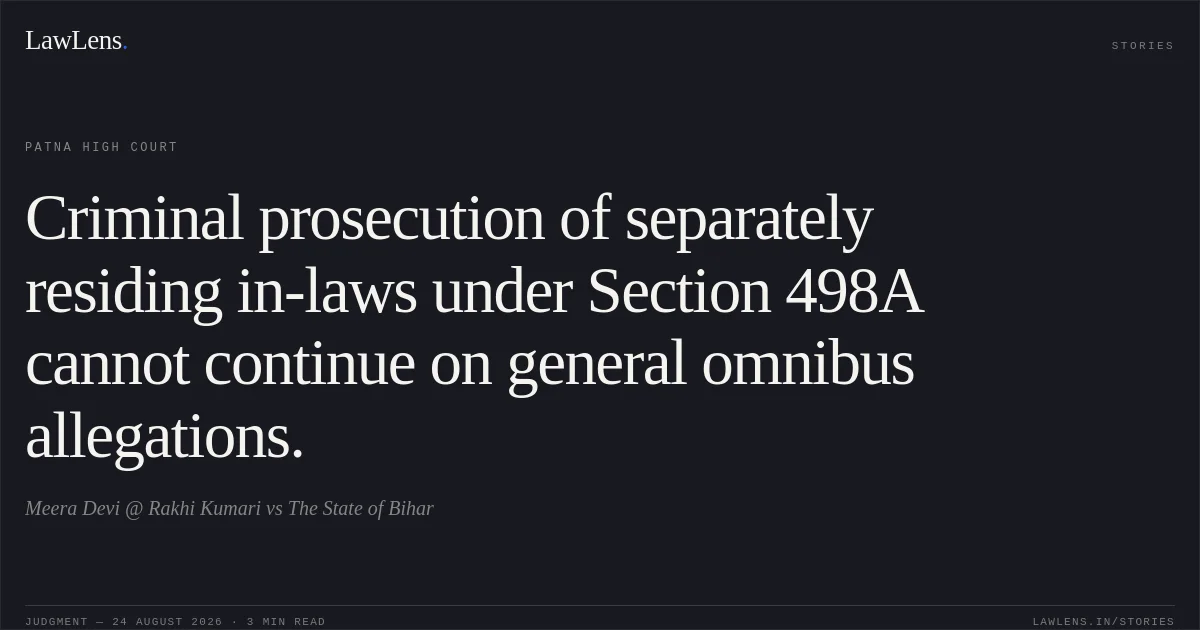
The Court held that the prosecution against the petitioners could not be sustained because the FIR contained no specific, proximate or credible allegations establishing their individual involvement in the alleged offences.
The cognizance order dated 22 March 2024 in G.R. No. 1039 of 2022, arising from Bettiah Nagar P.S. Case No. 198 of 2022, was quashed insofar as it related to Meera Devi and Hira Lal Mahto.
Source reference: para. 13The application was accordingly allowed, with the clarification that the observations would not prejudice the trial of the other accused.
Source reference: paras. 14–15Acts & Sections Cited
8 provisions across 3 statutes referred to in this judgment. Linked provisions open on LawLens.
Indian Penal Code, 18605
Dowry Prohibition Act, 19612
Code of Criminal Procedure, 19731
Original Court PDF
Meera Devi @ Rakhi KumarivsThe State of Bihar
Click to open original judgment
Original judgment, available to read, download and summarize on LawLens.in