Facts
The applicant (Accused No. 11) was implicated in FIR No. 11198068230274 of 2023 for allegedly allowing a dummy candidate to appear on his behalf in a Junior Clerk examination held on February 12, 2017
Source reference: p. 3While the alleged act occurred in 2017, the FIR was registered on April 14, 2023—nearly 11 years after the broader conspiracy began and several years after the specific exam
Source reference: p. 2The police charged the applicant under various sections of the IPC and the Information Technology Act, as well as Sections 12(1), 12(3), and 12(4) of the Gujarat Public Examination (Prevention of Unfair Means) Act, 2023
Source reference: p. 2-3The applicant moved the High Court to quash the charges specifically relating to the 2023 Examination Act, arguing that the law cannot be applied retrospectively to an act committed in 2017
Source reference: p. 3Issues
1. Whether the provisions of the Gujarat Public Examination (Prevention of Unfair Means) Act, 2023, can be applied retrospectively to offences allegedly committed prior to its enactment
Source reference: p. 3-42. Whether the invocation of the 2023 Examination Act against the applicant violates the fundamental rights guaranteed under Article 20(1) of the Constitution of India
Source reference: p. 4, 7Law Applied
Article 20(1) of the Constitution of India, which prohibits the conviction of a person for an act that was not an offence at the time of its commission (ex post facto laws)
Source reference: p. 4, 7Section 5 of the General Clauses Act, which establishes the presumption that statutes are prospective unless stated otherwise
Source reference: p. 3Legal maxim lex prospicit non respicit (the law looks forward, not backward)
Source reference: p. 5, 7Precedent set in Assistant Excise Commissioner, Kottayam v. Esthappan Cherian, which held that laws affecting substantive rights cannot be construed as retrospective without express legislative intent
Source reference: p. 5, 7Reasoning
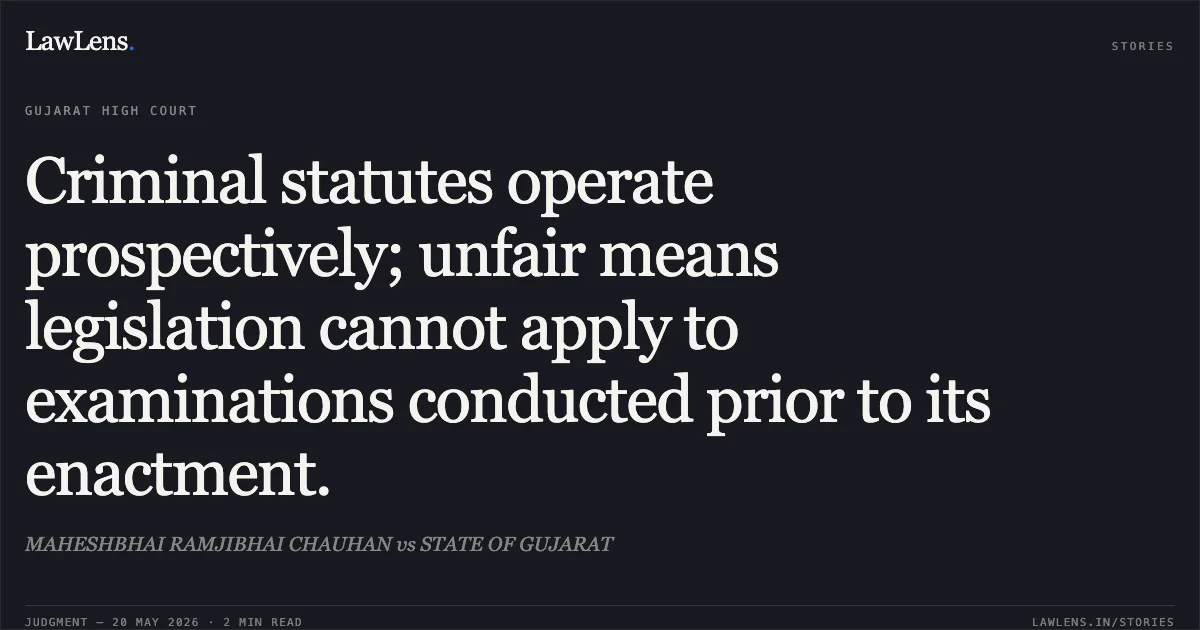
The court reasoned that the Gujarat Public Examination Act, 2023, came into force on March 3, 2023, whereas the alleged offence (using a dummy candidate) took place in 2017
Source reference: p. 3, 8Since the Act does not contains any provision for retrospective application, the court held that charging the applicant under this new law for past conduct violates the constitutional protection against ex post facto criminalization
Source reference: p. 7The court noted that a Coordinate Bench had already discharged co-accused in the same case on identical grounds, emphasizing that an individual can only be tried under the laws in force at the time of the alleged offence
Source reference: p. 4, 6Consequently, applying the 2023 Act to a 2017 incident was deemed "bad, illegal, and violative of fundamental rights"
Source reference: p. 7Holding
The Court allowed the application, answering that the 2023 Examination Act cannot be applied retrospectively
The Court quashed the FIR and subsequent proceedings (Sessions Case No. 64 of 2023) qua the applicant specifically for the offences under Sections 12(1), 12(3), and 12(4) of the Gujarat Public Examination (Prevention of Unfair Means) Act, 2023
Source reference: p. 9The charges under the Indian Penal Code and the Information Technology Act remain unaffected as they were not challenged in this petition
Source reference: p. 3, 9Acts & Sections Cited
12 provisions across 3 statutes referred to in this judgment. Each provision opens on LawLens.
Bharatiya Nagarik Suraksha Sanhita, 20231
Indian Penal Code, 1860
General Clauses Act, 18971
Original Court PDF
MAHESHBHAI RAMJIBHAI CHAUHANvsSTATE OF GUJARAT
Click to open original judgment
Original judgment, available to read, download and summarize on LawLens.in