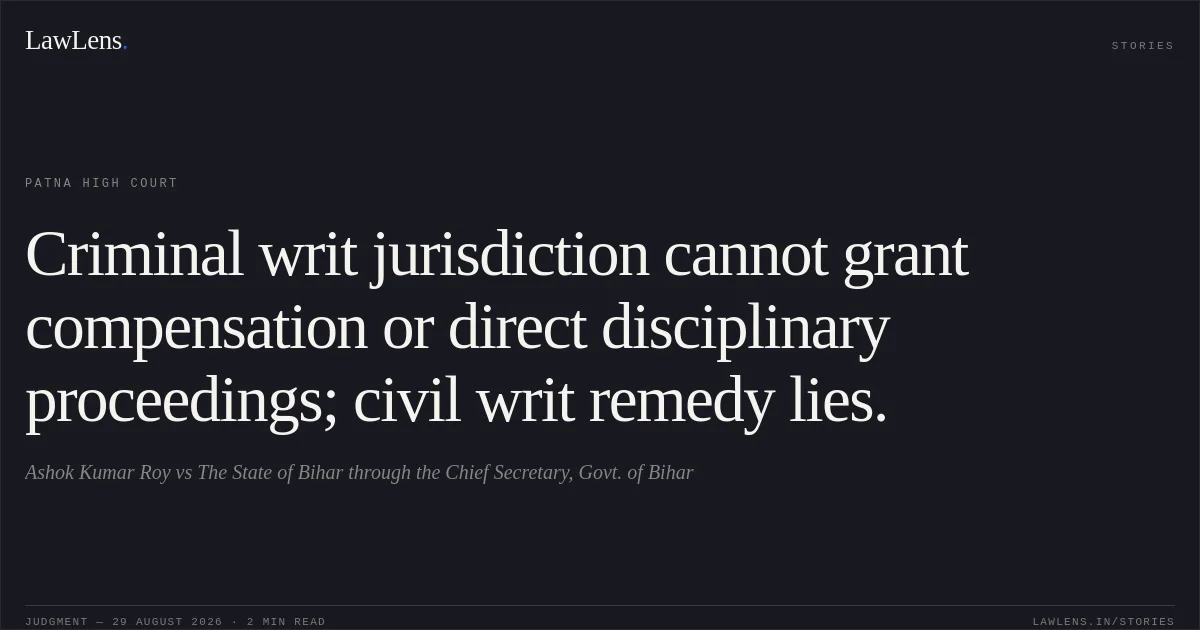
Facts
The petitioner approached the Patna High Court under Article 226 of the Constitution seeking compensation for alleged infringement of his Article 21 rights and disciplinary/departmental action against the Station House Officer, Chautham Police Station, for allegedly failing to register an FIR on his written complaint disclosing a cognizable offence.
Source reference: p.1, para. 2The petitioner relied on Imran Pratapgadhi v. State of Gujarat, 2025 INSC 410, and the principle stated in Lalita Kumari v. Government of Uttar Pradesh, (2014) 2 SCC 1, concerning action against police officers who fail to register an FIR in appropriate cases.
Source reference: p.2, para. 3Issues
Whether a criminal writ petition under Article 226 is maintainable for seeking compensation for alleged infringement of the petitioner’s fundamental rights.
Source reference: p.2, paras. 3–4Whether a criminal writ petition is maintainable for seeking disciplinary or departmental proceedings against a police officer for allegedly failing to register an FIR.
Source reference: p.2–3, paras. 3–4Whether the petitioner should be granted liberty to pursue an appropriate remedy before the competent forum.
Source reference: p.4, paras. 5–6Law Applied
The Court held that the maintainability of a criminal writ depends on whether the relief falls within the recognized categories of criminal writ jurisdiction, including quashing of FIRs or proceedings, police protection, proper investigation, police harassment, registration of FIRs, custody-related reliefs, and other specified criminal matters.
Source reference: p.2–3, para. 4It relied on S.A.L. Narayan Row v. Ishwarlal Bhagwandas, (1965) 57 ITR 149, for the principle that proceedings seeking enforcement of civil rights and consequential relief such as damages or compensation are civil proceedings.
Source reference: p.3–4, para. 4The Court distinguished the principles concerning police officers’ failure to register FIRs discussed in Lalita Kumari and quoted in Imran Pratapgadhi, holding that the nature of the relief sought, rather than the fact that the underlying dispute arose from a criminal matter, determines the appropriate jurisdiction.
Source reference: p.2–4, paras. 3–4Reasoning
The Court found the petitioner’s reliance on the criminal context of the alleged misconduct misconceived. Although the grievance concerned the alleged non-registration of an FIR, the reliefs actually sought were compensation and initiation of disciplinary or departmental proceedings against the SHO.
Source reference: p.2–3, paras. 3–4Those remedies entail civil consequences and did not fall within any of the enumerated categories of criminal writ jurisdiction, including the category relating to registration of FIRs. Applying the principle in S.A.L. Narayan Row, the Court held that the character of the final relief governs jurisdiction; accordingly, the petition could not be entertained as a criminal writ merely because the alleged misconduct arose in connection with a criminal proceeding.
Source reference: p.2–4, para. 4Holding
The Court held that a criminal writ petition was not maintainable for claiming compensation or seeking disciplinary/departmental action against the SHO for alleged failure to register an FIR.
The writ petition was disposed of without granting the reliefs sought. The petitioner was granted liberty to pursue an appropriate remedy before the appropriate forum in accordance with law.
Source reference: p.4, para. 6Original Court PDF
Ashok Kumar RoyvsThe State of Bihar through the Chief Secretary, Govt. of Bihar
Click to open original judgment
Original judgment, available to read, download and summarize on LawLens.in
![A police constable cannot be removed for unauthorized absence without a Rule 359-compliant inquiry.. Mohammad Sidiq Khan vs D/o Home Ut Of Jammu & Kashmir. CAT - ['Srinagar']. LawLens](/stories/thumbnails/a-police-constable-cannot-be-removed-for-unauthorized-absence-without-a-rule-359-compliant-7b43fc316bd94f22a62676153bbc9d54.webp)
![A Review DPC lacks authority to determine or alter inter se seniority.. SAURABH KUMAR vs REVENUE. CAT - ['Patna']. LawLens](/stories/thumbnails/a-review-dpc-lacks-authority-to-determine-or-alter-inter-se-seniority-4b21640f20af46fcabdfc8273d2ce959.webp)