Facts
The three petitions arose from cross-cases relating to an incident occurring on the night of 7–8 August 2016 in the jurisdiction of Police Station GTB Enclave.
Source reference: para. 2–5FIR No. 305/2016 was registered on Rajan’s complaint alleging that Sachin Kumar Sharma and Pawan assaulted him with an iron rod and a sharp object; offences under Sections 307/308/34 IPC were invoked.
Source reference: para. 2–3FIR No. 306/2016 was registered on Sachin Kumar Sharma’s complaint alleging that Rajan and Vipin assaulted him with an iron rod, invoking Section 308/34 IPC.
Source reference: para. 4FIR No. 307/2016 was registered on the complaint of Sachin’s mother, alleging assault, robbery, damage to a vehicle and tearing of her clothes by Rajan, Sunny, Sandhya, Sumit and Soniya.
Source reference: para. 5During the pendency of the proceedings, all parties entered into an amicable settlement recorded in a Memorandum of Understanding dated 2 June 2025.
Source reference: paras. 6–7The complainants and injured persons appeared before the Court, confirmed the settlement, and stated that it had been entered into voluntarily and without coercion or pressure.
Source reference: paras. 8–10The cases were pending at the stage of prosecution evidence.
Source reference: para. 13Issues
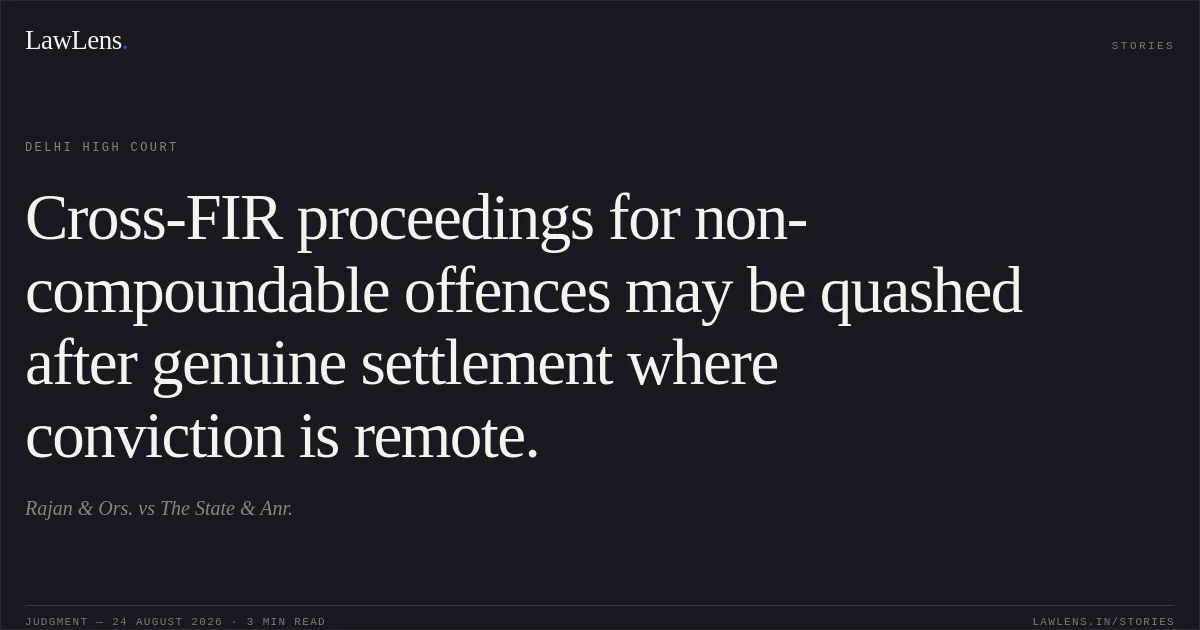
Whether the High Court could exercise its inherent jurisdiction under Section 528 of the Bharatiya Nagarik Suraksha Sanhita, 2023 to quash proceedings arising from non-compoundable offences under Sections 307/308/34 IPC on the basis of an amicable settlement between the parties?
Source reference: paras. 11–14Whether, in view of the voluntary settlement and the circumstances of the cases, continuation of the criminal proceedings would serve any meaningful purpose or whether the possibility of conviction had become remote and bleak?
Source reference: paras. 11–14Law Applied
The Court applied Section 528 of the Bharatiya Nagarik Suraksha Sanhita, 2023, which preserves the High Court’s inherent power to pass orders necessary to give effect to any order under the Sanhita, prevent abuse of process, or secure the ends of justice.
Source reference: para. 14It relied on Gian Singh v. State of Punjab & Anr., (2012) 10 SCC 303, recognising that the High Court may quash criminal proceedings in appropriate cases involving private disputes even where the offences are non-compoundable.
Source reference: para. 11It further relied on Narinder Singh & Ors. v. State of Punjab & Anr., (2014) 6 SCC 466, under which proceedings may be quashed where the Court is satisfied that continuation would serve no meaningful purpose and the likelihood of conviction is remote and bleak.
Source reference: para. 11The Court also referred to Antonnette Promilla Fernandez v. State (NCT of Delhi) & Anr., 2026 SCC OnLine Del 809, and Mohd. Rashid & Ors. v. State (NCT of Delhi) & Anr., CRL.M.C. 8182/2025, decided on 18 November 2025, where proceedings involving Section 308/34 IPC were quashed following amicable settlements.
Source reference: para. 12Reasoning
The Court found that the disputes arose from a single neighbourhood incident and had been amicably resolved by all concerned complainants and injured persons through a written settlement.
Source reference: paras. 2, 6–10The parties personally confirmed the settlement and its voluntariness, eliminating any apparent concern regarding coercion or undue influence.
Source reference: para. 10Although the alleged offences were non-compoundable, the principles in Gian Singh and Narinder Singh permitted quashing where the dispute was essentially private, the parties had restored cordial relations, and the continuation of the prosecution would not advance any meaningful purpose.
Source reference: para. 11Since all three matters were pending at the prosecution-evidence stage and the complainants no longer wished to pursue them, the Court concluded that the prospect of a useful prosecution was remote and that keeping the proceedings alive would serve no real purpose.
Source reference: para. 13Exercise of inherent jurisdiction was therefore considered necessary to secure the ends of justice and facilitate restoration of cordiality between the parties.
Source reference: para. 14Holding
The Court answered the issues in favour of the petitioners and exercised its inherent jurisdiction under Section 528 BNSS, 2023.
FIR Nos. 305/2016, 306/2016 and 307/2016, registered at Police Station GTB Enclave, together with all consequential proceedings, were quashed.
Source reference: para. 15The parties were directed to submit the Memorandum of Understanding dated 2 June 2025 and the original affidavits before the Trial Court within four weeks so that they could form part of the Trial Court record.
Source reference: para. 16The petitions and pending applications were accordingly disposed of.
Source reference: paras. 17–18Acts & Sections Cited
4 provisions across 2 statutes referred to in this judgment. Linked provisions open on LawLens.
Indian Penal Code, 18603
Bharatiya Nagarik Suraksha Sanhita, 20231
Original Court PDF
Rajan & Ors.vsThe State & Anr.
Click to open original judgment
Original judgment, available to read, download and summarize on LawLens.in