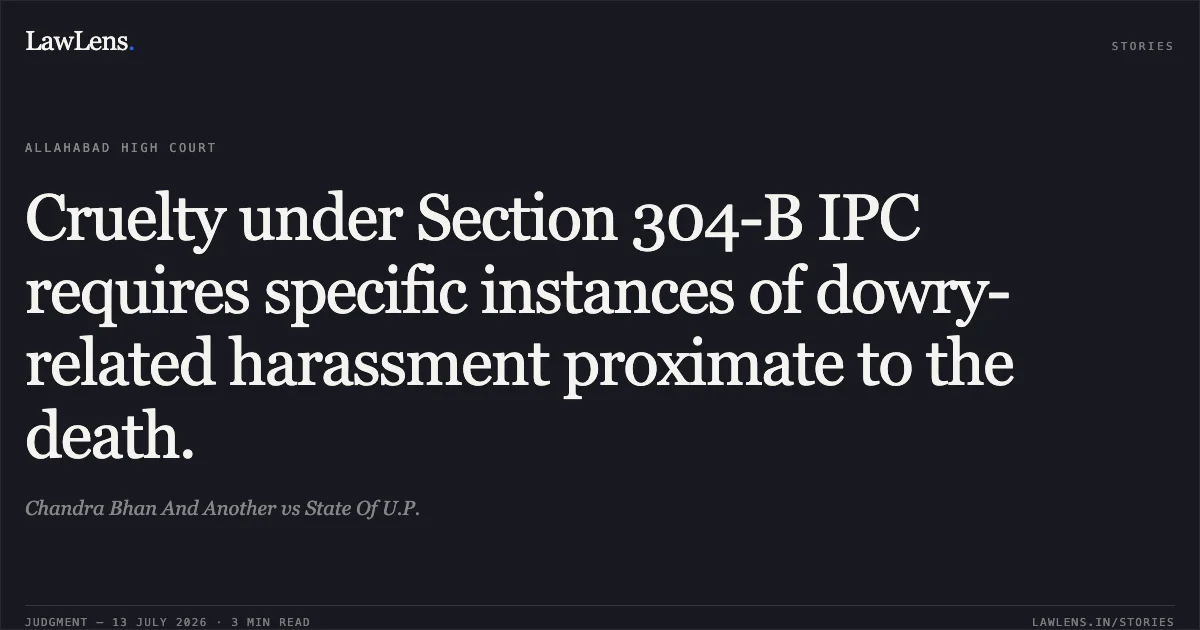
Facts
The Appellant, Chandra Bhan, married the deceased, Munni Devi, approximately 8-9 months prior to her death on March 1, 1988
Source reference: para. 4The first informant (the father of the deceased) alleged that the Appellant and his relatives harassed and physically tortured the deceased for failing to provide a scooter or ₹10,000 in cash as additional dowry
Source reference: para. 4On February 29, 1988, the deceased was brought to the hospital by the Appellant with 90% burn injuries; she died the following morning
Source reference: para. 29, 33The Trial Court convicted the Appellant under Sections 304-B and 498-A of the IPC, sentencing him to life imprisonment
Source reference: para. 2The Appellant challenged the conviction, contending that the death was not related to dowry and that he sustained 15% burn injuries while attempting to save his wife
Source reference: para. 30, 51Issues
1. Whether the prosecution proved beyond reasonable doubt that cruelty or harassment was committed in connection with a demand for dowry under Sections 498-A and 304-B IPC
Source reference: para. 132. Whether the prosecution established a "proximate and live link" between the alleged dowry demand and the death to satisfy the "soon before death" requirement
Source reference: para. 44, 453. Whether the conviction could be sustained based on the dying declaration and the conduct of the Appellant
Source reference: para. 46, 52Law Applied
The court applied Section 304-B (Dowry Death) and Section 498-A (Cruelty) of the IPC
Source reference: para. 35It relied on Section 113-B of the Indian Evidence Act, which creates a presumption of dowry death only after the prosecution proves the deceased was subjected to cruelty "soon before her death" in connection with dowry
Source reference: para. 36The court followed Satbir Singh v. State of Haryana (2021), defining "soon before" as requiring a "proximate and live link" rather than being "immediately before"
Source reference: para. 44Furthermore, it applied the principle from Shamnsaheb M. Multtani v. State of Karnataka (2001) regarding the distinction between Sections 302 and 304-B IPC, noting they are not "cognate offences" for the purpose of Section 222 CrPC
Source reference: para. 55, 56Reasoning
The Court found the demand for dowry unproven because the informant’s testimony regarding the scooter demand was vague and lacked specific instances
Source reference: para. 43A letter written by the deceased (Ext. Ka-1) dated November 29, 1987, made no mention of dowry but instead highlighted her distress over the Appellant’s alleged illicit relationship with his sister-in-law
Source reference: para. 18, 19, 48As the last reported instance of harassment occurred in October 1987 and the death occurred in March 1988, the Court held there was no "proximate and live link" to satisfy the "soon before death" mandate of Section 304-B
Source reference: para. 45Regarding the dying declaration, although it alleged the Appellant poured kerosene, it notably omitted any mention of dowry harassment
Source reference: para. 47, 50The Court also noted the Appellant’s conduct—15% burns on his person and his act of taking the deceased to the hospital—suggested an attempt to save her rather than a dowry-related murder
Source reference: para. 46, 51, 57Holding
The Court answered the issues in the negative, holding that the prosecution failed to prove the essential ingredients of Sections 304-B and 498-A IPC
The appeal was allowed, the judgment dated October 4, 1989, was set aside, and the Appellant was acquitted of all charges
Source reference: para. 59, 61The Court further held that the Appellant could not be convicted under Section 302 IPC in the absence of a specific charge or opportunity to defend against a murder allegation during the Section 313 CrPC statement
Source reference: para. 54, 58Acts & Sections Cited
7 provisions across 3 statutes referred to in this judgment. Each provision opens on LawLens.
Indian Penal Code, 18601
Code of Criminal Procedure, 19733
Original Court PDF
Chandra Bhan And AnothervsState Of U.P.
Click to open original judgment
Original judgment, available to read, download and summarize on LawLens.in


