Facts
Dalvir Singh was allegedly travelling from Bhubaneswar to Ghaziabad on 28 April 2018 with a valid journey ticket. While Purushottam Express was passing near Danwar Railway Station, he allegedly fell from the moving train due to a jerk and the push of fellow passengers, sustaining fatal injuries.
Source reference: p.3, para. 2The Station Master’s Memo recorded that a person had fallen from Train No. 12801 and was lying near the station.
Source reference: p.5, para. 7The Railway Claims Tribunal dismissed the claim, holding that the deceased was not proved to be a bona fide passenger and that the injuries indicated that he had been run over as a trespasser; the Tribunal relied upon the non-recovery of the journey ticket, an old ticket relating to another journey, the nature of the injuries, and the DRM Report.
Source reference: p.3, para. 3; p.4, para. 5The claimants challenged that decision under Section 23 of the Railway Claims Tribunal Act, 1987.
Source reference: p.3, para. 1The High Court also condoned a delay of 350 days in filing the appeal, considering the appellants’ economic circumstances and the beneficial nature of the legislation.
Source reference: p.2, paras. 3–5Issues
Whether the deceased was a bona fide passenger despite the non-recovery of the alleged journey ticket.
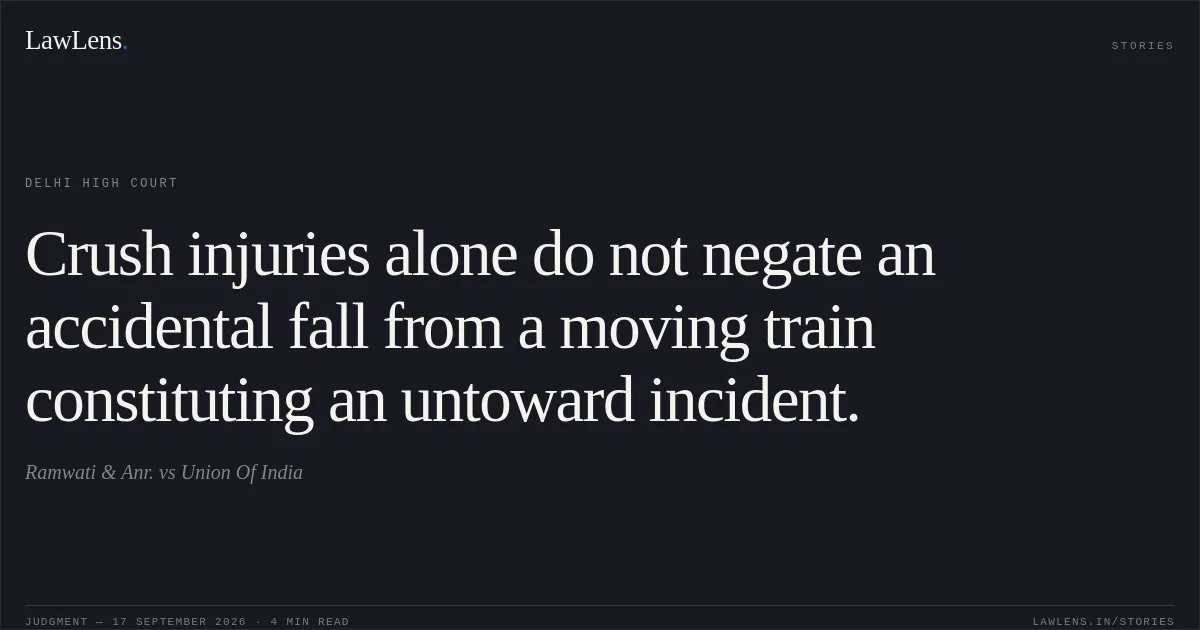
Source reference: p.4, para. 6Whether the deceased’s death resulted from an accidental fall from a moving train, constituting an “untoward incident” under Sections 123(c) and 124-A of the Railways Act, 1989.
Source reference: p.3, para. 3; p.5, para. 7Whether the Tribunal was justified in treating the deceased as a trespasser or concluding, solely from the nature of his injuries, that he had been run over.
Source reference: p.5, para. 7; p.6, paras. 8–9Law Applied
The Court applied Section 23 of the Railway Claims Tribunal Act, 1987, governing appeals from Tribunal orders, and Sections 123(c) and 124-A of the Railways Act, 1989, concerning “untoward incidents” and the Railway’s statutory liability for resulting death or injury.
Source reference: p.3, para. 1; p.3, para. 3Relying on Union of India v. Rina Devi, (2019) 3 SCC 572, and Lata v. Union of India, 2026 SCC OnLine SC 1350, the Court held that mere absence or non-recovery of a ticket does not, by itself, disprove bona fide passenger status; the claimant must first place relevant facts and circumstances on record, after which the burden shifts to the Railways.
Source reference: p.4, para. 6The Court further relied on Prempal Singh & Anr. v. Union of India, 2018 SCC OnLine Del 9571, for the principle that the possibility of a passenger falling from a moving train and subsequently coming under its wheels cannot be rejected merely because the body bears crush or amputation injuries.
Source reference: p.6, para. 8In condoning delay, the Court adopted a liberal approach consistent with the beneficial nature of the legislation, referring to Mohsina v. Union of India and Reshma v. Union of India.
Source reference: p.2, paras. 3–5Reasoning
The Court found that the testimony of the deceased’s wife and step-son established that he had travelled from Bhubaneswar towards Ghaziabad, possessed a journey ticket, and had informed his step-son of the journey; their evidence remained materially unshaken in cross-examination.
Source reference: p.4, para. 6The Railways failed to rebut this evidence, and therefore the deceased was held to be a bona fide passenger notwithstanding the missing ticket.
Source reference: p.4, para. 6On the second issue, the contemporaneous Station Master’s Memo supported the account that the deceased had fallen from Train No. 12801.
Source reference: p.5, para. 7Although the injuries were consistent with the deceased having come under the train, they did not conclusively establish that he had been a trespasser on the track. No direct evidence showed that he was crossing the track or was otherwise present there as a trespasser.
Source reference: p.5, para. 7The post-mortem report did not rule out an accidental fall, while the DRM Report was prepared much later, after institution of the claim, and was not proved through any witness.
Source reference: p.6, paras. 8–9Accordingly, the Tribunal had impermissibly treated the injuries and the later DRM Report as conclusive, disregarding the contemporaneous railway record and the absence of contrary direct evidence.
Source reference: p.6, para. 10Holding
The High Court held that the deceased was a bona fide passenger and that his death resulted from an accidental fall from a moving train, constituting an “untoward incident” under the Railways Act, 1989.
The Tribunal’s judgment dated 6 December 2021 was set aside, and the matter was remanded to the Tribunal to assess the compensation payable in accordance with law and direct its disbursement within two months of receiving the judgment.
Source reference: p.6, para. 11The appeal was allowed and disposed of accordingly; the matter was directed to be listed before the Tribunal on 7 October 2026.
Source reference: p.7, paras. 11–13Acts & Sections Cited
2 provisions across 2 statutes referred to in this judgment. Each provision opens on LawLens.
Railway Claims Tribunal Act, 19871
Railways Act, 19891
Original Court PDF
Ramwati & Anr.vsUnion Of India
Click to open original judgment
Original judgment, available to read, download and summarize on LawLens.in