Facts
On 11.11.2015, during Deepawali, an altercation broke out between the informant’s family and the appellants’ sons over bursting crackers
Source reference: para. 2(i)The appellants joined the fight; Sudarshan Gupta allegedly struck the deceased, Janardan Prasad, on the head with a kapa (sharp-edged weapon) while others assaulted the informant and his brother
Source reference: para. 2(ii), 4The deceased died due to an ante-mortem head injury
Source reference: para. 2(iv)The Trial Court convicted the appellants under Sections 302/34 (Murder), 323/34 (Voluntary causing hurt), and 452 (House-trespass) of the IPC, and the SC/ST Act
Source reference: para. 1, 30The appellants challenged this conviction, arguing the death resulted from a single blow during a sudden provocation without premeditation
Source reference: para. 32, 38Issues
1. Whether the act of inflicting a single blow during a sudden fight amounts to murder under Section 302 or culpable homicide not amounting to murder under Section 304 Part II of the IPC?
Source reference: para. 39, 422. Whether the prosecution established the common intention of the appellants to commit murder?
Source reference: para. 48Law Applied
The Court applied Section 299 (Culpable Homicide) and Section 300 (Murder) of the IPC, specifically focusing on Exception 4 to Section 300, which mitigates murder to culpable homicide if committed without premeditation in a sudden fight
Source reference: para. 38, 46It relied on the precedent Anbazhagan v. State of T.N. (2024), which established that a single injury inflicted without premeditation in a sudden quarrel usually leads to an inference of "guilty knowledge" rather than "guilty intention," warranting a conviction under Section 304 Part II IPC
Source reference: para. 38, 66.13The Court also applied Sections 323, 34, and 452 of the IPC regarding hurt, common intention, and house-trespass
Source reference: para. 47Reasoning
The Court observed that while the medical evidence (PW-7) confirmed the fatal nature of the head injury, it also verified that the deceased sustained only one single blow
Source reference: para. 43The incident originated from a trivial dispute over crackers, suggesting the act was committed in the "heat of passion" during a sudden fight
Source reference: para. 45, 46Applying the Anbazhagan test, the Court found that although the appellant Sudarshan Gupta had the knowledge that a kapa blow to the head could cause death, there was no evidence of premeditated intention to kill or acting in a "cruel or unusual manner"
Source reference: para. 45, 46Regarding the co-appellant Vijay Kumar, his participation in the sudden fight while armed supported common intention for the lesser offense but not for murder
Source reference: para. 48, 50Holding
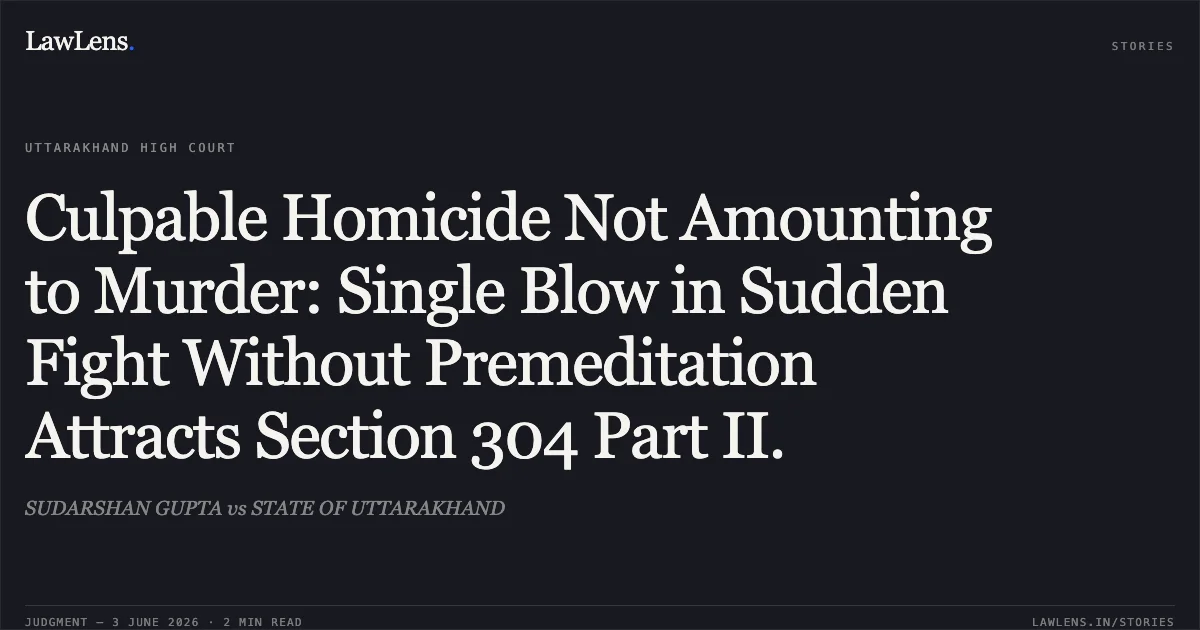
The High Court partly allowed the appeal, modifying the conviction from Section 302/34 IPC to Section 304 Part II IPC
Sudarshan Gupta was convicted under Section 304 Part II; Vijay Kumar was convicted under Section 304 Part II read with Section 34. Both were sentenced to 7 years of rigorous imprisonment. The convictions and sentences under Sections 452 and 323/34 IPC were upheld. The appellants were directed to serve the remaining period of their 7-year modified sentence
Source reference: para. 49, 50, 47, 53Acts & Sections Cited
9 provisions across 3 statutes referred to in this judgment. Each provision opens on LawLens.
Indian Penal Code, 18607
Scheduled Castes and the Scheduled Tribes (Prevention of Atrocities) Act, 19891
Code of Criminal Procedure, 19731
Original Court PDF
SUDARSHAN GUPTAvsSTATE OF UTTARAKHAND
Click to open original judgment
Original judgment, available to read, download and summarize on LawLens.in


