Facts
The Petitioner was convicted under Section 509 of the Indian Penal Code (IPC) for intentionally insulting the modesty of a woman.
Source reference: p. 2The complainant, then aged approximately 19, alleged that while traveling in the Delhi Metro on 16.11.2018, the Petitioner stood in front of her, unzipped his trousers, and exposed his private parts.
Source reference: p. 2The Petitioner denied the allegations, claiming the case was a fabrication following a verbal altercation over a reserved senior citizen seat.
Source reference: p. 3The Trial Court acquitted him of Section 354A(1)(i) IPC (due to Lack of physical contact) but convicted him under Section 509 IPC, sentencing him to six months' imprisonment and a ₹5,000 fine.
Source reference: p. 3The Appellate Court affirmed the conviction on 11.03.2026.
Source reference: p. 4The Petitioner moved the High Court in revision, challenging the legality of the conviction given the absence of independent witnesses or CCTV footage.
Source reference: p. 5Issues
1. Whether the High Court, in its revisional jurisdiction, should interfere with concurrent findings of fact regarding the credibility of the prosecutrix's testimony
Source reference: p. 6, para. 112. Whether the act of a male unzipping his trousers and exposing himself to a woman in public fulfills the essential ingredient of "intention to insult modesty" under Section 509 IPC
Source reference: p. 9, para. 183. Whether the absence of independent public witnesses or CCTV footage is fatal to the prosecution's case when the prosecutrix's testimony is found to be reliable
Source reference: p. 10, para. 19Law Applied
The Court applied Section 438 of the Bhartiya Nagarik Suraksha Sanhita (BNSS), corresponding to Section 397 of the CrPC, which limits revisional jurisdiction to correcting patent defects, errors of jurisdiction, or gross miscarriages of justice rather than re-appreciating evidence.
Source reference: p. 6, para. 11-12Regarding Section 509 of the IPC, the Court defined the offense as requiring an act intended to insult a woman's modesty.
Source reference: p. 8, para. 15It relied on State of Kerala v. Puttumana Illath Jathavedan Namboodiri to define the narrow scope of revision.
Source reference: p. 6Ganesan v. State for the principle that the credible testimony of a prosecutrix is sufficient for conviction without corroboration.
Source reference: p. 8, para. 16Appabhai v. State of Gujarat regarding the common reluctance of public witnesses to join proceedings.
Source reference: p. 10, para. 19Reasoning
The Court observed that the prosecutrix's testimony was consistent across her initial complaint, Section 164 CrPC statement, and court deposition.
Source reference: p. 9, para. 16It rejected the Petitioner’s argument regarding the lack of independent witnesses, noting that under Appabhai, the absence of corroborative public evidence does not invalidate a reliable primary witness.
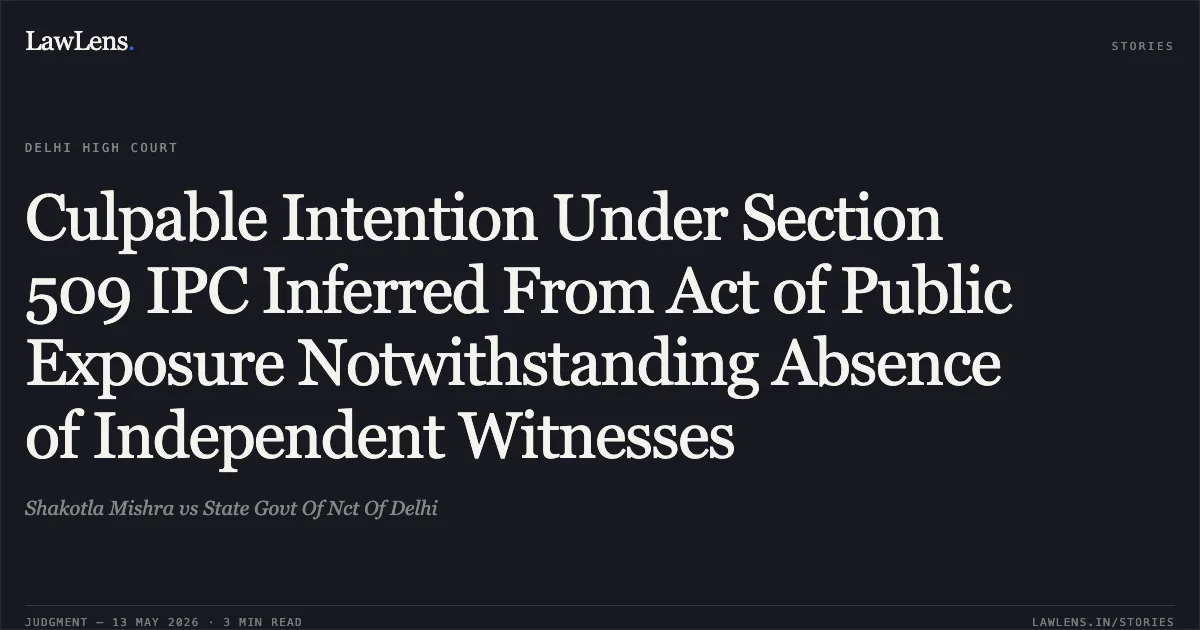
Source reference: p. 10, para. 19The Court reasoned that "intention" under Section 509 IPC was inherent in the act itself; unzipping one's trousers and flashing a woman in a public metro is, by its nature, intended to shock and insult her modesty, particularly as there was no claim of mistake or forgetfulness.
Source reference: p. 9-10, para. 18The Court found no perversity or jurisdictional error in the lower courts' dismissal of the Petitioner's alternate "seat dispute" theory.
Source reference: p. 10, para. 18Holding
The High Court dismissed the revision petition, holding that the concurrent findings did not suffer from any illegality or material irregularity.
The Court affirmed that the sole testimony of a credible prosecutrix is sufficient to sustain a conviction.
Source reference: p. 8-9It further held that a six-month sentence was proportionate and even "lenient" given the three-year maximum provided under Section 509 IPC.
Source reference: p. 10, para. 20The conviction and sentence were upheld.
Source reference: p. 11, para. 22Acts & Sections Cited
2 provisions across 2 statutes referred to in this judgment. Each provision opens on LawLens.
Bharatiya Nagarik Suraksha Sanhita, 20231
Indian Penal Code, 18601
Original Court PDF
Shakotla MishravsState Govt Of Nct Of Delhi
Click to open original judgment
Original judgment, available to read, download and summarize on LawLens.in