Facts
The appellant, an Assistant Professor, was convicted under Section 354 IPC for allegedly summoning a student to his cabin on 21 November 2011 and touching her cheeks, shoulders and buttocks.
Source reference: paras. 3.1, 6The trial court sentenced him to five years’ rigorous imprisonment and a fine of ₹1,000
Source reference: paras. 3.1, 6On appeal, he challenged the conviction, relying, among other matters, on delay in lodging and forwarding the FIR, inconsistencies in the witnesses’ accounts, non-production of an alleged earlier complaint to college authorities, non-examination of the Principal, and failure to obtain call records
Source reference: paras. 8.1–8.14The High Court independently assessed the evidence, including the testimony of the prosecutrix and witnesses to the events said to have followed the incident
Source reference: paras. 10–17Issues
Whether the prosecution proved beyond reasonable doubt that the appellant committed an offence under Section 354 IPC
Source reference: para. 18Whether the conviction and sentence required interference in light of the alleged inconsistencies, delays, and omissions in the prosecution evidence
Source reference: paras. 18, 20–34Law Applied
Section 354 IPC penalises assault or criminal force against a woman with the requisite intention or knowledge to outrage her modesty.
Source reference: para. 20The prosecution bears the burden of proving guilt beyond reasonable doubt; the accused is not required to prove innocence, and a reasonable doubt must enure to the accused
Source reference: para. 20The Court also considered the principles in Hemraj v. State of Haryana, (2005) 10 SCC 614, and Allarakha Habib Menon v. State of Gujarat, (2024) 9 SCC 546, concerning the significance of unexplained omissions, suppression or non-production of material evidence, and non-examination of material witnesses when assessing the reliability of the prosecution case
Source reference: para. 25The appellant also invoked Section 114, Illustration (g), of the Evidence Act regarding the non-examination of the Principal
Source reference: para. 8.5Reasoning
The Court found that the alleged first complaint to the college authorities and the subsequent disciplinary action were not supported by contemporaneous records; the Principal, identified as a material witness, was not examined; and the prosecution evidence left unresolved inconsistencies about the complaint and the events immediately following the alleged incident
Source reference: paras. 21–23, 30–31The FIR was lodged about two days after the incident, with no specific explanation recorded, and reached the Magistrate the following day
Source reference: para. 24The Court further noted inconsistencies concerning Ex.P.1 and the roles of the witnesses, as well as the failure to obtain call records despite the prosecution’s claim that the appellant had summoned the prosecutrix by telephone
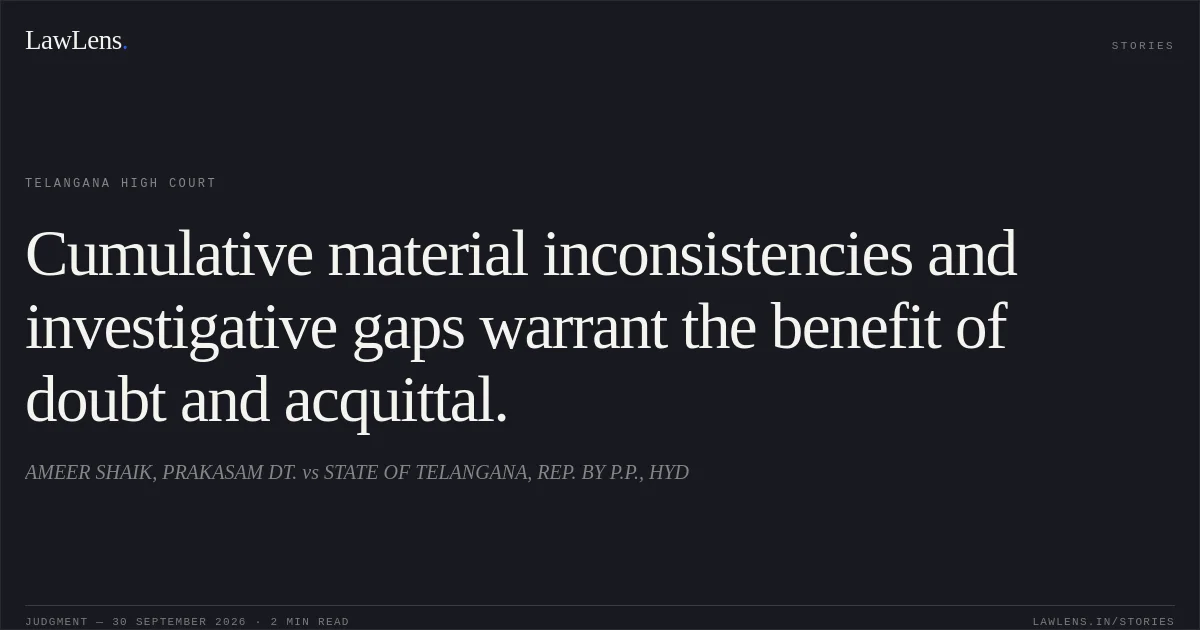
Source reference: paras. 20–21, 26, 28–29Although individual deficiencies might not have been decisive, their cumulative effect, considered alongside the principal witness’s evidence, left reasonable doubt about the occurrence as alleged and the appellant’s involvement
Source reference: paras. 31–34Holding
The Court held that the prosecution had not proved the appellant’s guilt under Section 354 IPC beyond reasonable doubt.
It allowed the appeal, set aside the conviction and sentence, and acquitted the appellant by extending the benefit of doubt
Source reference: para. 35Any fine paid was ordered to be refunded in accordance with law; bail bonds, if any, were cancelled, and pending miscellaneous applications were closed
Source reference: para. 35Acts & Sections Cited
4 provisions across 2 statutes referred to in this judgment. Each provision opens on LawLens.
Indian Penal Code, 18602
Code of Criminal Procedure, 19732
Original Court PDF
AMEER SHAIK, PRAKASAM DT.vsSTATE OF TELANGANA, REP. BY P.P., HYD
Click to open original judgment
Original judgment, available to read, download and summarize on LawLens.in