Facts
The parties married on 5 May 2009 according to Hindu rites and customs and had two children, born in 2010 and 2015.
Source reference: para. 2The appellant-wife instituted Matrimonial Divorce Case No. 333 of 2019 seeking dissolution of marriage on grounds including physical and mental cruelty, alleging ill-treatment, assault, demand-related misconduct, and breakdown of the matrimonial relationship.
Source reference: paras. 1, 3The respondent-husband denied the allegations, asserted that the wife had voluntarily left the matrimonial home in April 2019, and alleged that she had an extramarital relationship with one Armaan Hussain; the wife denied the allegation of adultery.
Source reference: para. 4The Principal Judge, Family Court, Muzaffarpur dismissed the matrimonial case on 20 September 2024, leading to the present appeal.
Source reference: para. 1The parties had remained separately since April 2019.
Source reference: para. 8Issues
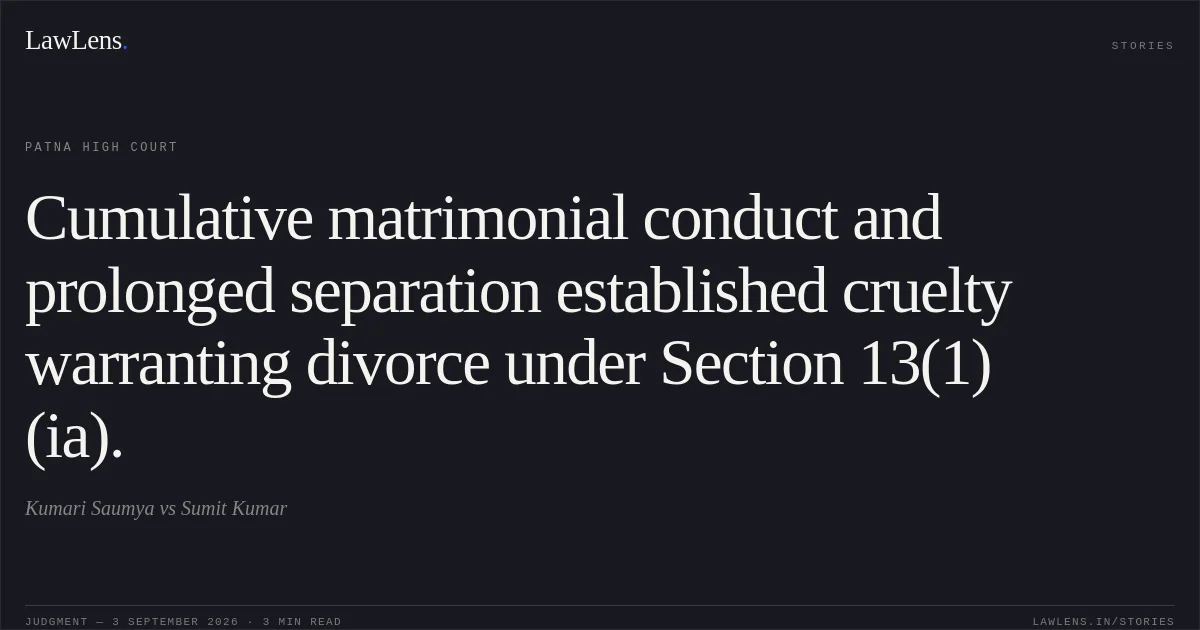
Whether the appellant-wife established matrimonial cruelty under Section 13(1)(ia) of the Hindu Marriage Act, 1955, warranting dissolution of the marriage despite the Family Court’s dismissal of her petition.
Source reference: paras. 5–11Whether the unproved allegations concerning impotence, artificial insemination, and the respondent’s alleged relationship with Armaan Hussain could independently justify a decree of divorce.
Source reference: paras. 7, 9Whether the appellant was entitled to permanent alimony under Section 25 of the Hindu Marriage Act and, if so, what amount would be just and reasonable.
Source reference: paras. 12–16What consequential directions were required regarding payment of alimony, adjustment of maintenance, the children’s rights, and pending proceedings.
Source reference: para. 17Law Applied
The Court applied Section 13(1)(ia) of the Hindu Marriage Act, 1955, under which a marriage may be dissolved where one spouse has treated the other with cruelty.
Source reference: para. 5Relying on Shobha Rani v. Madhukar Reddi, (1988) 1 SCC 105, the Court held that cruelty may be physical or mental, intentional or unintentional, and must be assessed by considering the nature of the conduct and its effect on the complaining spouse.
Source reference: para. 5The Court further relied on Samar Ghosh v. Jaya Ghosh, (2007) 4 SCC 511, which identifies sustained abusive or humiliating conduct, conduct affecting mental health, and prolonged separation indicating that the matrimonial bond is beyond repair as illustrative instances of mental cruelty, while distinguishing ordinary quarrels and trivial irritations.
Source reference: para. 6The Court held that unproved allegations could not themselves constitute the basis for divorce.
Source reference: para. 7For permanent alimony, the Court applied Section 25 of the Hindu Marriage Act and the principles in Rajnesh v. Neha, (2021) 2 SCC 324, requiring a realistic assessment of the parties’ income, needs, liabilities, earning capacity, and other circumstances, without applying a rigid mathematical formula.
Source reference: para. 12Reasoning
The Court assessed the parties’ matrimonial relationship cumulatively rather than relying on the unsubstantiated allegations regarding impotence, artificial insemination, or adultery.
Source reference: paras. 7, 9Although prolonged separation was not treated as an independent statutory ground for divorce, the parties’ separation since April 2019, the prolonged matrimonial discord, and the failure to restore the relationship despite the passage of time were considered relevant circumstances demonstrating that the appellant could not reasonably be expected to continue the relationship.
Source reference: para. 8Applying the principles of Shobha Rani and Samar Ghosh, the Court concluded that the cumulative conduct and circumstances established matrimonial cruelty under Section 13(1)(ia).
Source reference: paras. 5–6, 10In determining alimony, the Court considered the respondent’s disclosed monthly income of ₹3,70,000, the duration of the marriage, the appellant’s lack of independent income, her reasonable requirements, and the respondent’s financial responsibilities towards the children.
Source reference: paras. 12–16On that basis, it fixed consolidated permanent alimony at ₹71,66,000.
Source reference: para. 16Holding
The appeals were allowed.
The Family Court’s judgment dated 20 September 2024 was set aside, and the marriage solemnised on 5 May 2009 was dissolved by a decree of divorce under Section 13(1)(ia) of the Hindu Marriage Act.
Source reference: para. 17The respondent-husband was directed to pay ₹71,66,000 to the appellant-wife as permanent alimony in two equal instalments of ₹35,83,000 each, payable within three and six months respectively from the date of judgment.
Source reference: para. 17Amounts already paid towards maintenance were to be adjusted, the independent rights and requirements of the minor children were preserved, and the parties were directed to withdraw pending cases after payment of the permanent alimony.
Source reference: para. 17Miscellaneous Appeal No. 133 of 2025, described as the analogous matter, was disposed of accordingly.
Source reference: para. 19Acts & Sections Cited
2 provisions across 1 statute referred to in this judgment. Each provision opens on LawLens.
Hindu Marriage Act, 19552
Original Court PDF
Kumari SaumyavsSumit Kumar
Click to open original judgment
Original judgment, available to read, download and summarize on LawLens.in