Facts
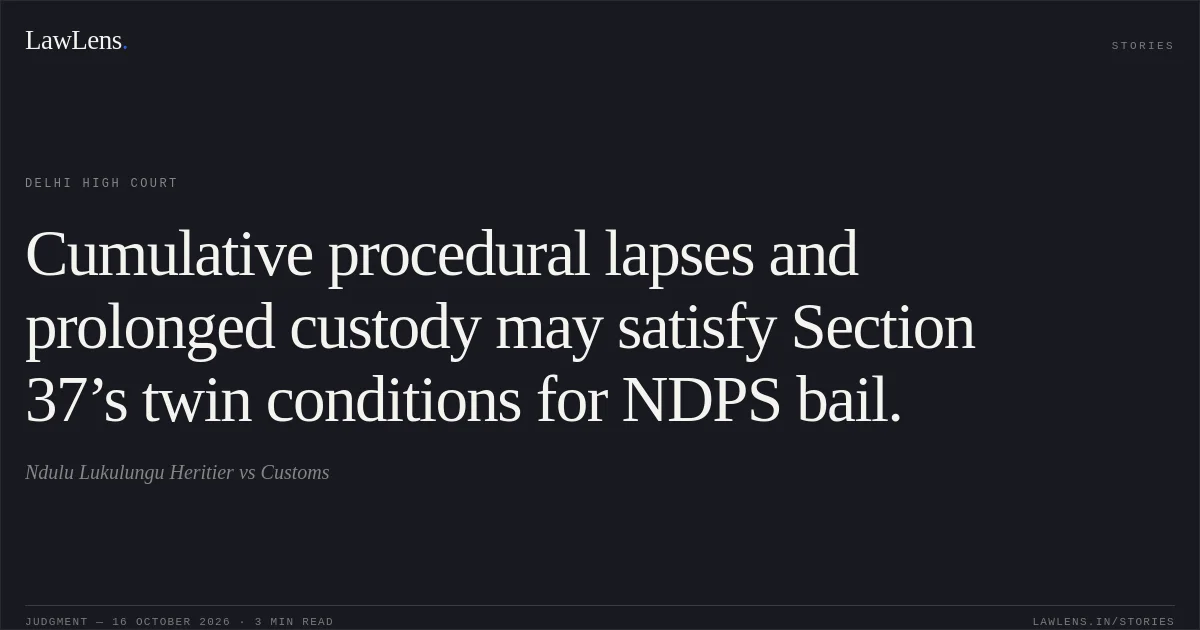
The petitioner, a national of the Democratic Republic of Congo, was intercepted at IGI Airport on 25 April 2022. He stated that he had ingested narcotic capsules and was taken to hospital, where 71 capsules were recovered in five separate lots between 25 April and 1 May 2022.
Source reference: pp. 2–6, paras. 5–6On 8 May 2022, the contents were field-tested positive for cocaine; the net weight was approximately 1,198 grams. The material was formally seized that day, and samples drawn before a Magistrate on 31 May 2022 later tested positive for cocaine.
Source reference: pp. 2–6, paras. 5–6Charges under Sections 21(c) and 23(c) of the NDPS Act were framed on 23 March 2023. At the time of the bail decision, the petitioner had been in custody for over four years and five months; 13 of 42 prosecution witnesses had been examined.
Source reference: pp. 2–6, paras. 5–6, 12Issues
Whether, on a prima facie assessment, the alleged procedural lapses in recovery, custody, seizure, and sampling provided reasonable grounds to believe that the petitioner was not guilty for purposes of Section 37 of the NDPS Act.
Source reference: pp. 10–12, 19–25, paras. 10–11, 24–30Whether the petitioner’s prolonged pre-trial detention and the projected duration of the trial, considered alongside Section 37, justified release on bail.
Source reference: pp. 12, 14–19, paras. 12, 16, 20–24Law Applied
Section 37(1)(b) of the NDPS Act imposes twin conditions for bail in offences involving commercial quantity: the court must find reasonable grounds to believe the accused is not guilty and that the accused is unlikely to commit an offence while on bail.
Source reference: pp. 6–7, para. 7Article 21 protects the right to a speedy trial, and statutory bail restrictions must be considered alongside—not in isolation from—that constitutional protection; Union of India v. K.A. Najeeb and Mohd. Muslim v. State (NCT of Delhi) were relied upon for the constitutional dimension and the prima facie nature of the bail assessment.
Source reference: pp. 15–16, para. 21State of Punjab v. Sukhwinder Singh emphasizes that prolonged incarceration does not, by itself, dispense with Section 37’s requirements.
Source reference: pp. 17–18, para. 21(d)Section 52A of the NDPS Act and paragraphs 2.1, 2.2, 2.4, 2.5, 2.9 and 3.3 of Standing Order No. 1/89 govern inventory, sampling, sealing and storage.
Source reference: pp. 8–9, 23–25, paras. 8, 27–29Under Bharat Aambale v. State of Chhattisgarh, such procedural deviations are assessed cumulatively and in light of their effect on the physical evidence; they are not automatically fatal, but may support an adverse inference where discrepancies arise.
Source reference: pp. 8–9, 23–25, paras. 8, 27–29Reasoning
The Court considered the petitioner’s substantial detention and the prospect of further delay, noting that 29 witnesses remained to be examined, but did not treat delay alone as sufficient to override Section 37.
Source reference: pp. 18–19, paras. 22–24On the statutory threshold, it identified that no classification, weighing, sampling or testing occurred when the capsules were recovered; the sealed containers and custody of the petitioner were transferred among Customs officers on 21 occasions; the formal seizure occurred later and before different witnesses; the contraband was deposited in the malkhana seven to thirteen days after recovery; and Magistrate-supervised sampling followed the formal seizure by over three weeks without explanation.
Source reference: pp. 19–22, para. 25Taken cumulatively, these matters raised a prima facie doubt about the chain of custody and did not establish substantial compliance.
Source reference: pp. 22–23, para. 26The Court left open for trial whether mixing the capsule contents was permissible, given paragraph 2.5 of the Standing Order and the apparent similarity of the capsules.
Source reference: pp. 22–23, para. 26It therefore found the Section 37 threshold met, while making clear that its assessment was provisional and would not determine the trial.
Source reference: pp. 24–25, paras. 29–30Holding
The Delhi High Court granted regular bail, finding that the cumulative procedural discrepancies supported the required prima facie satisfaction under Section 37 and that continued detention was unwarranted given the petitioner’s over four years and five months in custody and the likely length of the trial.
Release was subject to a personal bond of ₹1,00,000 with two sureties in the like amount and conditions including prior verification of the sureties and address, surrender of any passport, restrictions on travel, regular court attendance, and registration with the Foreigners Regional Registration Office.
Source reference: pp. 25–27, para. 32The Court clarified that its observations were only for the bail application and would not influence the trial.
Source reference: p. 28, para. 34Acts & Sections Cited
17 provisions across 5 statutes referred to in this judgment. Each provision opens on LawLens.
Bharatiya Nagarik Suraksha Sanhita, 20231
Narcotic Drugs and Psychotropic Substances Act, 1985
Customs Act,19622
Maharashtra Control of Organised Crime Act, 19991
Prevention of Money-Laundering Act, 20021
Original Court PDF
Ndulu Lukulungu HeritiervsCustoms
Click to open original judgment
Original judgment, available to read, download and summarize on LawLens.in